Why Is Dubrovnik Such a Rip-Off?
Dubrovnik has a reputation for high prices, but most of the rip-off complaints trace to four avoidable mistakes. Here is what actually costs too much, and what does not.
Why Is Dubrovnik Such a Rip-Off?
Dubrovnik earns its rip-off reputation from a small number of concentrated costs, not from everything being overpriced. The adult City Walls ticket is 40 euro in main season, a Lokrum visit is 30 euro, and the cable car round trip is 30 euro, so a couple can spend 200 euro on three sights before lunch. The fix is simple: those prices are fixed and published, the true rip-offs are the traps around them.
I have walked these streets with travellers since 2015, and the complaint I hear most is not that Dubrovnik is expensive. It is that Dubrovnik is expensive in a way that feels engineered. A coffee on the Stradun costs several times what the same coffee costs ten minutes away in Gruž. A restaurant menu without prices printed is a warning sign anywhere in the world, and Dubrovnik has a few of them. And the walls ticket, at 40 euro for an adult, is genuinely one of the most expensive single monument tickets in Europe.
But here is the part most first-time visitors miss. That 40 euro ticket is not just the walls. It is the walls plus Fort Lovrijenac, plus the Western Outer Wall, plus the Collection of Coins of the Republic of Ragusa, and Lovrijenac bought alone is 15 euro. The Things to Do in Dubrovnik site exists partly because of this exact confusion: people pay for things twice, buy the wrong ticket, or eat in the wrong place, and then blame the city.
The real economics are also worth knowing. Dubrovnik recorded about 4.2 million overnight stays in 2025, sharing first place among Croatian destinations with Rovinj, according to the Croatian Bureau of Statistics. A city of 41,562 residents at the 2021 census, per the City of Dubrovnik's own announcement, absorbing that volume means demand pushes prices up in a tiny walled core of 24.7 hectares. That is not an excuse for a 15 euro beer on the Stradun. It is an explanation of why the economics concentrate where they do.
So the honest answer to the question has three layers. First, the headline attractions are expensive but the price is fixed, published by the operators, and includes more than most people realise. Second, the genuine rip-offs are avoidable and concentrated: unpriced menus, immediate-adjacent-to-the-gate everything, and buying things in the wrong order. Third, the crowd experience, not the price, is what turns a costly day into a resentful one, and the crowd is predictable.
Here is the fixed-price picture for the big three, all read from the operators' own webshops:
| Sight | Adult price | What it actually includes |
|---|---|---|
| City Walls | 40 euro main season, 20 euro in December | Walls circuit, Fort Lovrijenac, Western Outer Wall (closed December to February), coin collection |
| Dubrovnik Pass, one day | 40 euro | Everything the walls ticket covers, plus ten more sights and a 24-hour bus ticket |
| Lokrum Island | 30 euro | Reserve entry and the return boat transfer, either way you travel |
| Cable car | 30 euro round trip, 17 euro one way | The ride only; food and drink on Srđ are separate |
Read that table again with the pass in mind. In main season, 1 March to 30 November, the one-day Dubrovnik Pass costs exactly the same 40 euro as the standalone walls ticket and adds ten more sights plus buses, as the official pass site lists in full. In December the walls ticket drops to 20 euro and no winter pass tier is on sale at all, so the "pass costs the same as the walls" line is a main-season comparison only. Anyone who buys the standalone walls ticket in main season without at least checking the pass has, in effect, donated ten museums to the city. That is the single most common self-inflicted rip-off in Dubrovnik.
If you want the walls explained rather than just walked, the guided options start lower than most people expect. The cheapest paid Old Town walk on this site's roster starts at $20 per person, and three walks are free or pay-what-you-want on GuruWalk. Here are the three products I would put in front of anyone weighing cost against coverage:
The combo walk deserves a word because it solves the exact problem this article is about. It is a single booking, about 3 hours 30 minutes, that covers the Old Town and then the walls with the same guide, rated 4.8 across 1,183 reviews and priced from $50.94 per person. Compare that to buying the admission-only ticket at from $36.37 and then walking the circuit with no context, and the value question answers itself for most people.
What Not to Do in Dubrovnik?
The four mistakes that create the rip-off reputation are eating on the Stradun without checking prices, buying the standalone walls ticket when the pass costs the same, arriving blind on a peak cruise day, and paying for water and sunscreen inside the walls. Every one of them is avoidable with ten minutes of planning. None of them requires spending more money, only spending it differently.
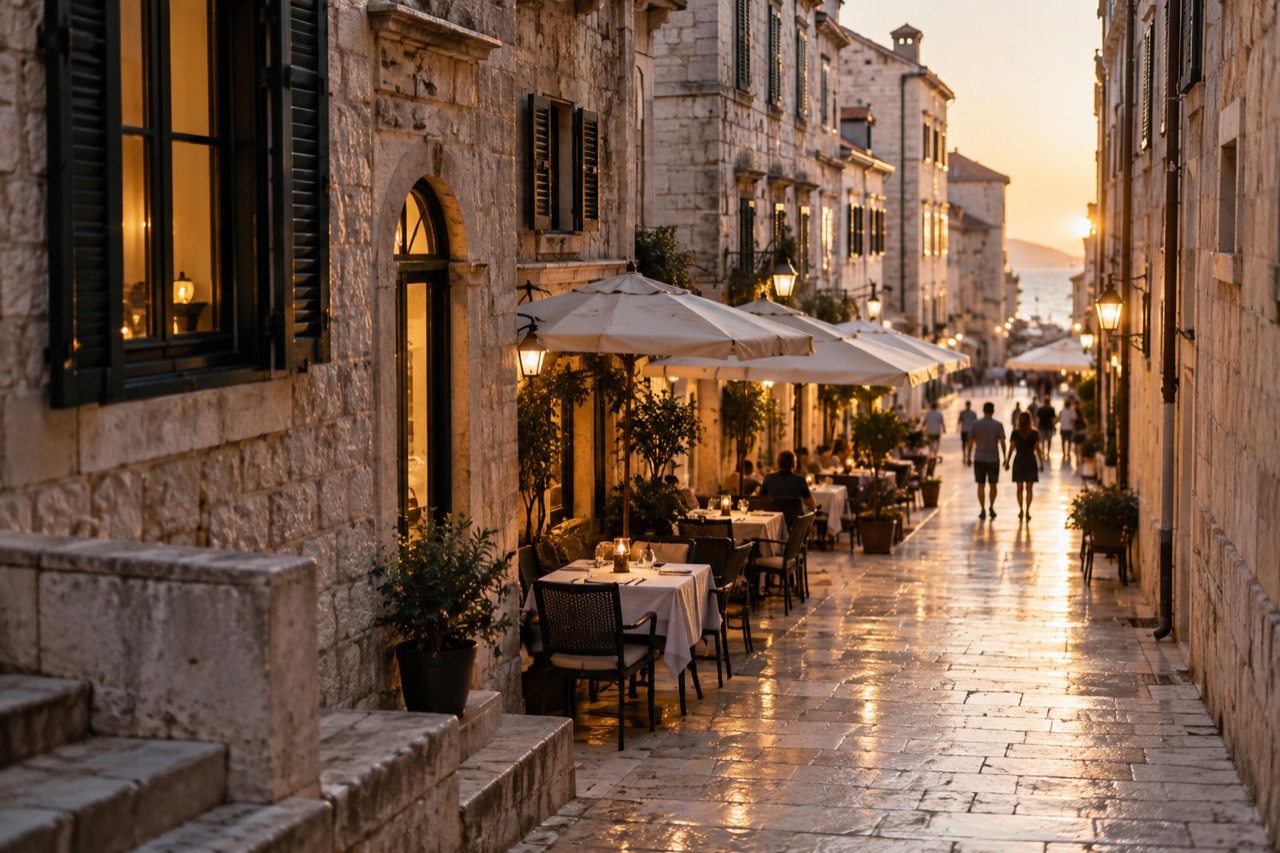
Start with the Stradun, the 298-metre main street whose final plan was fixed by the 1272 Statute. It is the most beautiful rented storefront in Croatia and the rent says so. A coffee there is a location fee, not a coffee price. Walk five minutes into side streets off it, or down to Gruž where the market is, and the same coffee costs a fraction. The pattern repeats for lunch, dinner and gelato: price falls steeply with every minute of walking away from the limestone shine. Our guide to budget Dubrovnik without missing anything maps this out street by street.
Second, never accept an unpriced menu. Croatia requires prices to be displayed, and any establishment that makes you ask is telling you what the answer will be. This is not a Dubrovnik-wide problem; it is a handful of places trading on footfall. Walk one street further and the menus are printed, in euro, with the cover charge, called the kuhinjska taksa, itemised.
Third, do not buy the walls ticket at the gate on a cruise peak without knowing what day it is. The Port Authority's own cruise destination page explains the system: passenger numbers are limited to 8,000 a day in most cases, out of 243 cruise days a year only 18 exceed that, and about forty call requests were refused in a single season. The counting system runs six counters at every Old Town entrance, updating a headcount every 15 minutes, against an official carrying capacity of 11,275 people. On a real September morning the curve read 5,419 people at 08:00, a 7,739 peak at 10:00, then 7,205 at 11:00. Walking the walls at 10:00 on such a day is queuing, not sightseeing.
Fourth, the small stuff. Water, sunscreen and hats inside the walls carry a captive-audience markup. A supermarket before you enter fixes that for the price of a five-minute detour.
Here is the trap table, what it costs and what the fix is:
| Trap | What it costs you | The fix |
|---|---|---|
| Coffee or lunch directly on the Stradun | Two to three times the side-street price | Walk five minutes off the main street, or eat in Gruž |
| Standalone walls ticket in main season | 40 euro with no museums, no bus | The one-day pass at the same 40 euro, main season only |
| Unpriced or verbal menus | Whatever the waiter decides | Leave; printed euro menus are one street away |
| Walls at 10:00 on a cruise peak | An hour of queueing in heat | Enter at 08:00 opening, or after 16:00 |
| Buying water and sunscreen inside the walls | Captive-audience markup | Supermarket before the gate |
None of this means Dubrovnik is cheap. It means the rip-off is optional. The city's fixed prices are high but honest, and the variable prices respond to exactly the behaviour you control.
For anyone who wants the structure of the city explained on day one, so the rest of the trip spends money in the right places, this is the booking I would point at first:
Is There a Hop-On Hop-Off Tour in Dubrovnik?
Yes, a hop-on hop-off yellow bus tour runs in Dubrovnik, from $35.46 per person for about 1 hour 30 minutes of circuit with an audio guide, rated 4.9 across 1,147 reviews. It is a genuine option for the panorama above the Old Town, but it is not a substitute for walking, because the walled core itself is pedestrian only.
The important structural fact: no vehicle of any kind enters the Old Town. The bus circuit covers the viewpoints and the modern districts, Lapad and the coastal road, which is exactly the part of Dubrovnik that walking tours cannot reach. So the honest framing is that the hop-on hop-off bus and a walking tour are complements, not competitors. If your question is whether the bus saves you money versus a guide, the answer is that it solves a different problem: it saves legs, and it gets you the coastal panorama without hiring anything.
The cheaper alternative in the same family is the convertible bus panorama tour at from $34.77, rated 4.6 across 796 reviews, which is a loop rather than hop-on hop-off. And if you would rather be driven through the Old Town's approaches in something smaller, the e-tuk-tuk panorama ride runs about 1 hour 45 minutes from $59.24 and is rated a perfect 5 across 1,799 reviews, the strongest rating in this whole category on the roster.
For the budget-conscious framing of this article, the real point is this: the free and nearly-free layer of Dubrovnik is bigger than people expect. The Stradun itself, the gates, the harbour, the views from the outer walls' free vantage points, all cost nothing. Three walks are free or pay-what-you-want on GuruWalk, including a 1 hour 45 minute Old City walk rated 4.87 across 2,242 reviews. Our free things to do in Dubrovnik guide covers the full no-cost layer, and the free walking tour guide explains how the pay-what-you-want model works honestly.
When to Avoid Dubrovnik?
Avoid Dubrovnik in the peak cruise windows, which are September and October, not July and August: 2025 cruise passengers peaked at 101,246 in September and 100,132 in October, above July's 96,072 and August's 87,385, per Port Authority data. Also avoid 10:00 to 14:00 inside the walls on any day, and the midday heat of July and August if you are walking the circuit.
That September and October outrank July and August for cruise passengers is the single most counter-intuitive fact on this site, and it inverts most of the advice you will read elsewhere. The conventional wisdom says come in shoulder season to dodge the crowds. For cruise traffic specifically, September is the busiest month of the year. The full-year 2025 total was 625,257 cruise passengers, up from 582,499 in 2024, and 461 cruise calls are scheduled for 2026.
One honesty note that matters: cruise passenger figures are ship capacity, not people who actually walk ashore. Write "up to X cruise passengers scheduled", never "X people will be in town". The counting system gives the real picture, and its 15-minute updates are what the city actually manages against, with the 11,275 carrying capacity as the ceiling.
For heat, the sea temperature series is the honest guide, and it is a long-run average, not a beach thermometer: the NOAA OISST 1991 to 2020 average for this coast is 25.8 degrees in August and 23.6 in September, with EMODnet corroborating within about a degree. Sheltered bays run warmer; the Croatian met service's Dubrovnik buoy read 27.0 to 27.4 degrees on one September day against that 23.6 monthly mean. What that means for rip-off avoidance: in July and August, midday is when you are most likely to overpay for shade, cold drinks and taxis because heat is doing the selling. Walk early, swim midday, sightsee late.
The value windows, then, are these: late October and November after the cruise peak falls off but before the December price drop, when the walls ticket falls to 20 euro; April to mid-June before the cruise season builds; and winter itself, if you accept shorter days and closed cable car, which shuts January to March. Our best time to visit Dubrovnik guide works through the whole calendar month by month.
| Window | Crowd level | Price level | Verdict |
|---|---|---|---|
| July and August | High, but below the cruise peak | Peak hotel rates, peak heat | Book everything early or skip |
| September and October | Highest cruise months of the year | High | Beautiful light, worst cruise crowding |
| April to mid-June | Moderate, building | Moderate | Best balance of the year |
| November | Low | Falling | Quiet, some closures |
| December | Low | Walls ticket 20 euro, no pass tier on sale | Cheapest sightseeing of the year |
Is Dubrovnik Good for Beaches?
Dubrovnik is good but not great for beaches, and it is not a beach-holiday town in the sandy-resort sense. The beaches are mostly stone, concrete and pebble: Banje is the famous one nearest the Old Town, Lapad Bay holds the family-friendly stretch, and Sveti Jakov has the best view. Swimming is excellent, with the sea averaging 24.9 degrees in July and 25.8 in August as a long-run figure.
If your mental image of a beach is sand, Dubrovnik will disappoint, and paying for a sunbed on a concrete platform can feel like the final rip-off of an expensive day. If your image is clear water over pale stone with a walled city behind it, it is close to perfect. The water clarity is real and consistent, and the swimming season runs long: the long-run averages are 22.5 degrees in June, 24.9 in July, 25.8 in August and 23.6 in September, so sea swimming is comfortable from June into October.
The cost trap here is the sunbed-and-umbrella bundle at the famous beaches, which is priced like a location fee because it is one. The fix is the same as everywhere else in this article: walk twenty minutes further. The less famous stretches, and there are several, cost a fraction or nothing. Our beaches guide ranks them all with the honest entry costs, and Copacabana beach and Sveti Jakov each have their own pages.
For combining swimming with sightseeing, the water-based tours are where Dubrovnik is genuinely good value rather than a rip-off. A guided kayak and snorkel tour runs from $35 per person, rated 4.9 across 3,619 reviews, and a two-hour kayak tour around Lokrum and Betina Cave is from $35.49, rated 4.9 across 1,518 reviews. Against 40 euro for ninety minutes of walking a wall, an afternoon on the water is arguably the better euro-per-hour spend in the city.
So is the whole city a rip-off? No, and the honest ledger looks like this. The fixed monument prices are high but include more than advertised, and the December walls price of 20 euro shows the operators do discount when demand falls. The food and drink layer is a two-tier market where ten minutes of walking halves the bill. The crowd experience is the one thing money cannot fix, but the calendar can. And the free layer, the streets, the viewpoints, the GuruWalk pay-what-you-want walks, is larger than the rip-off reputation suggests. Come informed and Dubrovnik is expensive the way Venice is expensive: a price you can plan around. Come blind and it is a rip-off you built yourself.
Before you lock anything in, these are the three bookings that solve the cost question in one pass:
Common Questions About Why Dubrovnik Is Such a Rip-Off
Why is Dubrovnik such a rip-off?
It mostly is not, in the sense of prices being hidden or dishonest. The fixed sight prices are high but published: 40 euro for the walls in main season, 30 euro for Lokrum, 30 euro for the cable car round trip. The rip-off feeling comes from tourist-trap food prices, buying the wrong ticket, and cruise-day crowding, all of which are avoidable.
What Not to Do in Dubrovnik?
Do not eat on the Stradun without checking prices, do not buy the standalone walls ticket in main season without comparing the 40 euro one-day pass, do not enter the walls at 10:00 on a cruise peak day, and do not buy water and sunscreen inside the gates.
Is There a Hop-On Hop-Off Tour in Dubrovnik?
Yes. A yellow hop-on hop-off bus with audio guide runs from $35.46 per person, rated 4.9 across 1,147 reviews. It covers the panorama and modern districts, because no vehicle can enter the pedestrian-only Old Town.
When to Avoid Dubrovnik?
Avoid September and October if you hate cruise crowds, since those were the two busiest cruise months of 2025 at 101,246 and 100,132 passengers, ahead of July and August. Also avoid 10:00 to 14:00 inside the walls on any busy day.
Is Dubrovnik Good for Beaches?
Good, not great. The beaches are mostly stone and pebble rather than sand, but the water is clear and warm, averaging 24.9 degrees in July and 25.8 in August as long-run figures. Banje, Lapad Bay and Sveti Jakov are the three to know.