Is Dubrovnik Walkable? What the Streets and Stairs Are Really Like
Dubrovnik is one of the most walkable cities on the Adriatic, and one of the least forgiving on the calves. Here is what the streets, stairs and distances actually feel like on foot.
Short answer
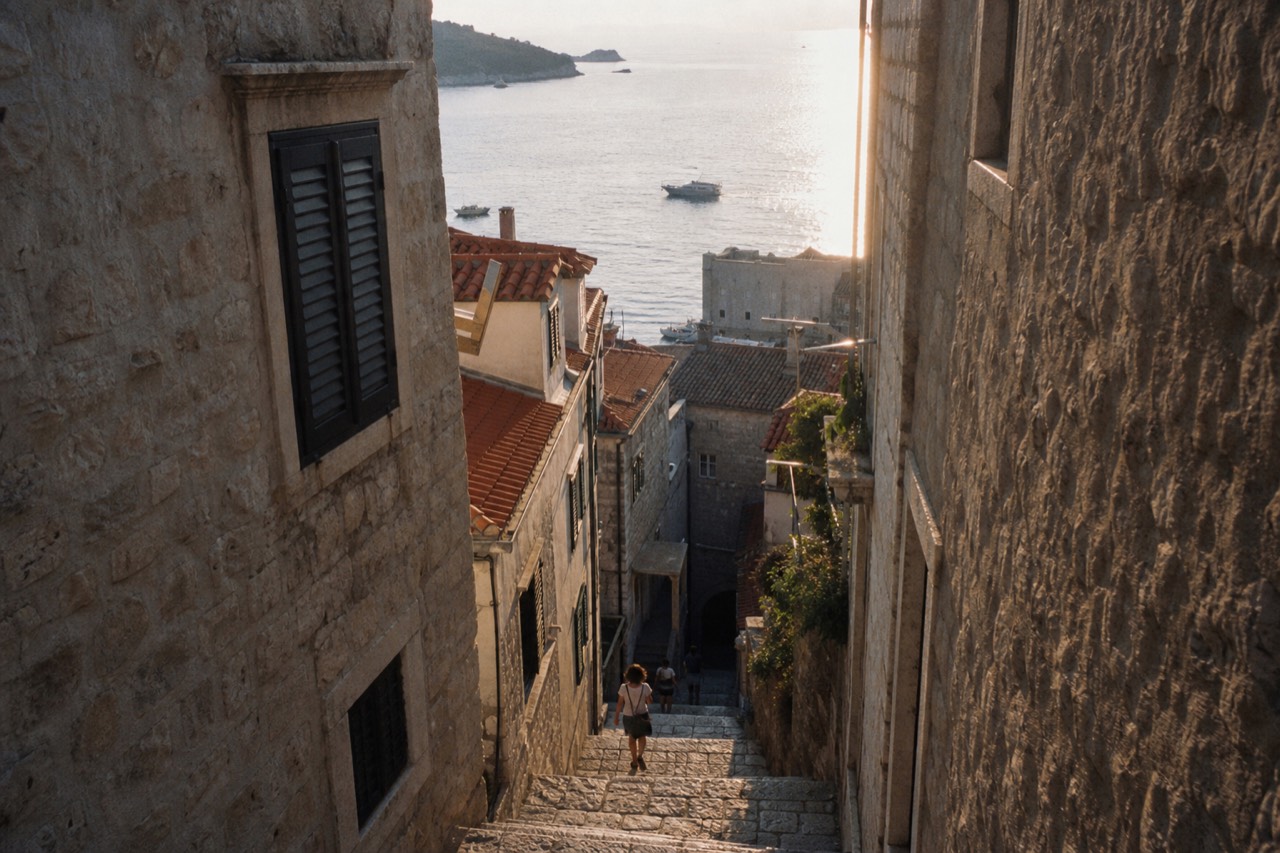
Yes, Dubrovnik is walkable, with a catch. The walled Old Town is fully pedestrianised, compact at 24.7 hectares, and every sight inside it is reachable on foot. The catch is terrain: polished stone, relentless stairs and hills. The cruise port sits about a 30 to 40 minute walk from Pile Gate, and Lapad and Ploče add real climbs.
Is Dubrovnik Walkable? What the Streets and Stairs Are Really Like
I have walked these streets with travellers since 2015, and the question I get asked most is not which sight to see first. It is whether the city can be done entirely on foot, and whether the shoes they packed will survive it. The short answer is yes, and yes, if you pack the right shoes. The longer answer is what this guide is for.
Dubrovnik splits into two very different walking experiences. Inside the walls, everything is pedestrian, close and flat along the main spine, with staircases shooting off it like ribs. Outside the walls, you are dealing with hills, coastal roads and a bus network that exists precisely because walking everywhere is not realistic. Understanding that split before you arrive changes the whole trip.

Is Dubrovnik a Walkable City?
Yes, Dubrovnik is a walkable city in the way few Mediterranean destinations are: its historic core is entirely car-free, UNESCO-listed, and small enough that the two farthest points inside the walls are a few minutes apart on foot. The catch is the surface and the gradient. Polished limestone, polished marble on the Stradun, and staircases everywhere mean walkability here is about footing and fitness, not distance.
Start with the numbers that matter. The walled Old Town covers 24.7 hectares, a space you can cross end to end without hurrying. The Stradun, the main street that runs its length, is 298 metres long, a fact the Dubrovnik Tourist Board records alongside the note that the 1272 Statute fixed the final plan of both the city and its main street. When your main street is under 300 metres, distances stop being the problem.
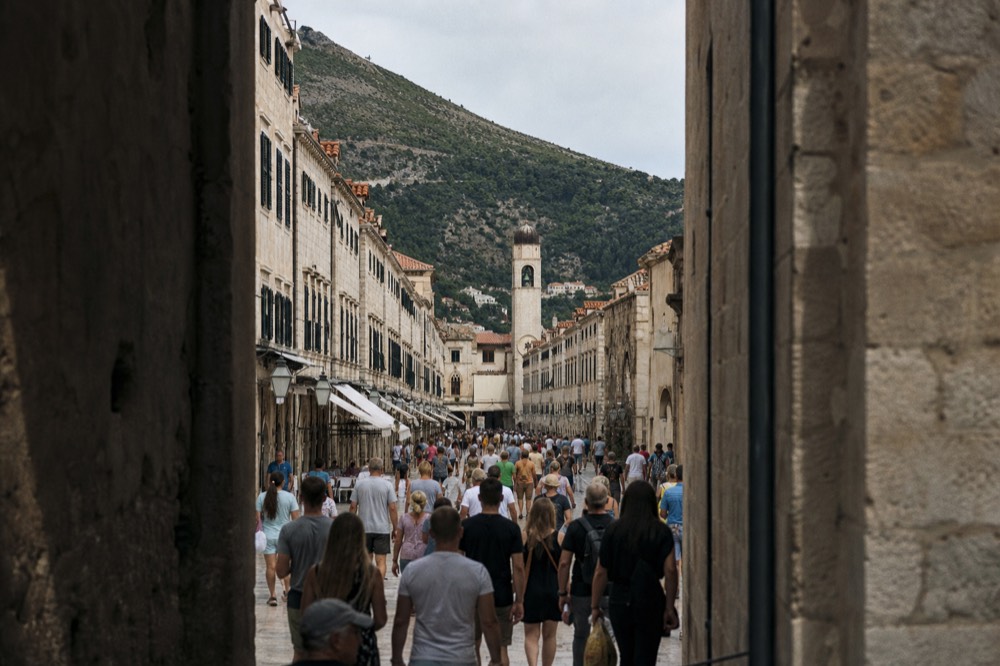
The problem is what your feet land on. The Stradun is polished marble, slick when wet. The side streets are either stepped lanes climbing the hillside or narrow alleys that funnel crowds at peak hours. And the city outside the walls is built on slopes: Ploče rises toward the cable car, Lapad sits behind a bay reached by a road that dips and climbs, and everything between is a hill with houses on it.
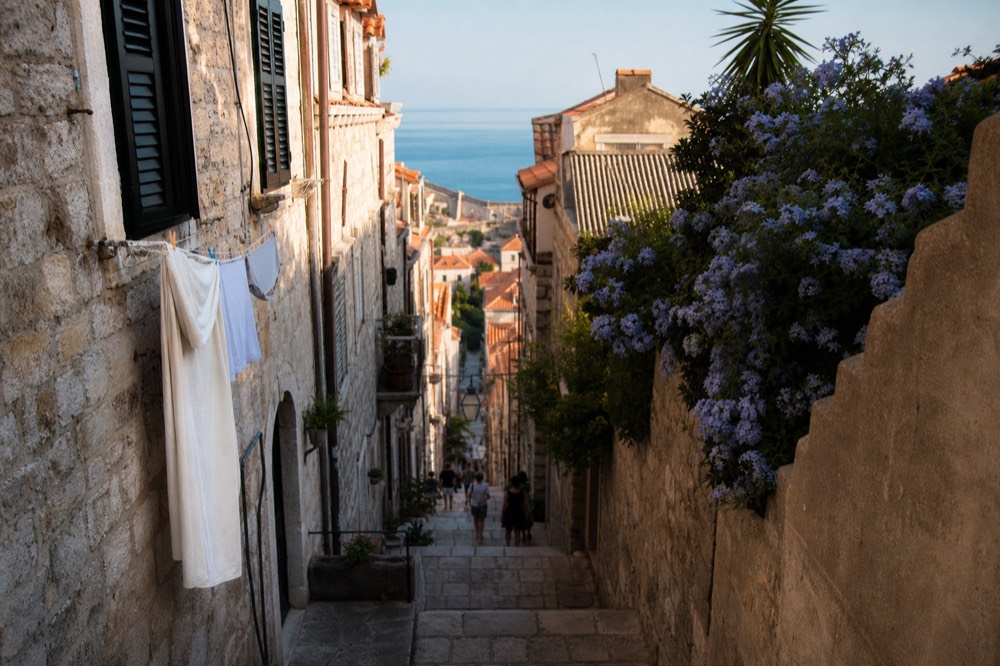
Here is the honest summary I give visitors:
| Area | Car-free? | Surface | Gradient | Walkable verdict |
|---|---|---|---|---|
| Old Town inside the walls | Yes, fully | Polished stone, marble, steps | Flat on the Stradun, stairs either side | Excellent, watch your footing |
| Pile and Buža approaches | Mostly | Stone and asphalt | Gentle near the gate | Easy |
| Ploče, east of the Old Town | No | Asphalt, stone steps | Steep climbs toward Srd | Demanding |
| Lapad bay and promenade | Partly, along the seafront | Paved promenade | Flat by the water, hills behind | Good with one hill |
| Gruž port and market | No | Asphalt | Mostly level | Good, but far from Old Town |
For context on scale, the city counted 41,562 inhabitants at the 2021 census, and the county around it 115,862. The historic core that everyone comes to walk is a small slice of that. If you base yourself in Lapad or Gruž, you will be riding buses into the Old Town, not walking, and that is a perfectly good plan.
The city walls themselves deserve a mention here because so many people conflate "walkable city" with "walking the walls." The circuit is 1,940 metres long, up to 25 metres high, and the operator's own site describes the full inventory: 16 towers, 3 fortresses, 6 bastions, 2 corner fortifications, 3 bulwarks, 3 moats, 2 flank fortresses, 1 breakwater and 2 drawbridges. It is a superb walk and a genuine workout, with long stair sections and almost no shade. More on planning it is in our guide to the city walls tickets and prices.
Is Dubrovnik Walkable From a Cruise Port?
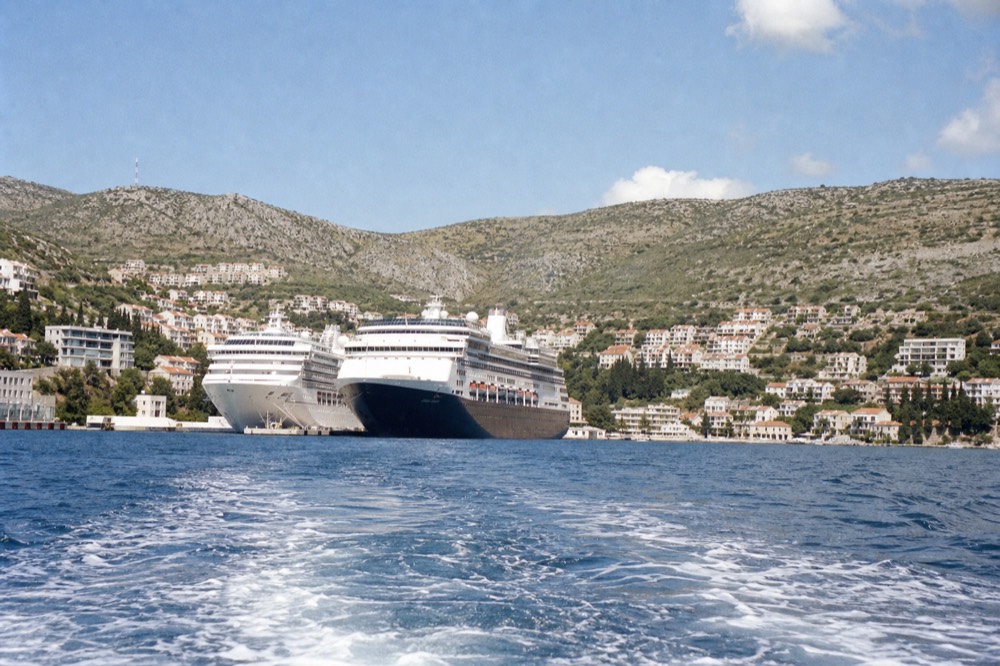
Yes, but it is a real walk, not a stroll. Cruise passengers dock either at Gruž, the main port, or tender ashore near the Old Town itself. From Gruž, reaching Pile Gate on foot takes most people around 30 to 40 minutes along a busy road, so many walkers take the bus one way and walk back. Tender passengers land practically inside the walking city and need no transport at all.
The two scenarios could not differ more. If your ship tenders, you step off a boat into the Old City Port and you are already in the pedestrian zone; the Stradun is minutes away. If your ship berths at Gruž, you are looking at a road walk with traffic, luggage-pace crowds in summer, and no shade in the middle of the day. The local buses run that corridor constantly and cost a fraction of a taxi.
Timing matters more than most cruise advice admits. The Port Authority's own statistics show 2025 cruise passengers peaked in September at 101,246 and October at 100,132, both above July's 96,072 and August's 87,385. Autumn, not high summer, is the busiest cruise season, and the walk from Gruž feels very different when three ships are in port. The full year 2025 brought 625,257 cruise passengers, up from 582,499 in 2024, and 461 calls are scheduled for 2026.
| Cruise month 2025 | Passengers | What it means for walkers |
|---|---|---|
| July | 96,072 | Heat plus crowds, walk early |
| August | 87,385 | Hottest month, sea breeze helps on the coast road |
| September | 101,246 | Busiest cruise month, busiest gates |
| October | 100,132 | Still at peak, cooler walking weather |
The Port Authority limits cruise passengers to 8,000 a day in most cases, out of 243 cruise days a year, with only 18 days exceeding that number and only 4 going slightly above 10,000, per its own cruise destination page. So the port itself is managed, and the walk from Gruž is rarely a crush. The crush is inside the walls, where a counting system with six counters at every Old Town entrance updates a headcount every 15 minutes against an official carrying capacity of 11,275 people.
For a full breakdown of both docking scenarios, with bus numbers and taxi costs, see our guide on getting from the cruise port to the Old Town. And if your day in port is short, the answer to "walk or ride" is usually ride out and walk in: take transport to Pile, spend your hours inside the pedestrian zone, and bus back.
If your legs are for the Old Town only, one option saves them on the roads in between:
The yellow hop-on hop-off bus covers the panorama route with an audio guide, from roughly $35.46 per person, rated 4.9 across 1,147 reviews. It is the sensible compromise for cruise days: you still walk every lane inside the walls, but you skip the Gruž road entirely.
How Walkable Is Dubrovnik Old Town?
Extremely walkable and completely car-free. The Old Town is 24.7 hectares of pedestrian streets where the Stradun's flat 298-metre spine connects everything, and stepped lanes climb off it to the walls and terraces. What limits walkers is not distance but stairs, polished stone and crowds: the side streets are staircases, and midday in season packs them solid.
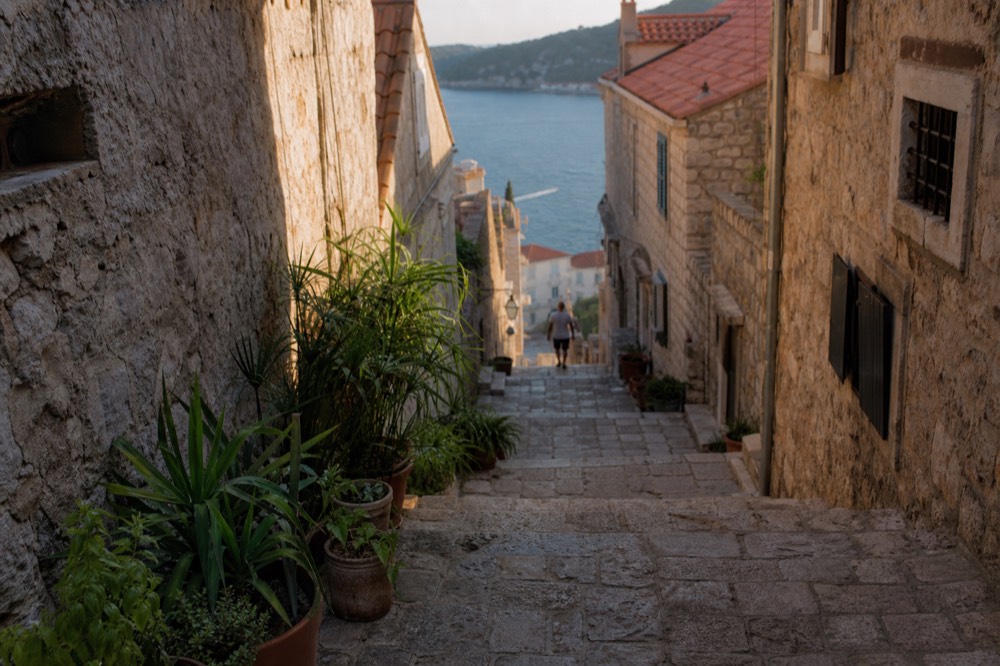
Inside Pile Gate the map stops mattering. You cannot get lost for long because the walls are always visible and the Stradun always leads back to the centre. The layout is a spine and ribs: the flat main street, with stepped lanes rising north and south toward the wall. If your hotel or restaurant sits on a "rib," you will climb stairs to reach it, sometimes a lot of them. That is the single most useful thing to know before booking accommodation inside the walls.
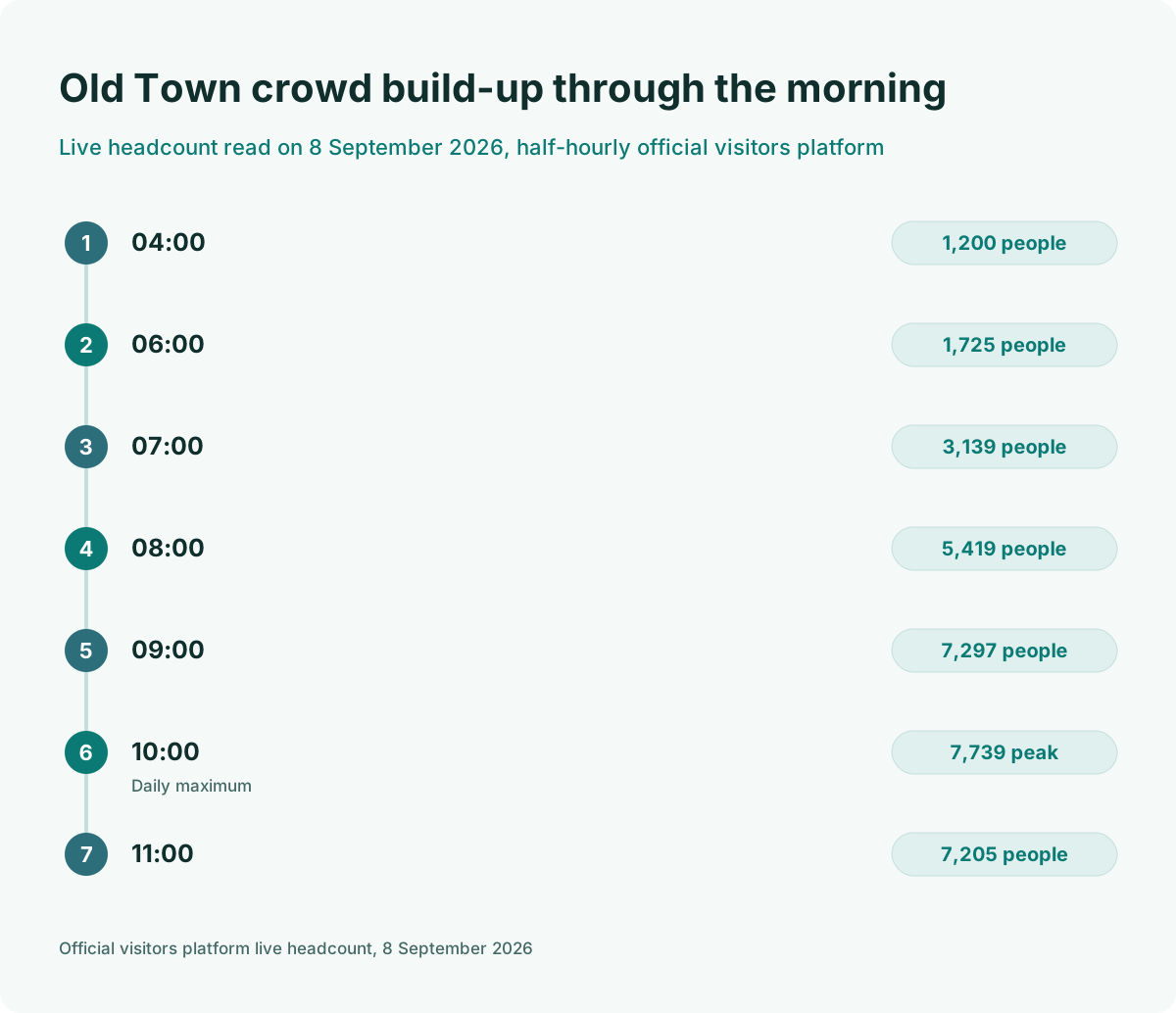
Crowd timing is the other half of the equation. The official visitors platform publishes a live headcount, and a real half-hourly curve read on 8 September 2026 shows how the day builds: 1,200 people at 04:00, 1,725 at 06:00, 3,139 at 07:00, 5,419 at 08:00, 7,297 at 09:00, a 7,739 peak at 10:00, then 7,205 at 11:00. By 10:00 the town is at its daily maximum. Walk before 09:00 and you share the lanes with locals and delivery carts; walk at 11:00 and you share them with everyone from three ships.
| Time | People in the Old Town | Walking experience |
|---|---|---|
| 06:00 | 1,725 | Empty lanes, photographers out |
| 08:00 | 5,419 | Busy but flowing |
| 10:00 | 7,739 | Daily peak, slowest walking |
| 11:00 | 7,205 | Still near peak |
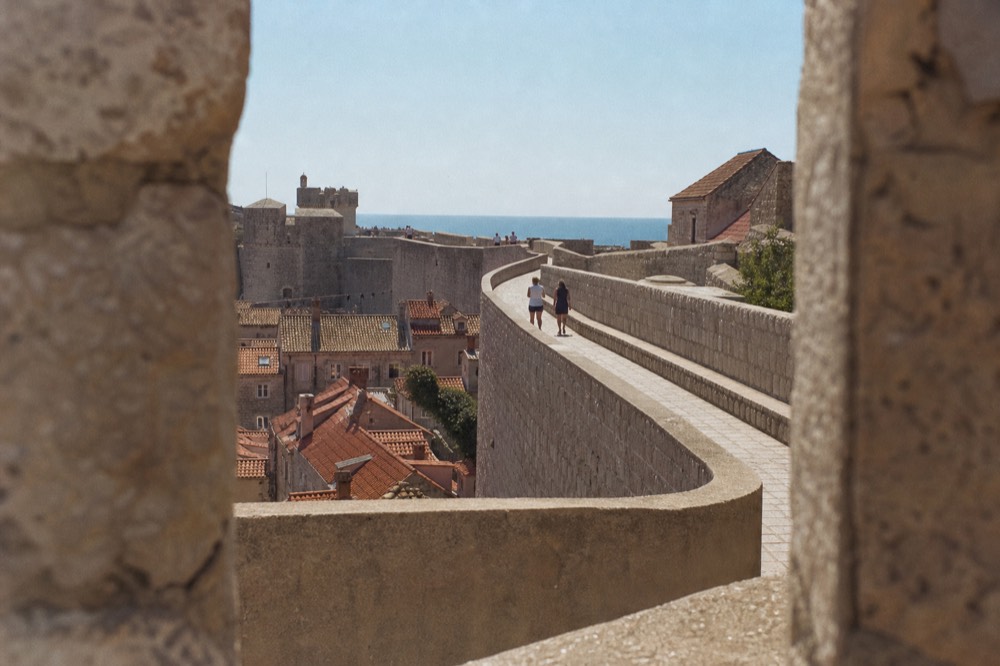
The walls walk itself is the Old Town's biggest physical demand. The operator's own site gives the circuit as 1,940 metres with the main wall 4 to 6 metres thick on the land side and 1.5 to 3 metres on the sea side. There are stairs at both ends, the climb to Minčeta at one end and the descent past the maritime museum at the other, and the operator's stated hours at time of check were 08:00 to 19:30. The adult ticket is 40 euro in main season, 1 March to 30 November, and 20 euro in December, and it is actually a combined ticket covering Fort Lovrijenac, the Western Outer Wall and the coin collection too.
A note on honesty that matters to walkers: the one-day Dubrovnik Pass costs the same 40 euro as the standalone walls ticket in main season and adds ten more sights plus a 24-hour bus ticket. That equivalence is a main-season fact only. In December the walls ticket drops to 20 euro and no pass tier is on sale at all, so the comparison flips entirely.
For walkers who want the walls explained rather than just walked, a guided option makes the stairs worthwhile. The Ancient City Walls & Wars walking tour runs about 2 hours from $29.58 per person, rated 4.8 across 1,387 reviews, and a guest review from linda_a captures the appeal:
When the stairs win, the convertible panorama bus is the recovery option: an open-top ride with audio guide from $34.77 per person, rated 4.6 across 796 reviews. It gives you the viewpoints above the town without a single step.
What Not to Do in Dubrovnik?
Do not walk the walls at midday in summer, do not wear smooth-soled shoes on polished stone, do not assume every "five minute" location is flat, and do not drive or expect taxis inside the walls, because no vehicles enter. Also do not skip the early morning: the counted crowd peaks at 10:00, so the worst mistake is sleeping through the only quiet hours the Old Town has.
Some mistakes here cost you comfort, others cost you the day. The most common one is footwear. The Stradun's marble and the lanes' worn limestone are treacherous when wet or in anything with a slick sole, and I have seen more twisted ankles on the Stradun than on any hiking trail in the county. Trainers or walking shoes with real grip, every day, no exceptions.
| Mistake | Why it fails | Do this instead |
|---|---|---|
| Walls at midday in July or August | No shade, 1,940 m of stone radiating heat | Start at 08:00 opening |
| Slick-soled shoes or flip-flops | Polished marble and limestone, slick when wet | Grippy trainers |
| Booking Old Town accommodation without checking stairs | Side streets are staircases, luggage drags | Ask the host how many steps from the Stradun |
| Walking from Gruž port at midday | Busy road, no shade, 30 to 40 minutes | Bus in, walk back along the coast |
| Assuming taxis reach your Old Town hotel | No vehicles inside the walls at all | Pack light, arrange luggage help in advance |
The second cluster of mistakes is about heat and timing. July and August walking needs to happen before 10:00 and after 18:00, with the middle of the day spent in the sea or in shade. The sea helps: the long-run September average for this coast is about 23.6 degrees, and August about 25.8, figures from a NOAA 1991 to 2020 open-water climatology, not a beach thermometer. Sheltered bays run warmer still. Swimming season and walking season overlap nicely, so plan the day as walk, swim, walk.
The third cluster is about expectations. People arrive having read that Dubrovnik is small and assume that means flat. It is small and stacked. The distance from the Stradun to a viewpoint restaurant can be 200 metres on the map and 150 steps in reality. Check elevation before you commit to a dinner reservation, and read our piece on what not to miss in Dubrovnik with the walking demands of each sight in mind.
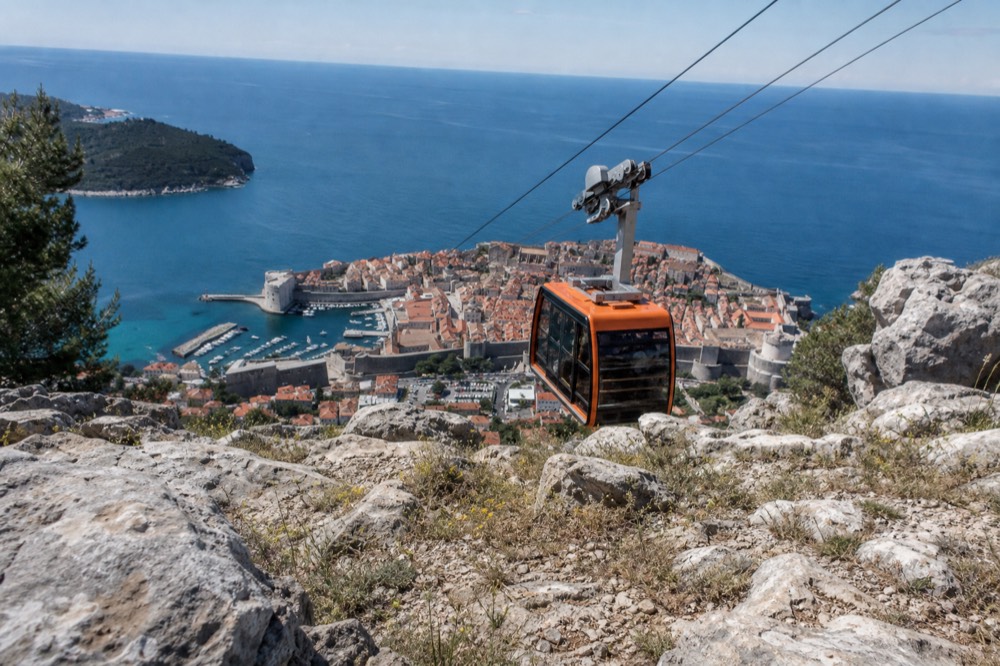
One more thing worth knowing: the cable car is not a year-round bail-out. It closes January to March, and in high summer it runs 09:00 to midnight, per the operator's own timetable. The round trip is 30 euro for an adult, the ride takes 3 minutes 30 seconds over a 778.2-metre track, and the upper terminal sits 405.0 metres above sea level. When it is open, riding up and walking down is a genuinely good compromise for strong knees.
When Your Legs Need a Break: Rides That Earn Their Keep
Dubrovnik rewards walkers but does not punish riders. The city bus network covers Gruž, Lapad and Pile cheaply, the cable car removes the biggest climb of all, and a handful of sightseeing vehicles, a hop-on hop-off bus, a convertible panorama bus, an e-tuk-tuk, cover the viewpoints while you rest. Using them is planning, not cheating.
I say this as someone who walks the Old Town for a living: the visitors who enjoy Dubrovnik most are the ones who walk hard in the morning and ride in the afternoon. The bus hub at Pile connects to everything outside the walls, and the Dubrovnik Pass tiers all include bus tickets, 24 hours on the one-day pass, 72 on the three-day, 168 on the seven-day, which quietly makes the pass a transport product as much as a museum product.
The e-tuk-tuk is the option people underestimate. It runs about 1 hour 45 minutes from $59.24 per person and is rated a perfect 5 across 1,799 reviews, which is about as strong a signal as review data ever gives.
The zipline is another legs-free way to see the town from above, rated 4.9 across 2,109 reviews from $64 per person. Between the cable car, the buses and the zipline, there is no reason to end the day exhausted unless you want to.
For families, the stakes are slightly different. Small children and Dubrovnik's stairs get along badly in the afternoon heat, and a stroller inside the walls is close to useless on the stepped lanes. Our guide to Dubrovnik with kids covers which routes actually work for short legs.
A Realistic Walking Day, Hour by Hour
A comfortable Dubrovnik walking day front-loads the miles: walls or Old Town lanes before 10:00 when the counted crowd peaks, a swim or long lunch through the middle, and viewpoints or a sunset cruise in the evening when the stone cools. Trying to walk steadily from 10:00 to 17:00 is the pattern that breaks people, and the crowd data explains exactly why.
Here is the shape I recommend, built around the headcount curve rather than against it. Be through Pile Gate by 08:00, when the counters read around 5,419 and the lanes still flow. Do the walls or your main walking sight first, while the stone is cool and the queue is short. By 11:00, when the count sits at 7,205, you should be at the beach, on a boat, or under a parasol with something cold.
| Time block | Old Town crowd | Best use of your legs |
|---|---|---|
| 07:00 to 10:00 | 3,139 rising to 7,739 | Walls, main lanes, photography |
| 10:00 to 13:00 | Peak, 7,205 at 11:00 | Beach, boat, museum, long lunch |
| 13:00 to 17:00 | Gradual easing | Shaded lanes, Lokrum, siesta |
| 17:00 to sunset | Thinning | Viewpoints, walls-adjacent terraces, sunset cruise |
The evening deserves its own mention because it is the city's best-kept walking secret. After the day-trippers leave, the Old Town drops back toward its morning numbers, the stone releases the day's heat, and the lanes you fought through at noon become a pleasure. The sunset cruise is the classic legs-off finale: the Karaka adults-only sail runs 1.5 hours from $59 per person, rated 4.8 across 833 reviews, and the shorter Cavtat option with drinks is from $23.66. Either way you end the day on the water instead of on a staircase.
And that is the honest answer to whether Dubrovnik is walkable. It is, superbly, for about six hours a day. The other hours belong to the sea, the buses and the cable car, and the travellers who use all three come home with photographs instead of blisters. For everything else the city offers beyond the walking core, start with Things to Do in Dubrovnik and plan from there.
Common Questions About Whether Dubrovnik Is Walkable
Is Dubrovnik a walkable city?
Yes. The walled Old Town is fully pedestrianised and compact at 24.7 hectares, with the 298-metre Stradun as a flat spine. The catch is terrain: polished stone underfoot and staircases on every side street, so walkability is about footing and fitness rather than distance.
Is Dubrovnik walkable from a cruise port?
Partly. Ships that tender put you right in the Old City Port, inside the walking zone. Ships berthed at Gruž face a 30 to 40 minute road walk to Pile Gate, so most walkers take the bus in and walk back along the coast.
How walkable is Dubrovnik Old Town?
Completely walkable and completely car-free. Every sight inside the walls is reachable on foot in minutes along the Stradun, with stepped lanes climbing to the walls and terraces. Crowds are the constraint: the counted population peaks at around 7,739 at 10:00 in September.
What not to do in Dubrovnik?
Do not walk the walls at midday in summer, do not wear smooth-soled shoes on the polished stone, do not book Old Town accommodation without asking how many stairs it sits on, and do not expect taxis inside the walls, because no vehicles enter at all.
is dubrovnik walkable
Yes, with a caveat. The Old Town is car-free, compact and flat along its main street, while the surrounding districts add hills and stairs. Most visitors walk everything inside the walls and use buses, the cable car or sightseeing vehicles for the rest.
Can you walk everywhere in Dubrovnik without a car?
Inside the Old Town, yes, and no car could help you there anyway. Beyond it, you can walk to Lapad or Ploče, but the distances and gradients make the city buses, all covered by the Dubrovnik Pass bus ticket, the sensible choice.