Do You Need to Book Restaurants in Dubrovnik?
Do you need to book restaurants in Dubrovnik? Short answer: in July, August and September, yes for dinner in the Old Town. Here is when to book, where to eat, and how many days you need.
Do You Need to Book Restaurants in Dubrovnik?
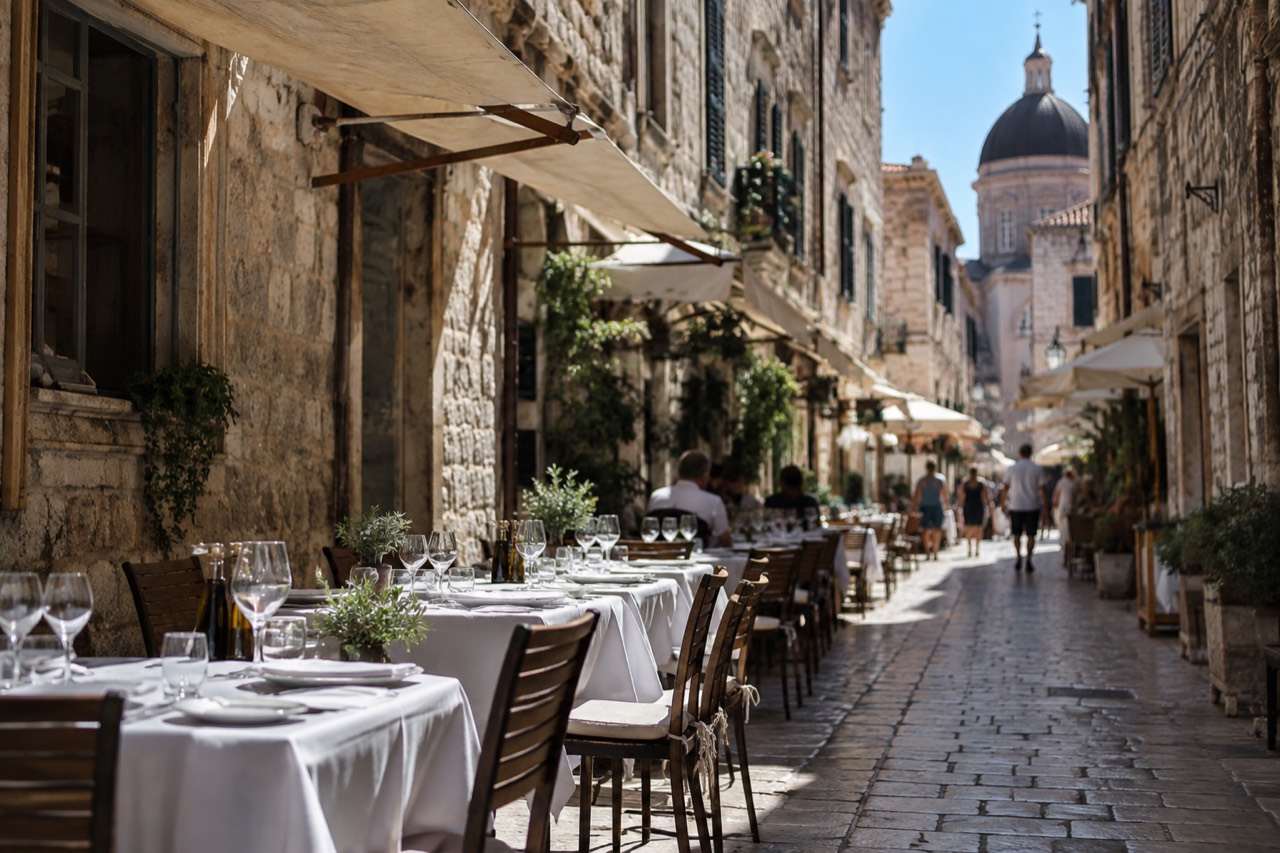
In July, August and September, yes, book dinner anywhere inside the walled Old Town. Dubrovnik recorded about 4.2 million overnight stays in 2025, sharing first place among Croatian destinations with Rovinj, and the walled core holds a finite number of tables behind a finite number of gates. Outside those three months a reservation is a courtesy rather than a necessity: walk-ins work most evenings from November through April, and lunch rarely needs booking at any time of year.
I have walked these streets at every hour of the day, and the pattern never changes. The Old Town empties in the late morning as excursion groups file back to their ships and buses, then refills from early evening as everyone who spent the afternoon at the beach or on a boat comes back hungry. Six counters at every Old Town entrance update a headcount every 15 minutes, and on a September day the count climbs from 5,419 people at 08:00 to a 7,739 peak at 10:00, then stays above 7,205 through late morning. Dinner demand follows the same curve, shifted five hours later.
The official carrying capacity for the historic core, from the UNESCO carrying-capacity assessment, is 11,275 people, and the counting system exists precisely because the city brushes against that ceiling. A restaurant seat is part of that capacity. When the town is full, the konobas on the Stradun and the side lanes off it are full too, and the parties without a booking are the ones eating at 21:30 or settling for the first table with a view of a scaffold.
One counter-intuitive point worth knowing before you plan anything: cruise passengers in Dubrovnik peaked in September 2025 at 101,246 and October at 100,132, both ABOVE July's 96,072 and August's 87,385, according to Port Authority data. The conventional wisdom that the crowds melt away the moment school starts is simply wrong here. September is the second-busiest dinner month of the year, and anyone telling you "September is quiet, you can just turn up" has not tried to seat a party of four at 20:00 near the Stradun.
There is a practical middle path that works in every season. Book one dinner per day in advance, the one you actually care about, and leave lunch and the second dinner open to whatever you find. Dubrovnik rewards walkers-in at lunch: the same kitchens that are slammed at night serve a calmer midday service, often at lower prices, and the sunlit tables on the squares are easier to get at 13:00 than at 20:00.
| Situation | Book ahead? | How far ahead |
|---|---|---|
| Dinner in the Old Town, July to September | Yes, always | 2 to 7 days; more for famous names |
| Dinner in the Old Town, May, June, October | Yes on weekends | 1 to 3 days |
| Dinner in the Old Town, November to April | Usually not needed | Same day is plenty |
| Lunch anywhere in the city | Rarely | Walk in, or book same morning |
| Large group, 6 or more, any month | Yes | As early as you can |
| Restaurants outside the walls, Lapad or Gruž | Peak season only | 1 to 2 days |
If you want to understand the food scene before you commit your evenings to it, a guided food walk is the most efficient first evening in the city. The Dubrovnik food and drink walking tour with a local guide runs about 3 hours, from $165.64 per person, and is rated 5 across 704 reviews. It doubles as reconnaissance: you eat at several stops, you learn which lanes hold the kitchens locals rate, and you leave knowing exactly where to book for the rest of your stay.
Where Are the Best Restaurants in Dubrovnik?
The best eating splits into three zones: the Old Town's konobas and fine-dining rooms inside the walls, the restaurant rows of Lapad Bay and the Gruž market quarter, and the cave-and-cliff spots on the water's edge. The Old Town has the atmosphere, Lapad and Gruž have the value and the locals, and the waterfront spots have the views that need booking earliest. Where you eat should decide whether you reserve.
Inside the walls, the geography is compact. The Stradun itself, 298 metres long per the Dubrovnik Tourist Board, is the main artery, and the best tables are rarely on it. They are one lane off, in the shadowed alleys where kitchens have room to work and the waiters are not dodging a rolling suitcase every ninety seconds. The whole UNESCO property is only 24.7 hectares, so nothing is more than a few minutes' walk from anything, which is exactly why the good rooms book out: the supply of tables is fixed by medieval street widths, and the demand is not.
Outside the walls, the picture changes. Lapad's café and restaurant strip around the bay serves a crowd that is mostly staying nearby, and Gruž, around the market and the port, is where the city of 41,562 residents actually eats. The number of overnight stays in 2025, about 4.2 million, means visitors outnumber locals at dinner by a wide margin for most of the year, but the imbalance is smallest in Gruž, and the prices follow.
The Croatian Bureau of Statistics, which publishes the destination rankings, records Dubrovnik and Rovinj sharing first place across all of Croatia for realised nights in 2025, and the full statistical release is worth a skim if you want to understand the scale. What it means for your dinner is simple: there is no month between May and October where the Old Town is quietly half-empty at 20:00.
A food-first way to see the city, if you would rather have the introductions made for you, is the three-hour food and drink walk mentioned above. One guest review captures what it does well:
Amazing food tour! Marija was a great guide, full of stories and facts that really brought Dubrovnik to life. The food was delicious, and generous. Wines at every stop. Would highly recommend this tour to anyone visiting Dubrovnik, especially to help get your bearings of the city and know where to go for dinner!
Bryan_M
That last sentence is the honest pitch for a food tour in a booking context: it is the fastest way to learn which restaurants deserve your reserved evenings. If you would rather cook than be guided, the Croatian traditional peka cooking lesson runs about 4 hours and teaches the Dalmatian slow-cooking method under a bell lid, a dish you will then recognise on every konoba menu in the city. For the broader lay of the land, our guide to Dubrovnik's restaurants breaks the scene down by neighbourhood and budget, and the where locals eat answer page covers the Gruž side specifically.
The food walk is also the one product on this page that solves the booking question directly rather than around the edges. A local guide who eats through the Old Town for a living knows which kitchens take same-day reservations, which ones hold tables for regulars, and which ones you should call a week out. Three hours and several tastings in, you have a shortlist that would otherwise take three evenings of trial and error to build, and on a short trip that time is worth more than the ticket.
Do You Need to Book the Cave Bar in Dubrovnik?
For the cliffside Buža bars, no, there is no booking system to use: you show up, you queue, and you take the next free spot on the rocks, which is why timing matters more than reservations. For the Cave Bar inside the converted cliffside space at the Hotel More, yes, book, because it is a single small venue with a fixed number of lounges and it sells out on summer evenings. Two "cave" experiences, two completely different answers.
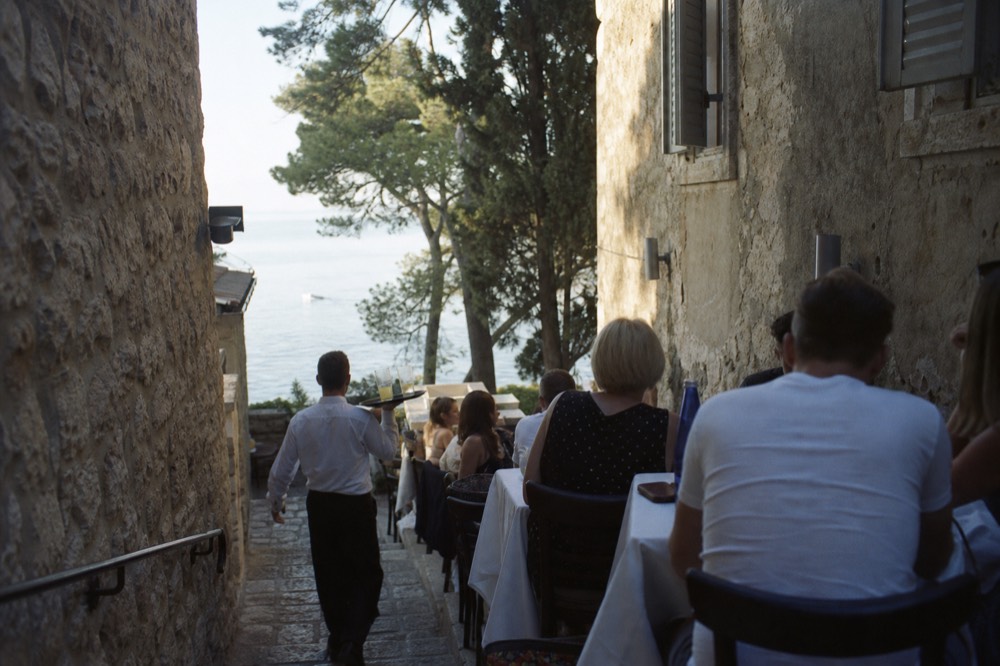
Start with the Buža bars, because they are what most people mean when they say "the hole in the wall bar." You find them by walking the southern wall and taking the unmarked doorway that opens straight onto the Adriatic, and there you drink at tables on bare rock above the sea. Nobody takes a reservation. The bars are small, the seats are informal, and the etiquette is that you order at the counter and settle wherever there is room. Arrive an hour or two before sunset in July or August and you may wait for a spot; arrive mid-afternoon and you will usually walk straight in. The sunset rush is the whole point, so if you want a sunset seat in peak season, treat arrival time as your reservation. The full index of guides sits on Things to Do in Dubrovnik.
The Cave Bar at Hotel More in Lapad is a different animal. It occupies a natural cave in the cliff below the hotel, part of the same complex that includes a cave-like swimming area, and it is a seated, serviced venue rather than a rock ledge. In summer the evening slots fill, and the hotel's own channels are the way to secure one. If a candlelit cave with the sea lapping below the terrace is on your list, that is the one to book rather than hope for.
A note on swimming, since the cave bar question usually comes from people planning a swim-and-drink afternoon. The September average sea temperature for this coast is about 23.6 degrees, from the NOAA long-run average for 1991 to 2020, and sheltered bays run warmer than that open-water figure: the Croatian met service's Dubrovnik buoy read 27.0 to 27.4 degrees on 8 September 2026 against that 23.6 mean. September swimming is excellent, in other words, but it brings the September crowds with it, and September is a peak cruise month, as covered above.
For the full picture on the cliff bars, including how to find the doorway, our Buža bar guide walks you through it, and the cave bar guide covers the Hotel More venue in detail. Neither experience is one you can reserve your way into or out of, so plan them by clock rather than by calendar.
How Many Days Do I Need to See Dubrovnik?
Three full days sees the city properly: day one for the Old Town and the city walls, day two for the cable car, Lokrum and a beach or kayak afternoon, day three for a boat trip to the Elaphiti islands. Two days covers the essentials if you move fast and skip the islands; one day, the classic cruise-ship constraint, is enough for the walls, the Stradun and one good dinner, and no more.
The walls alone justify a morning. The circuit is 1,940 metres long, up to 25 metres high, and the operator's stated hours at the time of check were 08:00 to 19:30, though only the price is firmly resolved, so check hours before you go. The adult ticket is 40 euro in main season, 1 March to 30 November, and that ticket is actually a combination covering the walls plus Fort Lovrijenac, the Western Outer Wall and the coin collection; in December the adult ticket drops to 20 euro. Walking the circuit with photo stops takes most people two unhurried hours, and it is the single best orientation exercise in the city: you see every rooftop, every gate and every swimming spot from above before you set foot in a single lane.
Day two is the height-and-water day. The cable car lifts you from a lower terminal at 38.0 metres to the Mount Srđ station at 405.0 metres, a 367.0-metre rise over a 778.2-metre track, in 3 minutes 30 seconds, and an adult round trip is 30 euro. Lokrum, the wooded island directly off the Old Town port, costs 30 euro per person for reserve entry plus the return boat, with departures at 09:00 and then every 15 minutes from 10:00 to 18:00. Doing both in one day is easy, and it leaves the late afternoon for Banje beach or a kayak.
Day three belongs to the sea. The Elaphiti islands cruise is the classic: the most-reviewed option runs about 8 hours with lunch included, from $59.16 per person, rated 4.9 across 10,312 reviews.
If your days are short, an Old Town walking tour compresses day one efficiently. The Dubrovnik Old Town walking tour with a local guide starts from $20 per person and is rated 4.8 across 5,826 reviews, and a couple of hours with a guide replaces an afternoon of self-guided map-reading.
How Many Days Do You Need for Dubrovnik?
For a relaxed trip rather than a checklist, four to five days: the three-day core above, plus one day trip beyond the city and one genuinely empty day for the beach, the cave bar and the restaurants you discovered on day one. Beyond five days you are not seeing more Dubrovnik, you are living in it, which is a fine thing to do but a different kind of trip.
The fourth day is where the region opens up. Mostar and the Kravica waterfalls sit across the border in Bosnia and Herzegovina, a day trip of roughly 11 hours from $53.19 per person on the small-group version, rated 4.8 across 1,254 reviews. Montenegro's bay is the other classic, from $58 per person, rated 4.4 across 5,611 reviews. Both involve border crossings, so pack your passport and expect queues in peak season. Closer to home, the Ston and Korčula trip with wine tasting runs about 11 hours from $81.69 per person, and pairs oysters and Pelješac wine with a walled town of its own.
The fifth day, the empty one, is the day this article is really about. It is the day you lunch at a konoba you found on Tuesday, swim in the afternoon, and hold a sunset table at a cliff bar or a cave lounge because you booked it three days earlier. Trips that sprint through Dubrovnik in 48 hours eat well but eat randomly; trips that stay longer get to choose.
Plan the dinner bookings around the port calendar when you can. The remaining 2026 schedule held 149 ship calls across 80 cruise days, and the busiest of those were 6 October with 2 ships and up to 5,798 passengers, 29 September with 2 and 5,675, 30 September with 3 and 5,536, and 15 September with 4 and 5,273. Those are ship-capacity figures, not people who actually walk ashore, but they tell you which evenings the Old Town will be at its fullest. The Port Authority's own statistics page publishes the underlying data if you want to check your dates.
For depth on any piece of this, the how many days in Dubrovnik guide works through the same question with full itineraries, and the one-day itinerary is the version for cruise passengers on the clock. Whatever length you choose, the booking rule stays constant: in this city, the table you reserve is the table you get, and the ones you do not reserve are whatever is left at 21:00.
Common Questions About Booking Restaurants in Dubrovnik
Do you need to book restaurants in Dubrovnik?
Yes for dinner in the Old Town between July and September, and on weekends in May, June and October. The city recorded about 4.2 million overnight stays in 2025 and cruise passengers peak in September and October, so the good rooms fill nightly. In winter, from November to April, walk-ins work most evenings, and lunch rarely needs a reservation at any time of year.
How Far Ahead Should You Book?
Two to seven days for a named Old Town restaurant in July, August or September, one to three days in the shoulder months, and same-day for winter. Groups of six or more should book as early as possible everywhere, since many konobas have limited large-table capacity in medieval-sized rooms.
Can You Get a Table on the Stradun Without a Booking?
Often at lunch, rarely at dinner in peak season. The Stradun is 298 metres long and its tables turn over fast, but the evening demand from a town whose counters read 7,297 by 09:00 on a September morning means walk-ins at 20:00 are usually offered the second seating or the bar.
Do You Need to Book the Cave Bar in Dubrovnik?
It depends which one. The cliffside Buža bars take no bookings at all: you arrive, queue and take the next free rock-side spot, so treat your arrival time as the reservation and come early for sunset. The Cave Bar at Hotel More is a seated venue in a natural cave and does sell out on summer evenings, so book that one.
How Many Days Do I Need to See Dubrovnik?
Three full days sees the city properly: the walls and Old Town on day one, the cable car and Lokrum on day two, and an Elaphiti islands boat trip on day three. Two days covers the essentials, and one day, the cruise-ship case, is enough for the walls, the Stradun and one good dinner.
Where Are the Best Restaurants in Dubrovnik?
In three zones: the konobas and fine-dining rooms inside the walls for atmosphere, the Lapad bay strip and the Gruž market quarter for value and local life, and the cliff and cave venues on the water for views. The Old Town needs bookings earliest; Gruž is the most forgiving for walk-ins.