Is Dubrovnik a Tourist Trap?
An honest answer to whether Dubrovnik is a tourist trap, what to skip, when the crowds peak and which parts of the city are genuinely worth your money.
Is Dubrovnik a Tourist Trap?
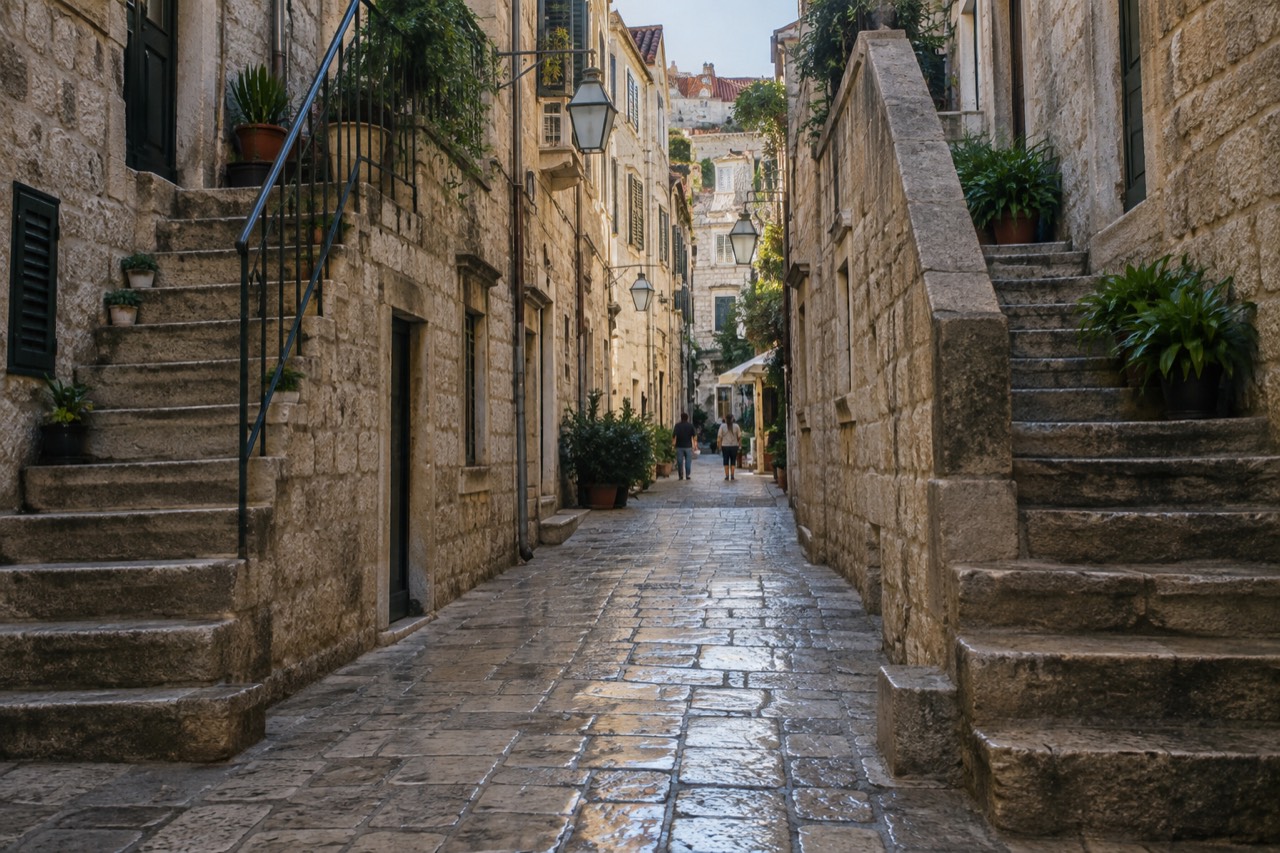
No, Dubrovnik is not a tourist trap, but it behaves like one on roughly twenty days a year when cruise traffic and summer heat stack on top of each other. The city walls, the Old Town streets and the sea around them are genuine, protected heritage, not a theme park, and the prices, while high, buy real things. The trap feeling comes from timing, not from the place itself.
I have walked these streets with travellers since 2015, and the question comes up every season, usually from someone standing on the Stradun at 11:00 in July wondering where Croatia went. It is a fair reaction. The main street, all 298 metres of it, can feel like an airport corridor in high summer, and a coffee near the fountain can cost what a full lunch costs in Mostar. But a tourist trap is a place that exists only to extract money, where the attraction is fake and the price is a bait. Dubrovnik fails that test on every count.
The Old City is a UNESCO World Heritage Site, inscribed in 1979 under criteria (i), (iii) and (iv), covering 24.7 hectares inside the walls with a buffer zone of 1,188.6 hectares around it. It spent 1991 to 1998 on the List of World Heritage in Danger after the siege, and the rooftops you see today are largely the terracotta of reconstruction. This is a lived-in city of 41,562 people at the 2021 census, with a working port, schools and a fishing economy, not a stage set. The Things to Do in Dubrovnik that draw the crowds are the same things that drew the Republic of Ragusa's rivals: the walls, the harbour, the islands.
What gives the city its trap-like reputation is concentration. Roughly 4.2 million overnight stays were recorded in the Dubrovnik destination in 2025, sharing first place in Croatia with Rovinj, and almost every one of those visitors wants the same two square kilometres at the same hours of the day. Six electronic counters at the Old Town entrances track the headcount every 15 minutes, and on a busy September day the curve reads 5,419 people at 08:00, a 7,739 peak at 10:00, then 7,205 by 11:00. The official carrying capacity for the historic core, from the UNESCO carrying-capacity assessment, is 11,275 people. On most days the city stays under it. On a handful it does not.
There is a useful comparison to make with the places everyone agrees are traps. A trap has nothing behind the facade: the medieval square is fibreglass, the castle is a gift shop with turrets, the local dish was invented for visitors last decade. Dubrovnik's facade is the real thing, and the deeper you push into it, the better it gets rather than the worse. The lanes off the Stradun hold convents, a synagogue, working konobas and staircases that climb past residents' front doors to the walls. The money question is real, and I will not pretend a family of four finds this city cheap. But expensive and trap are different accusations, and only one of them sticks.
The honest framing is this: Dubrovnik is a real destination that gets trap-like for a few hours a day in peak season, and the difference between a magical visit and a miserable one is almost entirely about when you walk and what you pay for. The rest of this article is the practical version of that answer, starting with the things that genuinely are not worth your money.
What Not to Do in Dubrovnik?
Skip four things: eating lunch on the Stradun itself, buying attraction tickets from street resellers, attempting the walls circuit at midday in July and August, and treating the Old Town as the whole city. Each of these is where the money goes out fastest and the experience comes back thinnest, and each has a better alternative within a ten minute walk.
The Stradun restaurants are the classic. You are paying for the address, and the address is a corridor with constant foot traffic, not a view. Walk two streets north or south, into Prijeko or the lanes below the cathedral, and the same kitchen standards cost meaningfully less with far less noise. The same logic applies to drinks: a table with a direct view of the Bell Tower prices the view into the bill.
Midday on the walls is the second mistake, and it is a safety issue as much as a comfort one. The circuit is 1,940 metres with almost no shade, the wall is 4 to 6 metres thick on the land side and holds the heat, and the operator's stated hours run 08:00 to 19:30 for a reason. Walk at 08:00 sharp or after 17:00 and you get the light photographers want anyway. The adult ticket is 40 euro in main season, 1 March to 30 November, and 20 euro in December, and there is no family ticket, only adult and child 7 to 18 at 15 euro, with under 6 free. That 40 euro covers the walls plus Fort Lovrijenac, the Western Outer Wall and the coin collection, per the walls operator's own site, so treat it as a bundle rather than a single sight.
The third mistake is letting the Old Town be the whole trip. Lapad has its own beaches and promenade, Gruž has the market where the city actually shops, and the Elaphiti islands sit a boat ride away. A visitor who never leaves the walled core gets the most expensive, most crowded slice of Dubrovnik and misses the parts locals defend. Gruž in particular surprises people: the market stalls, the bakeries serving the neighbourhood rather than the port, and the ferry terminal that puts Mljet and the islands within a morning's reach. If your only image of the city is the Stradun at noon, you have seen its worst hour and none of its best ones.
The fourth is paying for things that are free. The walk to Sveti Jakov beach, the viewpoints above Ploče, the harbour at dusk, wandering the lanes at 07:00: none of it costs anything. There are also genuinely free walks, including a 1 hour 45 minute Old City walk and a Game of Thrones and history walk on GuruWalk, pay-what-you-want, if you want a guide without a fixed fee. A paid guide is worth the money when the subject is dense, and Dubrovnik's history is dense, but the free tier exists and it is honest about what it is.
If you do want the walls explained rather than just walked, the guided option is the one I would point people to. The Ancient City Walls and Wars walking tour runs about 2 hours, from $29.58 per person, rated 4.8 across 1,387 reviews, and a guide who knows the siege history turns a hot staircase into a story. For visitors who want the full picture in one morning, the combo version adds the Old Town to the walls circuit over about 3 hours 30 minutes, from $50.94 per person, rated 4.8 across 1,183 reviews.
This well organized tour helped put Dubrovnik's past (and present) into perspective. It's incredible that the city walls have withstood the test of time. Antun was a wonderful guide.
linda_a
Is Dubrovnik Worth Visiting?
Yes, for the walls, the sea and the day trips, and emphatically so if you can travel in the shoulder months. The walled city is one of the best preserved medieval urban cores in the Mediterranean, the water around it is swimmable for half the year, and the islands, vineyards and border towns within reach are the equal of anything on the Croatian coast. The question is not whether but when.
Start with what is unarguable. The wall circuit, 1,940 metres long and up to 25 metres high in places, with 16 towers, 3 fortresses and 6 bastions, is a walk with no real equivalent between Venice and Istanbul. Fort Lovrijenac stands on its own 37-metre sea rock across the water. The Stradun's final plan was fixed by the city Statute of 1272, which is why the street feels so deliberate. None of this is manufactured charm; it is why UNESCO inscribed the place in the first place, a record you can read on the World Heritage Centre's listing page.
Then the sea. The long-run September average for this coast is about 23.6 degrees, and August about 25.8, from the NOAA OISST 1991 to 2020 climatology, with EMODnet corroborating within about a degree. Sheltered bays run warmer still: the Croatian met service's Dubrovnik buoy read 27.0 to 27.4 degrees on 8 September 2026 against that 23.6 September mean. What that means practically is a swimming season that runs comfortably from June into October, which most visitors do not expect from a city this far north.
The value question is where it gets interesting. The one-day Dubrovnik Pass costs 40 euro, exactly the same as the standalone walls ticket in main season, 1 March to 30 November, and adds ten more sights plus a 24-hour bus ticket. In December the walls ticket drops to 20 euro and no pass tier is on sale at all, so the comparison only works in season. If you are visiting three or more of the included museums, the pass is arithmetic, not marketing.
| Experience | Real cost | Verdict |
|---|---|---|
| City walls circuit (adult, main season) | 40 euro, includes Lovrijenac | Worth it, walk early or late |
| One-day Dubrovnik Pass | 40 euro, ten sights plus bus | Worth it if visiting museums |
| Cable car round trip (adult) | 30 euro | Worth it at sunset, skip midday |
| Lokrum island ticket | 30 euro, includes return boat | Worth it, go on a morning boat |
| Stradun terrace lunch for two | Varies, priced for the address | Skip, walk two streets over |
Beyond the city, the day trips are a large part of the worth-it case: the Elaphiti islands by boat, the oysters and walls of Ston, Mostar across the border, Montenegro's bay of Kotor. A city that can fill four days without repeating itself is not a trap, it is a hub. The most reviewed boat trip in the roster, a full-day Elaphiti cruise with lunch, runs from $59.16 per person and carries 10,312 reviews at 4.9, which tells you the islands are not a consolation prize but half the reason to come. For a fuller rundown, see our guide to the best things to do in Dubrovnik.
When to Avoid Dubrovnik?
Avoid late July and August if you can, and be equally careful about the last week of September, because cruise passengers peaked in September and October 2025, not in summer. The busiest single windows in the remaining 2026 season are 6 October, 29 September, 30 September and 15 September, each with two to four ships and up to 5,798 passengers scheduled.
The counter-intuitive fact first, because almost every guidebook gets it backwards. Port Authority data shows 2025 cruise passengers at 101,246 in September and 100,132 in October, above July's 96,072 and August's 87,385. The full year came to 625,257 passengers against 582,499 in 2024. So the "avoid summer, come in autumn" advice, which is right for heat, is only half right for crowds. September brings the best sea temperatures of the shoulder season and the heaviest cruise schedule of the year at the same time.
Heat is the other axis. July and August air temperatures push the midday walls circuit from strenuous into unpleasant, and the sea, while at its warmest, does little for you on a stone staircase with no shade. June is the sweet spot many locals name: the sea is already at a 22.5-degree long-run average, the cruise count is lower than July's, and the lavender and light are at their best.
| Period | Crowds | Heat | Best for |
|---|---|---|---|
| July to mid August | High | Extreme | Swimmers who walk at dawn |
| Mid August to June shoulder | Moderate | Mild | First-time visitors |
| Mid September to early October | Highest cruise traffic | Warm | Boat trips, museum days |
| November to February | Low | Cool | Quiet, low prices, short days |
Within any day, the pattern the counters publish is your friend. The headcount builds steeply between 07:00 and 10:00, from 3,139 to 7,739 on the September day I quoted, then eases through lunch. If you are inside the walls by 08:00 and out of the core by 11:00, you will see a different city from the person who arrives off a morning excursion at 10:30. The Port Authority's own cruise destination page publishes the daily limits and the berthing arrangement if you want to plan against the schedule.
One more scheduling note worth knowing: cruise passenger figures are ship capacity, not a headcount of people who actually walk ashore. On a day with 5,798 passengers scheduled, a share of them never leaves the ship, and the ones who do come ashore spread across excursions, the walls and the Stradun over several hours. The numbers are a ceiling, not a forecast, but the ceiling is high enough in late September that it shapes your day regardless.
For timing strategy in more depth, our piece on the best time to visit Dubrovnik breaks the year down month by month, and the overtourism explainer covers what the city is doing about the peaks.
Is Dubrovnik Good for Beaches?
Yes, though not in the wide-resort sense: Dubrovnik's beaches are small, mostly stone or pebble, and dramatic rather than sandy, with the swimming season running from roughly June into October. The best of them, Sveti Jakov, is a fifteen minute walk from the Old Town with a view of the walls and the old harbour, and the sea around the city is clean, clear and warm well past summer.
Manage expectations first. This is a rocky coastline, and the classic Dubrovnik beach is a smooth slab of limestone or a pebble cove with clear water, not golden sand. If sand is the requirement, the nearest genuinely sandy stretches are on the islands, Šunj on Lopud being the famous one, reachable on a full-day Elaphiti boat trip. Within the city, Banje sits closest to the Old Town with the walls behind you as you swim, while the Lapad bay beaches, including Copacabana, have the facilities and shallow water families want.
The water itself is the argument for swimming here. The long-run averages from the NOAA OISST 1991 to 2020 climatology put June at 22.5 degrees, July at 24.9, August at 25.8, September at 23.6 and October at 21.0, and these are open-water grid-cell figures, not beach thermometer readings, so sheltered bays often run warmer. Locals swim into October without a wetsuit. What those numbers also mean is that May, at an 18.6-degree average, is bracing, and anything before May is for the determined.
The trap-avoidance angle on beaches is simple: the beach clubs nearest the Ploče gates price for the view and the sunbed rows. Walk twenty minutes further, to Sveti Jakov or the coves below the road to Cavtat direction, and the same sea costs nothing. On Sveti Jakov you swim with the whole Old City skyline across the bay, which is as close to a free spectacle as this coast offers. Bring water shoes for the pebble entry and go early, because the descent and the climb back up are part of the price you pay in effort instead of euro.
If your trip is beach-first, base yourself in Lapad rather than the Old Town. You trade the walls-at-dawn convenience for walking access to the bay beaches, and the bus connection into the core is quick. Our guide to Dubrovnik's beaches covers each one in detail, and the swimming season guide gives the month-by-month water picture.
One more honest note on the water: clarity varies with weather and boat traffic like anywhere on the Adriatic, and after a storm the coves can carry debris for a day. The baseline, though, is genuinely exceptional, which is why the kayaking and snorkelling trips around Lokrum and Betina Cave are among the best reviewed activities in the city. A two-hour kayak tour of Lokrum and Betina Cave runs from $35.49 per person, rated 4.9 across 1,518 reviews, and it is the activity I would put in front of any swimmer who has already done the walls.
Common Questions About Whether Dubrovnik Is a Tourist Trap
Is Dubrovnik a tourist trap?
No. The Old Town is a UNESCO World Heritage Site and a living city, not a manufactured attraction. It gets trap-like crowds and trap-like prices in peak windows, mainly around 10:00 to 14:00 on heavy cruise days, but the underlying sights, the walls, the sea and the islands, are genuine and worth the money if you time them.
Why Does Dubrovnik Feel So Expensive?
Concentration. Roughly 4.2 million overnight stays landed on the Dubrovnik destination in 2025, and most visitors want the same small walled core. Rent, and therefore menu prices, reflect that. The 40-euro walls ticket is the headline cost, but it bundles Fort Lovrijenac and two more sites, and the one-day Dubrovnik Pass at the same 40 euro adds ten sights plus buses in main season.
Can You Avoid the Crowds Without Skipping Dubrovnik?
Yes. Be inside the walls by 08:00, be out of the core or on a boat by 11:00, and return after 17:00 when the day-trippers leave. The counters' own curve shows the peak at 10:00 and a fall through the afternoon. September and October carry the heaviest cruise schedules, so check the port calendar before booking autumn dates.
Is One Day in Dubrovnik Enough?
One day covers the walls circuit, a swim and an evening on the Stradun, which is a full and worthwhile day. Two or three days let you add Lokrum, an Elaphiti boat trip or a cable car sunset without rushing. Cruise visitors on a single port day should walk the walls first and everything else after.
Is Dubrovnik Worth Visiting in Winter?
For quiet and price, yes. The walls ticket drops to 20 euro in December, crowds are a fraction of the summer peak, and the light on the limestone is beautiful. The trade-offs are short days, cooler sea, some closures and no Dubrovnik Pass tier on sale, so check what is open before you commit.