Is Korcula, Croatia Worth Visiting?
Is Korcula worth the trip from Dubrovnik? An honest answer from a Dubrovnik-based specialist, covering the old town, the ferry, the best month to go, and how Korcula compares with Split and Zadar.
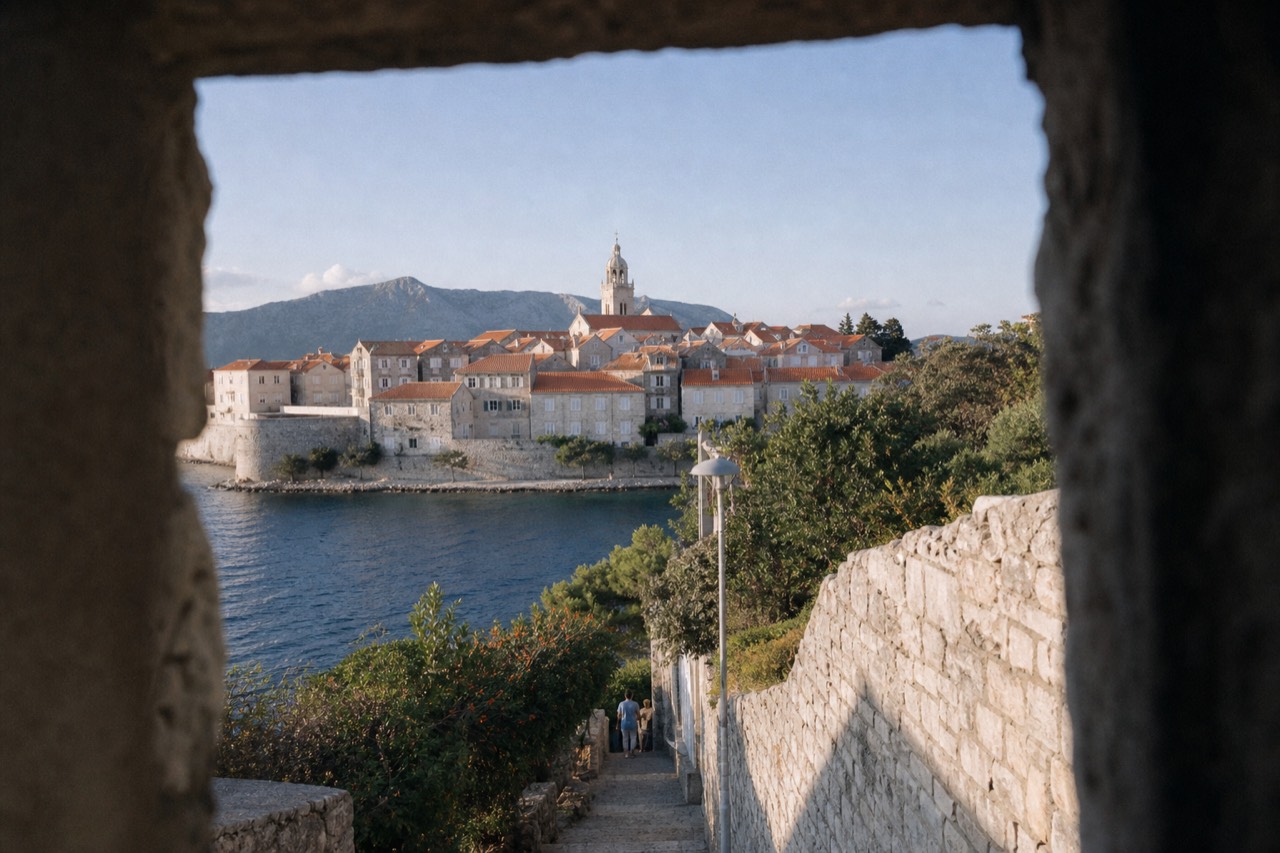
Is Korcula, Croatia Worth Visiting?
Yes, Korcula is worth visiting for almost every traveller who has the time: a compact walled old town, swimming straight off the town walls, a wine region on the same island, and crowds that feel manageable next to Dubrovnik. The honest caveat is the journey. It is a half-day commitment from Dubrovnik each way by ferry or bus, so it rewards an overnight stay far more than a rushed round trip.
I get this question from guests in Dubrovnik every week, usually in the second or third day of their trip, once they have walked the walls here and felt the crush on the Stradun at midday. Korcula is the natural next thought: another walled town, on an island, with its own character and far fewer people. The short answer is that it delivers exactly what people hope it will, a slower, greener, more lived-in version of the Dalmatian coast, and the only real question is whether your itinerary has room for the transit.
Korcula town sits on a narrow point on the island's east side, a herringbone of streets behind sea walls, with the Peljesac channel in front of it and vineyards rolling away behind. The channel crossing from Orebic, on the mainland, is a short hop, and that geography is the whole reason the town exists: a defensible spur controlling a busy shipping lane. What you get today is a walkable old core, swimming ladders off the rocks on both sides of the town, and a promenade of konobas where the evening paseo still belongs to locals as much as visitors.
The comparison people actually care about is with Dubrovnik, so let me be direct about it. Dubrovnik recorded about 4.2 million overnight stays in 2025, sharing first place among Croatian destinations with Rovinj, according to the Croatian Bureau of Statistics. Korcula is not in that league of volume, and you feel it immediately: you can find a quiet lane in Korcula town in July, which is simply not true of the Stradun at noon. What Korcula lacks is scale and the sheer architectural drama of Dubrovnik's main street, so travellers who only have two or three days total should not sacrifice Dubrovnik time for it. Travellers with five days or more, or anyone based here for a week, should go.
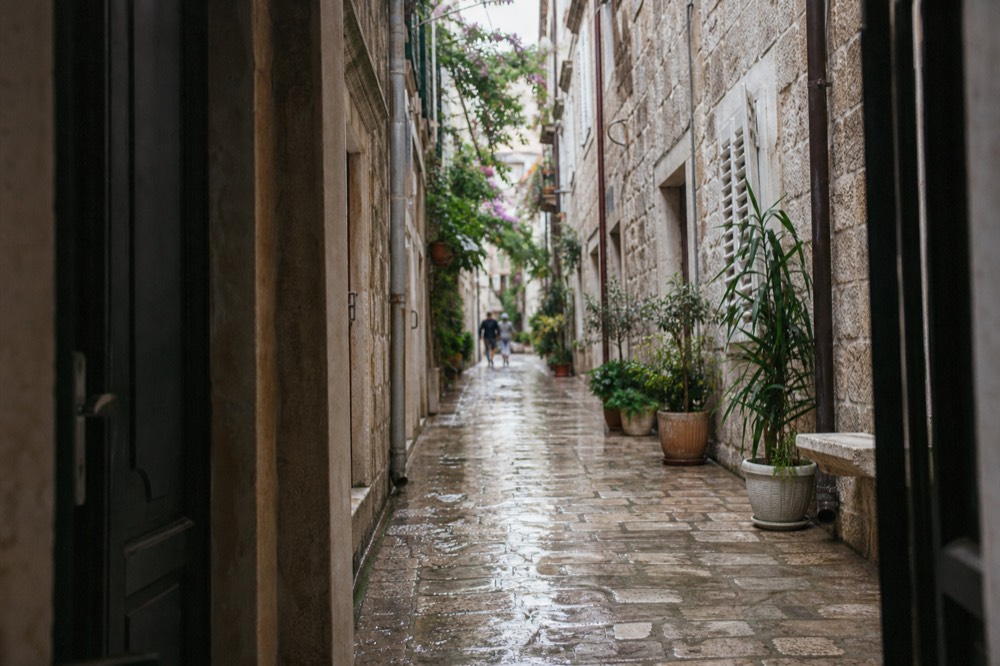
The island itself is bigger than most visitors expect, and most of what people call "Korcula" in a day trip is only the town. The interior holds working vineyards, the white wine grape grk in Lumbarda on the eastern tip, quiet coves on the south coast, and villages that see tour groups only in passing. If your question is really "is Korcula worth visiting, or just Korcula town?", the answer is that the town alone justifies a day, and the island justifies two or three. We have a fuller breakdown in the Korcula day trip guide, including the ferry logistics.
One practical note on how to see it. If you would rather not puzzle out buses and ferry timetables yourself, there is a structured option that covers the highlights of the Peljesac peninsula and Korcula in one long day: the Ston and Korcula Island day trip with wine tasting, which runs about 11 hours from Dubrovnik, is priced from $81.69 per person, and is rated 3.8 across 131 reviews. It pairs the famous walls at Ston, an oyster and shellfish stop, and free time in Korcula town with a wine tasting on the way back, which is a lot of the peninsula's character for one ticket.
For independent travellers, the self-planned version is entirely doable and I have written about the crossing times and timetables in how long the ferry from Dubrovnik to Korcula takes. The trade is simple: the organised day trip buys you the wine stop and the commentary, while the independent route buys you the freedom to linger wherever the afternoon takes you. Both work; neither is a mistake.
What to Be Careful of in Croatia?
Croatia is a safe, orderly country where the things to watch are practical rather than dangerous: sun and heat on exposed walls and boats, sea urchins on rocky swimming spots, seasonal crowds that compress whole towns into a few hours, and border crossings if you day trip into Bosnia or Montenegro. Petty theft exists at tourist density but is rare. None of it should change your plans, only your packing list.
The heat is the one that catches people out. Dalmatian summer days regularly push into the thirties Celsius, and the experiences that define a visit here, walking city walls, kayaking, standing on a boat deck, are all unshaded. On the Dubrovnik walls there is nowhere to hide from the sun for the full circuit, and the same is true of the walls at Ston and the open decks of the island ferries. Bring more water than feels reasonable, start early, and treat the middle of the day as time for swimming or shade rather than sightseeing. Sunburn is the most common way a Croatia trip goes wrong, not crime.
The sea deserves respect in a specific way. Rocky shores mean sea urchins, and the swimming spots around Korcula town, like most of the Dalmatian coast, are rocks and ladders rather than sand. Water shoes solve most of it. The water itself is a different matter from what the guidebooks imply: the headline sea-temperature figures for this coast are long-run averages, a 1991 to 2020 open-water climatology rather than a beach thermometer reading, so the September average is about 23.6 degrees while a sheltered bay on a calm afternoon can read several degrees warmer. Neither number is wrong; they measure different things.
Crowds are the third practical hazard, and they are more predictable than people assume. Dubrovnik's Port Authority limits cruise passengers to 8,000 a day in most cases, and of 243 cruise days a year only 18 exceed that number, according to the Port Authority's own cruise-destination page. The counter-intuitive part is the timing: cruise passengers in 2025 peaked in September at 101,246 and October at 100,132, both above July's 96,072 and August's 87,385. September is not the quiet shoulder month people imagine on the Dalmatian coast; late June or early October are the smarter picks for thin crowds. The Port Authority's statistics application publishes the full monthly cruise figures if you want to check a specific window.
Money and logistics are minor but real. Croatia uses the euro and cards are accepted almost everywhere, including most konobas and ferry ticket offices, so cash anxiety is largely misplaced. What deserves care is scheduling: ferries and catamarans on the coastal routes fill up in high summer, and the "be careful" moment is arriving at a port assuming a walk-up ticket. Book the Dubrovnik to Korcula crossing ahead in July and August, and check whether your return leg leaves from the same port your outbound arrived at, because some island services use different terminals.
Finally, if your itinerary stretches beyond Croatia's borders, the day trips into Bosnia and Herzegovina or Montenegro involve border crossings that can take anywhere from minutes to an hour or more depending on the day and the season. Travellers on organised tours report crossings as short as 15 minutes in September, but that is luck, not a promise. Bring your passport, keep it accessible rather than buried in a suitcase, and build slack into any same-day plans on the far side.
What Is the Best Month to Go to Croatia?
For the Dalmatian coast and Korcula specifically, the best months are June and September: the sea is warm enough for long swims, the ferries run full schedules, and the crowds sit below the late-July and August peak. May and early October are quieter still but cooler. July and August are hottest, busiest and most expensive, and worth it mainly if school holidays force your hand.
The sea temperature is the honest starting point, because it is what separates a beach trip from a sightseeing trip. The long-run monthly averages for this coast, from a 1991 to 2020 open-water climatology, run 18.6 degrees in May, 22.5 in June, 24.9 in July, 25.8 in August, 23.6 in September and 21.0 in October. Read that as a planning range rather than a promise: these are open-water averages, and a sheltered bay like the swimming spots off Korcula's walls will run warmer on a calm afternoon, while a windy stretch can pull the surface down. By June the water is genuinely pleasant; by mid-October it is brisk on first entry.
| Month | Long-run sea average | What it means for a visit |
|---|---|---|
| May | 18.6 degrees | Warm days, cool swims, thin crowds, full ferry season beginning |
| June | 22.5 degrees | The best balance of warm sea, good weather and manageable crowds |
| July | 24.9 degrees | Peak heat, peak crowds, peak prices; book everything ahead |
| August | 25.8 degrees | Warmest water of the year, busiest towns, busiest ferries |
| September | 23.6 degrees | Warm sea and thinner crowds, but cruise traffic peaks this month |
| October | 21.0 degrees | Quiet, green after autumn rains, brisk swims, some services cut back |
The crowd picture is where I will push back on the standard advice. Almost every guidebook repeats that September is the sweet spot, and it is true that land-based crowds thin after the school holidays end. But the cruise data tells a different story for the coastal hotspots: September and October were the two busiest cruise months of 2025 in Dubrovnik, ahead of July and August. If your itinerary is Dubrovnik plus Korcula, and you want the walls and the lanes to yourself, early June or the second half of October beats mid-September. If your heart is set on swimming, September's warmer water wins and you should simply start your days early, before the excursion groups arrive.
Rain is the quiet variable. The Dalmatian summer is genuinely dry, and July and August can pass with almost none, which is why the coast looks parched and golden by August. Autumn rains return from roughly October onward and the islands turn green again, which is lovely, but it also means an October visit carries a real, if modest, chance of a day lost to weather, and boat schedules begin their winter reductions. For a first visit built around swimming, islands and boats, plan between late May and late September, and treat October as a beautiful shoulder option with different expectations.
Whatever month you choose, the booking advice holds: in July and August reserve your ferries, your accommodation and your wall-of-choice tickets in advance, and in the shoulder months reserve only the things that are genuinely capacity-limited, mainly the fast catamarans. If you are leaning on an organised day trip to compress Korcula into a Dubrovnik stay, the summer months are exactly when the structured option earns its keep, since it removes the risk of arriving at a port to a sold-out sailing.
Is Split in Croatia Worth Visiting?
Yes, Split is worth visiting, but as a city with a Roman core rather than a postcard old town: the Palace of Diocletian, a working waterfront, and the main transport hub for the central Dalmatian islands. Give it one full day and an evening, not a beach holiday. It pairs naturally with Korcula and Hvar if you are building a coastal route.
Split divides opinion more than any other Croatian city, and the disagreement is really about expectations. The palace is not a ruin behind a fence; it is a living quarter where bars, apartments and shops occupy Roman walls, and some visitors find that thrilling while others find it scruffy. I land on the side of thrilling. Walking out of a basement hall straight into a maze of Roman stonework with laundry strung above it is an experience no other Croatian city offers, and the basement halls themselves are among the most complete Roman interiors anywhere. Everything else covered here is indexed on Things to Do in Dubrovnik.
The practical case for Split is stronger than the aesthetic one. It is the transport spine of central Dalmatia: the fast catamarans and car ferries to Hvar, Brac, Vis and, heading south, the coastal connections that eventually reach Korcula, mostly run from Split or its immediate area. If your trip is an island chain rather than a single base, Split is where the geometry works. The city also carries real everyday life in a way resort towns do not, a university city with a year-round population, which means better food value and a nightlife calendar that does not switch off on 1 September.
The honest weaknesses: Split's beaches are functional rather than beautiful, the immediate port district is the least charming part of town, and in August the combination of cruise calls and ferry traffic makes the Riva waterfront feel like a transport corridor rather than a promenade. One night is enough for most itineraries, two if you want a slower pace and a day trip to Trogir or an island. Travellers who skip Split entirely to race between Dubrovnik and the islands are not wrong, but they do miss the single most extraordinary piece of Roman architecture on the eastern Adriatic.
For a Dubrovnik-based traveller, the real question is whether Split belongs on this trip at all, and we work through that in detail in the best way to get from Dubrovnik to Split. The short version: Split is two and a half to four hours from Dubrovnik depending on the mode, so it is a stop on a route, not a day trip. Fit it in if you are flying out of Split, island-hopping north, or genuinely drawn to the palace; otherwise Korcula gives you more beauty per hour of transit.
Is Zadar in Croatia Worth Visiting?
Yes, Zadar is worth visiting for travellers already in northern Dalmatia: a compact Roman and Venetian old town on a peninsula, the Sea Organ and Greeting to the Sun on its western edge, and famously good sunsets. It is too far from Dubrovnik and Korcula for a day trip, so treat it as a stop between Split and Plitvice or as a destination in its own right.
Zadar is the connoisseur's pick among Croatian coastal cities, and I say that with affection for all of them. It has the Roman forum and the Venetian walls that Dalmatian towns trade in, but its signature is modern: the Sea Organ, a set of tuned pipes set into the waterfront steps that turns the waves into a low, shifting chord, and beside it the Greeting to the Sun, a glass installation that charges all day and glows after dark. Alfred Hitchcock is credited with calling Zadar's sunset the world's most beautiful, and while quote provenance on that line is shaky, the sunset itself needs no celebrity endorsement: the old town faces due west over open water and the Kornati islands, and the whole peninsula stops to watch it.
The practical strengths are real. Zadar has an airport with good domestic and seasonal international links, it is the natural gateway to the Kornati archipelago and to Plitvice Lakes heading inland, and it is substantially calmer and cheaper than Dubrovnik or Split in the peak months. The old town is small enough to see in a relaxed day, which makes it an easy overnight rather than a base. Its weaknesses are the mirror of its strengths: there is less sheer content than Split or Dubrovnik, the beaches nearby are ordinary, and from Dubrovnik it is a four-hour-plus drive, so it simply does not fit a southern-Croatia itinerary built around Korcula.
The right frame for choosing among the three is what each does best. Split is the Roman city and the transport hub. Zadar is the quiet peninsula with the modern installations and the sunset. Korcula is the island: walls, swimming, wine and slow afternoons. A two-week Dalmatian route can honestly hold all three, and in that order north to south or south to north they complement rather than repeat each other. A one-week route should pick two, and if swimming and wine matter to you, Korcula beats Zadar for the second slot.
| City or island | Signature experience | Best for | Skip it if |
|---|---|---|---|
| Korcula | Walled town, swimming off the rocks, island wine | Slow days, beaches, wine lovers, ferry routes | |
| Split | Diocletian's Palace as a living quarter | Roman history, island hopping, transport links | |
| Zadar | Sea Organ and the western sunset | Northern Dalmatia routes, Kornati, Plitvice | |
| Dubrovnik | The full city walls circuit and the Stradun | First visits, architecture, cruise days |
Can You See Korcula on a Day Trip from Dubrovnik?
Yes, Korcula works as a long day trip from Dubrovnik, either independently by catamaran or bus, or on an organised tour, and the organised version usually adds Ston and a Peljesac wine tasting that the independent route misses. Expect a full day of eleven hours or more door to door. An overnight on the island is better if your schedule allows it.
The geography is the whole story. Korcula sits beyond the Peljesac peninsula, so the road route from Dubrovnik runs up the coast, along the peninsula, and across the channel, while the catamaran cuts straight across the water. Both are commitments, which is why the day trip versions of this route start early and return late. The organised tours have turned that transit into content: the standard structure stops at Ston for its walls and its oysters, crosses to Korcula town for a few hours of free time, and breaks the return journey with a wine tasting in the Peljesac vineyards, which is where the plavac mali grape does its best work. Our overview of the best day trip from Dubrovnik puts this route in context against the other heavyweights.
If you are weighing Korcula against the other big day trips out of Dubrovnik, be honest about what kind of day you want. Korcula is the choice for sea, stone and wine; Mostar is the choice for the feeling of crossing into somewhere genuinely different. Both are long days.
The overnight case deserves a word, because it is what I would do myself. Every day-trip schedule compresses Korcula town into the hours when the excursion groups are also there, roughly late morning to mid-afternoon. Stay a night and you get the town in the evening and at breakfast, when the lanes belong to the people who live in them, plus the option of a morning in Lumbarda's vineyards before the return sailing. Two nights lets you add a south-coast beach day and turns the journey into the point of the trip rather than the cost of it. For a first visit to Croatia built around Dubrovnik, though, the day trip, done either way, is a fair and enjoyable sample.
So, is Korcula worth visiting? If you have five or more days on the Dalmatian coast, or you are already plotting a route north through the islands, the answer is an unqualified yes. If you have three days in Dubrovnik and are tempted to sacrifice one of them, the answer is to stay put, walk the walls early, and save Korcula for the next trip, when it can have the full day and the overnight it deserves.
Common Questions About Whether Korcula Is Worth Visiting
Is Korcula, Croatia worth visiting?
Yes. Korcula offers a compact walled old town, swimming straight off the rocks, a working wine island behind it, and far thinner crowds than Dubrovnik. It rewards an overnight stay, but a well-planned day trip from Dubrovnik, ideally one that adds Ston and a Peljesac wine tasting, gives you a genuine sample of what the island is about.
What to Be Careful of in Croatia?
Croatia is very safe; the practical hazards are sun and heat on unshaded walls and boats, sea urchins on rocky swimming spots, sold-out ferries in July and August, and border queues if you day trip into Bosnia or Montenegro. Bring your passport on those trips, carry more water than feels reasonable, and wear water shoes on rocky shores.
What Is the Best Month to Go to Croatia?
June and September are the best months for the Dalmatian coast: the sea averages 22.5 degrees in June and 23.6 in September, ferries run full schedules, and crowds sit below the late-July and August peak. Note that cruise traffic in Dubrovnik actually peaks in September and October, so early June or late October are the quietest warm-weather windows.
Is Split in Croatia Worth Visiting?
Yes, for one day and an evening. Diocletian's Palace, a living Roman quarter with bars and apartments inside its walls, is unique on the Adriatic, and Split is the transport hub for the central islands. It is not a beach destination, and it is too far from Dubrovnik for a day trip, so fit it into a route rather than adding it as an excursion.
Is Zadar in Croatia Worth Visiting?
Yes, if you are already in northern Dalmatia. The Roman and Venetian old town, the Sea Organ and the west-facing sunset make a rewarding overnight, and Zadar is the natural gateway to the Kornati islands and Plitvice. It is more than four hours from Dubrovnik, so it belongs on a longer route, not on a Korcula-and-Dubrovnik itinerary.
Can You Visit Korcula as a Day Trip from Dubrovnik?
Yes. The catamaran and bus routes both make it feasible, and organised tours run about 11 hours, usually adding Ston's walls, an oyster stop and a Peljesac wine tasting to the Korcula town time. Expect an early start and a late return. An overnight on the island is the better experience if your schedule allows it.