What Is the Best Way to Get from Dubrovnik to Split?
The honest answer to getting from Dubrovnik to Split: bus, ferry, private transfer or rental car, ranked, plus what to do with your last hours in Dubrovnik.
What Is the Best Way to Get from Dubrovnik to Split?
For most travellers the best way is the direct intercity bus: it runs year round, several times a day, it is the cheapest scheduled option, and it crosses the Neum corridor and the new Peljesac bridge route without you having to think about borders at all. The seasonal catamaran ferry is the better choice in summer if you want the ride itself to be the experience, and a private transfer wins when you are three or more people with luggage.
I get this question constantly, usually from travellers finishing a Dubrovnik stay and heading north toward Split, and the honest answer depends less on cost than on what kind of day you want. The bus is the workhorse. The ferry is the memory. The transfer is the shortcut. Each has a real downside too, and I would rather you knew those before you booked than after.
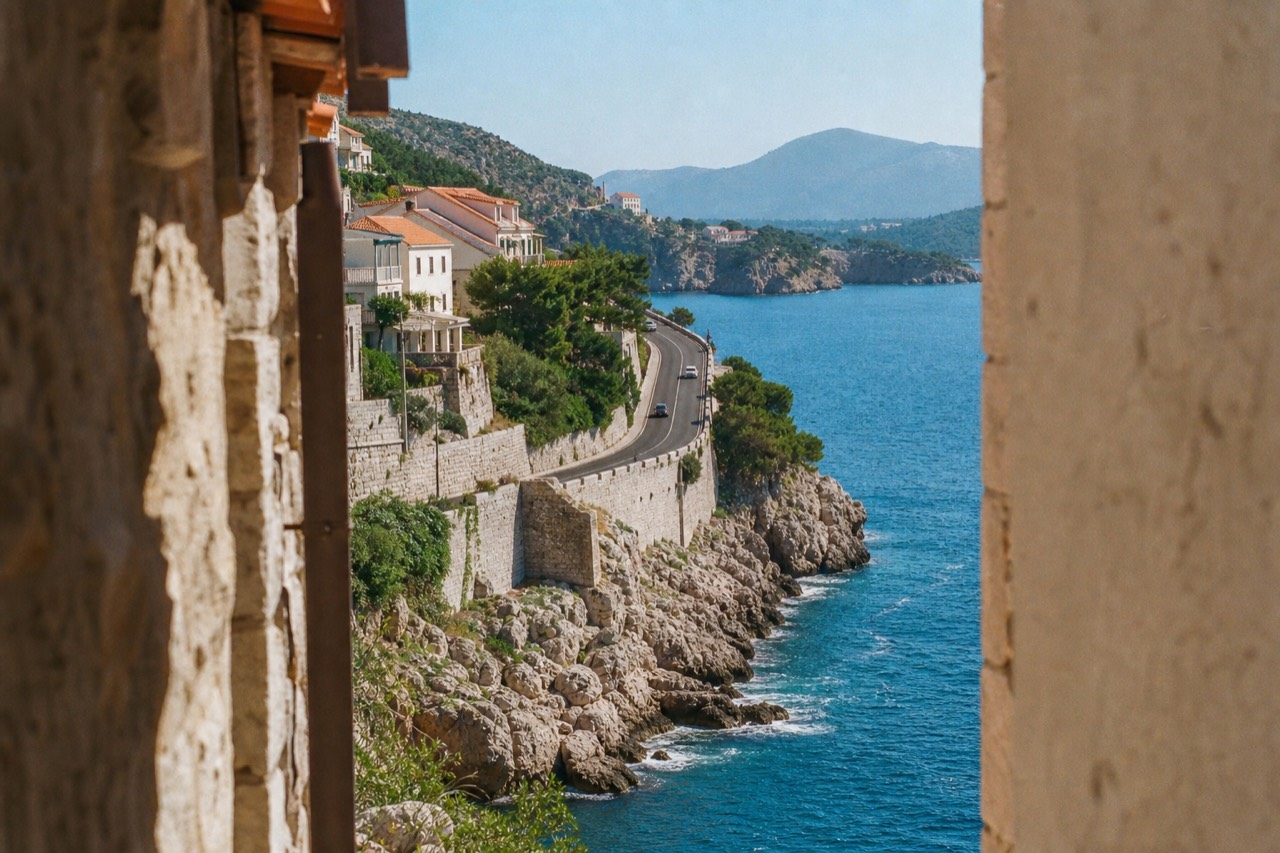
A quick geography note that explains everything else. Dubrovnik sits on a narrow strip of Croatian coast that is physically cut off from the rest of the country by a short stretch of Bosnian territory around Neum. For decades every bus and car had to dip through a border checkpoint twice. The Peljesac bridge changed the calculus by letting traffic stay inside Croatia the whole way, and the driving experience is genuinely better for it. There is still no train to Dubrovnik at all, which surprises people who assume Croatia's second city must be on a rail line. It is not, and it never has been in the modern era.
Before you leave, it is worth being honest about when you are travelling. September and October are the two busiest cruise months in Dubrovnik, with 101,246 and 100,132 cruise passengers respectively in 2025, ahead of July's 96,072 and August's 87,385, according to the Port Authority's own statistics. If your departure day falls on a heavy cruise day, the Old Town entrances and the Pile bus stop area get congested by mid-morning, and that affects how relaxed your transfer start can be. Plan to be packed and out of the core early.
If you still have energy on your last morning, this is also the moment to squeeze in one final view rather than sitting at a bus stop. The cable car to Mount Srd is the classic one, and there are tours that bundle it with a proper Old Town walk so you are not improvising logistics on departure day. More on those further down.
For the reverse direction and a deeper comparison of the two legs, our guide on Dubrovnik to Split transport options breaks down every operator and season, and the answer page on bus versus ferry from Split covers the same trade-off coming the other way.
What Is the Best Way to Travel from Dubrovnik to Split?
Travel by bus if you want the simplest, cheapest, year-round option; travel by catamaran ferry between roughly April and October if you want the sea route and are travelling light; take a private transfer if you are a group of three or more or have an early flight from Split; drive a rental car only if the Peljesac peninsula or Ston are part of your plan. There is no train, and there is no domestic flight.
Let me take these one at a time, because the details matter more than the headline.
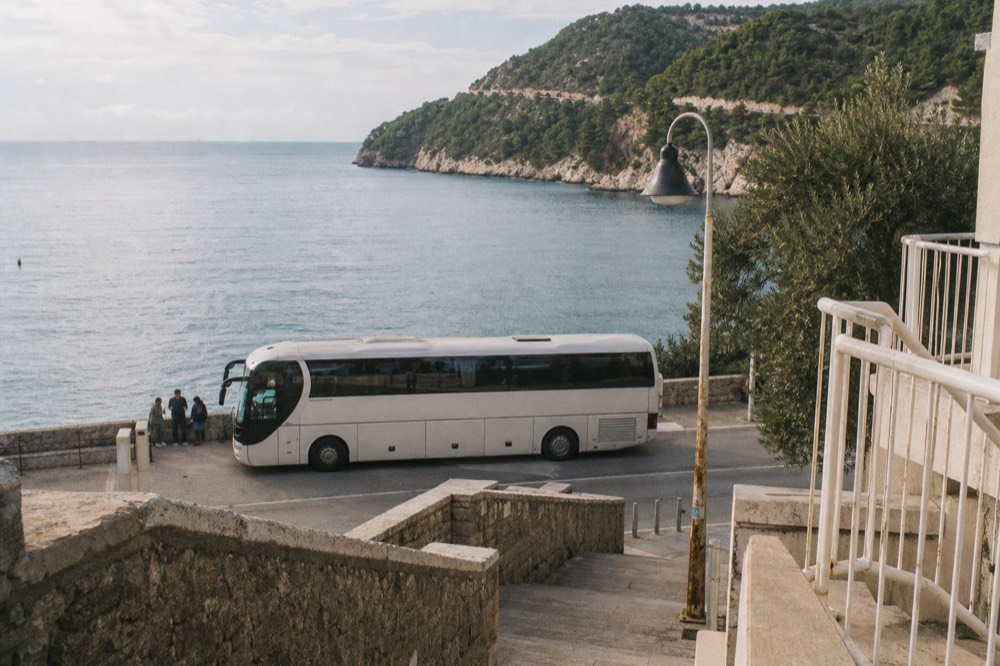
The bus. Coaches leave from Dubrovnik's main bus station in Gruz, not from the Old Town, and the ride north is genuinely scenic once you are past Neum, especially across the new bridge and along Peljesac. You can walk to the Gruz station from much of the city, or take a short local bus or taxi from Pile. Book ahead in July, August and September, because those are the months when the whole coast is moving and the popular departures fill. Luggage handling is usually a small extra fee paid to the driver in cash, so keep a few coins ready. The buses are modern coaches with air conditioning, and the route terminates at Split's harbour-side station, which puts you within walking distance of Split Old Town and the ferry port.
The ferry. The fast catamaran between Dubrovnik and Split is seasonal, typically running in the warmer half of the year, and it is the option people remember for years afterward. You leave from Gruz port, stop at islands such as Hvar along the way depending on the line, and arrive in Split's harbour with the sea in your hair. Two honest caveats. First, capacity is small compared with a coach, so it sells out far earlier in peak season. Second, luggage space is limited and rough seas can occasionally disrupt schedules. If you are prone to seasickness, think hard. If you want the full breakdown of whether the boat is worth it over the bus, read our piece on whether the Split to Dubrovnik ferry is worth it.
The private transfer. A door-to-door transfer costs more per person than a bus ticket, but split across three or four travellers the gap narrows a lot, and you control the departure time. This is the option I steer families and anyone with an awkward flight connection toward. It is also the only option where a stop at Ston or a viewpoint is simply a matter of asking the driver.
The rental car. I recommend this only if the drive is part of the trip. If you want to break the journey at Ston for the walls and oysters, or detour onto Peljesac for wine, a car transforms the transfer into the best day of your holiday. If you just want to get there, a car is a liability: parking in both old towns is scarce, and you will pay for the privilege.
| Option | Best for | Main drawback |
|---|---|---|
| Intercity bus | Solo travellers and couples, year round, lowest scheduled cost | Fixed timetable, luggage fee in cash, crowded in peak months |
| Seasonal catamaran | Travellers who want the sea route and travel light | Summer only, small capacity, sells out early, weather sensitive |
| Private transfer | Groups of three or more, early departures, awkward connections | Highest cost for one or two people |
| Rental car | Trip plans that include Ston, Peljesac or island stops | Parking in both old towns is scarce and paid |
One thing that catches people out: there is no train, and no domestic flight between the two cities. Croatia's rail network simply does not reach Dubrovnik, and the short hop is not served by a scheduled domestic flight. Anyone selling you a "quick flight" is routing you through Zagreb or a connection that takes longer than the bus. Plan around surface transport or the seasonal boat and you will not be disappointed.
Timing matters more than mode. Whatever you choose, avoid departing on a day when the Old Town is saturated. The city runs six electronic counters at every Old Town entrance, updating a headcount every 15 minutes, and the official carrying capacity from the UNESCO assessment is 11,275 people. On a heavy day the count passes 7,297 by 09:00. Leaving early beats leaving comfortably.
A note on buying tickets. For the bus, you can buy at the station in Gruz, but the same seats are cheaper if you book online in advance, and in peak months the online inventory is what disappears first. For the catamaran, book as early as your dates allow: the boat holds a fraction of a coach's passengers, and July and August departures are frequently full weeks out. If your travel date is fixed, treat the ferry ticket as the first thing you lock in, before hotels or tours.
One more practical point on the drive. The route runs along the Adriatic coast road, and the stretch across Peljesac is where the scenery earns its reputation, but the same curves that make it beautiful make it slow. If you are driving to Split with a flight to catch, leave a generous buffer rather than trusting the map's estimate. And if you rent in Dubrovnik and drop the car in Split, expect a one-way fee, which is another reason the car only makes sense when the stops along the way are the point.
What Is the Best Way to Get to Dubrovnik?
Fly directly into Dubrovnik Airport if you are coming from abroad, which most visitors do; arrive by bus or private transfer from Split or Mostar if you are already in the region; arrive by ferry if you are island hopping up or down the coast; and arrive by cruise ship if, like 625,257 passengers in 2025, Dubrovnik is a port of call rather than a destination.
The airport is the main gate. It sits well south of the city, and the transfer into town is a fixed part of every arrival plan. There is a local bus, there are taxis, and there are pre-booked transfers; the choice is really about how many of you there are and how much luggage you are hauling. Our guide on getting from the airport to the Old Town walks through all of them in detail.
Coming overland, the same logic as the Dubrovnik to Split run applies in reverse. Buses arrive at the Gruz station, private transfers drop you at your door, and a rental car only makes sense if the Dalmatian coast is the point of the trip rather than an obstacle. From the north, the drive across the Peljesac bridge has replaced the old Neum border double-cross, which makes overland arrival smoother than it was for decades.
Arriving by sea is the underrated option. Ferries and catamarans connect Dubrovnik with Split, the Elaphiti islands, Korcula, Mljet and, across the season, Italian ports. If your itinerary is an island chain, arriving by boat is not a compromise, it is the plan. And if you are arriving on a cruise, know that the Port Authority limits cruise passengers to 8,000 a day in most cases, with a "2+1" berthing arrangement that keeps one large ship anchored off the Old City, so even peak days are managed rather than chaotic.
If you are arriving from the north and have a full day to spare, the overland route can be turned into the best day trip in the region. Some travellers time their Split departure around exactly this kind of detour.
However you arrive, give yourself at least a full day in the city before you leave again. Dubrovnik recorded about 4.2 million overnight stays in 2025, sharing first place among Croatian destinations with Rovinj, and the volume is why: the walled core rewards a second look once the day-trippers have gone.
What Is Prettier Split or Dubrovnik?
Dubrovnik is prettier as a single overwhelming ensemble: a complete 1,940-metre circuit of walls, 24.7 hectares of UNESCO-listed stone, a 298-metre main street polished like marble. Split is prettier in the layered, lived-in sense: a Roman emperor's palace that an entire city grew inside. If you want a postcard, choose Dubrovnik. If you want a city that feels alive, choose Split.
I refuse to give a fake-neutral answer here, because travellers ask this to make a decision, so let me be specific about what "pretty" means in each place.
Dubrovnik is a complete object. The Old City was inscribed by UNESCO in 1979 under criteria (i), (iii) and (iv), covering 24.7 hectares inside walls that run 1,940 metres, up to 25 metres high, 4 to 6 metres thick on the land side and 1.5 to 3 metres on the sea side. The Stradun, the main street, is 298 metres long and shines from centuries of footfall. There is nothing dilapidated, nothing out of scale, nothing modern to break the frame. That totality is the beauty, and it is also the constraint: it is a stage set, and in peak season it can feel like one.
Split is a ruin that became a city. Diocletian's Palace is not a monument you visit, it is a grid of streets, apartments, bars and bakeries occupying the bones of a Roman structure. You eat breakfast inside a former emperor's basement, you get lost in alleys that were never designed as alleys. It is scruffier, cheaper, louder, and it has a pulse Dubrovnik's core deliberately keeps out.
| What you value | Split | Dubrovnik |
|---|---|---|
| Architectural unity | Layered, Roman core with later accretions | Complete walled ensemble, intact circuit |
| Atmosphere after dark | Lived-in, locals everywhere | Quieter core, evening calm on the Stradun |
| The single best view | Bell tower over the palace roofs | Mount Srd panorama over the whole walled city |
| Cost of an evening | Noticeably lower | Noticeably higher |
| Time needed | Half a day satisfies most | A full day minimum, two is better |
My honest advice, since the two cities are connected by exactly the transport options above: see both. The standard pattern is two or three nights in Dubrovnik, transfer north, one or two in Split, and nobody I have ever steered this way has regretted it. The two cities are less than a day apart and they answer different questions.
What to Do With Your Last Morning in Dubrovnik?
Spend your last morning on the Mount Srd cable car or on the walls themselves, because both give you the one view you cannot get from street level, and both are doable before a midday departure. The cable car climbs 367 metres in 3 minutes 30 seconds, and the walls circuit is the 1,940-metre walk the whole city is famous for. Then leave for Split with the picture in your head.
The cable car is the efficient choice. The lower terminal sits just outside the Old Town, the upper station stands 405 metres above sea level, and the operator quotes a view range of up to 60 km on a clear day, which on a good morning takes in the Elaphiti islands and the Montenegrin coastline in one sweep. The 2026 adult round trip is 30 euro, one way 17 euro, children 4 to 12 are 8 euro round trip, and under 4s ride free, per the operator's own price page. Note it closes January to March, so winter travellers should not build a morning around it.
The walls are the immersive choice. The adult ticket is 40 euro in main season, 1 March to 30 November, and 20 euro in December; children 7 to 18 pay 15 euro then 5 euro, and under 6s are free. That 40-euro ticket is actually the walls plus Fort Lovrijenac combination, and it also covers the Western Outer Wall and the Collection of Coins of the Republic of Ragusa. Go at opening: the operator's stated hours are 08:00 to 19:30, and the first hour is the cool, quiet one.
If you would rather have someone else run the logistics on departure day, the guided combination tours are built exactly for this. The Cable Car Ride and Old Town Walking Tour, about 4 hours 30 minutes from $163.50 per person and rated 4.6 across 716 reviews, pairs the summit panorama with a guided walk through the core, and it finishes back in the Old Town well positioned for grabbing your bags and heading to Gruz.
Great tour with a great guide. Terrific views from the cable car. The old town is fascinating. We walked part of the wall because it was very hot. Sara was a fabulous guide and gave us recommendations for lunch and what else we should see.
Fred_W
A cheaper sibling is the Cable Car, Walking Tour and City Walls Combo, from $90.66 per person and rated 4.6 across 360 reviews, which folds the walls into the same morning. Whichever you choose, book it for the morning before your transfer, not the morning of, because a delayed tour and a departing bus are a bad pairing.
For everything else the city offers before you go, the full Things to Do in Dubrovnik catalogue is where to browse, and the transfer guide covers the reverse leg in depth.
Common Questions About Getting from Dubrovnik to Split
What is the best way to get from Dubrovnik to Split?
For most travellers the intercity bus is the best way: it runs year round, several times daily, it is the cheapest scheduled option, and it uses the Peljesac bridge route without border stops. In summer the seasonal catamaran is the better pick if you want the sea crossing and travel light, and a private transfer wins for groups of three or more.
Is there a train from Dubrovnik to Split?
No. Croatia's rail network does not reach Dubrovnik at all, and there is no domestic flight between the two cities either. Your realistic options are the bus, the seasonal catamaran ferry, a private transfer or a rental car.
Is the ferry from Dubrovnik to Split worth it?
If the journey itself matters to you, yes. The fast catamaran leaves from Gruz port, calls at islands along the way depending on the line, and arrives in Split's harbour. It is summer-only, has far less capacity than a coach, and can be disrupted by rough seas, so book early and have a bus as a fallback.
What is prettier Split or Dubrovnik?
Dubrovnik is prettier as a complete ensemble: 24.7 hectares of UNESCO-listed stone inside a 1,940-metre wall circuit. Split is prettier in a lived-in way, a whole city grown inside Diocletian's Palace. Choose Dubrovnik for the postcard, Split for the pulse, and see both if you can.
Where do buses to Split leave from in Dubrovnik?
From the main bus station in Gruz, not from the Old Town. From Pile Gate you reach it on a short local bus ride or a taxi. Arrive with time to spare in July, August and September, when departures fill, and keep a little cash for the luggage fee usually collected by the driver.