What Is the Most Famous Festival in Croatia?
The Dubrovnik Summer Festival is the most famous festival in Croatia, staged inside the walled Old Town. Here is what it is, plus what Croatia and Dubrovnik are famous for.
What Is the Most Famous Festival in Croatia?
The most famous festival in Croatia is the Dubrovnik Summer Festival, a summer season of theatre, classical music and dance performed in the open-air squares, fortresses and courtyards of Dubrovnik's walled Old Town. It is the festival most international visitors associate with the country, because its stages are the limestone streets and fortress terraces of a UNESCO World Heritage city. Our Dubrovnik Summer Festival guide covers the season in depth.
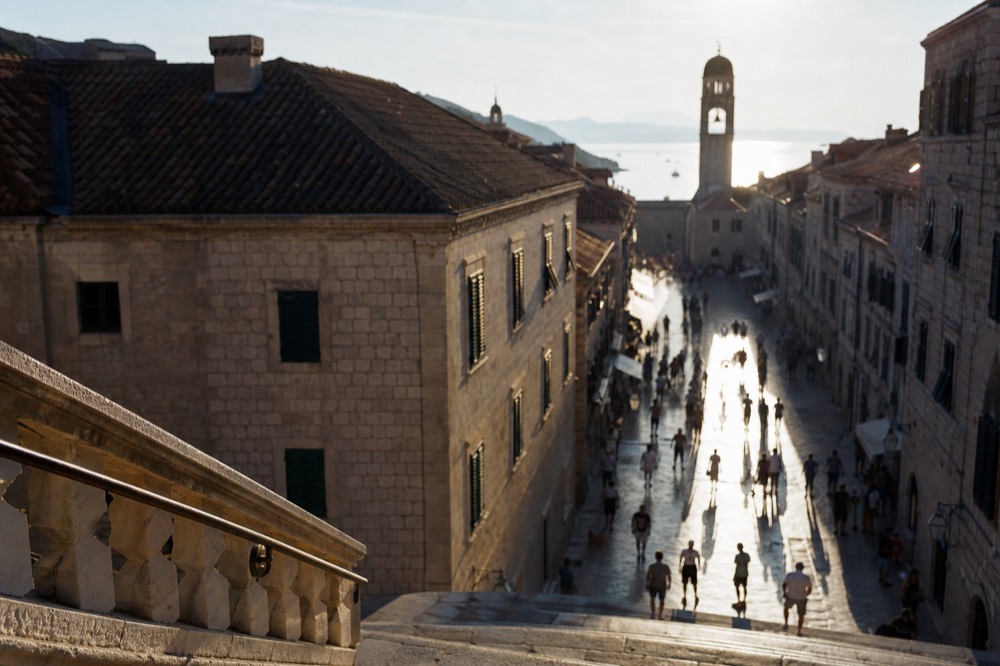
I have walked those streets in every month of the year, and the festival weeks change the city more than any other event on the calendar. The Stradun, the 298-metre limestone main street whose final plan was fixed by the 1272 Statute, becomes a promenade between venues. Fort Lovrijenac, standing on its 37-metre sea rock on the western side, serves as one of the most dramatic open-air stages on the Adriatic. A performance there, with the illuminated walls across the water, is the single experience most visitors describe when they get home and try to explain Croatia to someone.
Why does this festival, rather than any of the country's other summer events, carry the national reputation? Partly longevity and prestige, and partly the setting. The Old City of Dubrovnik was inscribed on the UNESCO World Heritage List in 1979 under criteria (i), (iii) and (iv), covering a property area of 24.7 hectares with a 1,188.6-hectare buffer zone, and it spent 1991 to 1998 on the List of World Heritage in Danger during the war years. A festival staged inside a site of that standing inherits an audience. The official UNESCO listing records the inscription details.
The festival is also the reason many first-time visitors time their trip for July and August, which is worth knowing before you book, because those months sit inside the busiest stretch of the year. Dubrovnik recorded about 4.2 million overnight stays in 2025, sharing first place among Croatian destinations with Rovinj, according to the Croatian Bureau of Statistics. Festival crowds and peak-season crowds overlap almost completely.
If you are coming for the festival itself, the practical base is simple: you want to be inside or beside the Old Town, because the venues are scattered through it and the evenings run late. The classic way to get your bearings before the first performance is a guided walk, and the two most useful options are below.
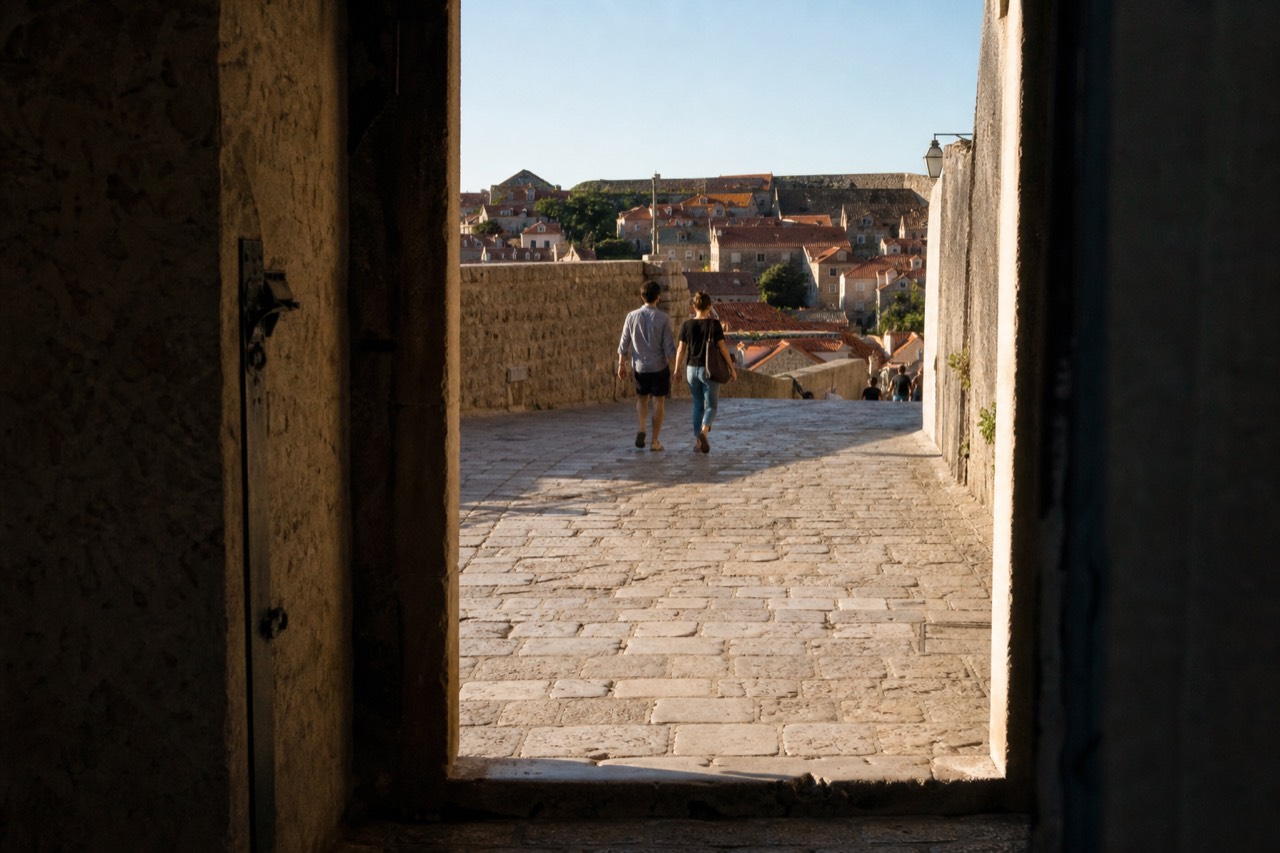
The combo walk pairs the Old Town circuit with the full city walls, which is the best preparation for understanding where the festival stages actually sit. The walls themselves are 1,940 metres long, up to 25 metres high, 4 to 6 metres thick on the land side and 1.5 to 3 metres on the sea side, and they carry 16 towers, 3 fortresses, 6 bastions, 2 corner fortifications, 3 bulwarks with rows of turrets, 3 moats, 2 flank fortresses, 1 breakwater and 2 drawbridges. The circuit reached its shape in the 13th century and was finished in 1660 with the Bastion of St Stephen. Walking it once before the festival begins gives you the whole geography of the city in a single morning.
What Is Croatia Famous For?
Croatia is famous for its Adriatic coastline and islands, its walled medieval cities, the Game of Thrones filming locations in Dubrovnik, Plitvice Lakes National Park, its national football team, and a food and wine culture built around fresh seafood, olive oil and local reds like Plavac Mali. The coast is the anchor: the country recorded 20.7 million arrivals and 94.8 million overnight stays in commercial accommodation in 2025.
The coastline is the honest starting point, and almost every famous thing in Croatia sits on or near that water. The Adriatic along this coast has a long-run September average of about 23.6 degrees Celsius, rising to an August average of 25.8, figures from the NOAA OISST v2.1 1991 to 2020 climatology for the open water off Dubrovnik, corroborated by EMODnet within about one degree. Those are open-water grid-cell averages rather than beach readings, and sheltered bays run warmer: the Croatian met service's own Dubrovnik buoy read 27.0 to 27.4 degrees on 8 September 2026 against that 23.6 September mean. The practical point for a festival trip is that the sea is genuinely swimmable through the whole festival season.
Beyond the water, the country's reputation rests on a handful of icons. Dubrovnik's Old Town is the most photographed. The Dalmatian islands, including the Elaphiti chain off Dubrovnik, carry the lazy-boat-day image. The Game of Thrones connection put Dubrovnik on the map for a whole generation of viewers, since the city stood in for King's Landing, a story we cover in was Game of Thrones filmed in Dubrovnik. Croatian wine, especially the Plavac Mali reds of the Pelješac and Dingač vineyards, has moved from a local secret to something sommeliers abroad actually stock.
And football. There is no pretending otherwise: a country of roughly four million people reaching a World Cup final is part of the national fame, and you will see the checkered shirt everywhere during any summer tournament.
Here is the counter-intuitive part most visitors never hear. The busiest cruise months in Dubrovnik are not July and August. Port Authority data for 2025 shows September peaked at 101,246 cruise passengers and October at 100,132, both above July's 96,072 and August's 87,385. If you are combining the festival with a quiet old town, the late-season performances are the ones to target.
The Old Town's own crowd system is worth understanding if you are festival-bound. Six counters at every entrance update a headcount every 15 minutes, and the official carrying capacity from the UNESCO assessment is 11,275 people. A real half-hourly curve read on 8 September 2026 showed 1,200 people at 04:00, 3,139 at 07:00, 5,419 at 08:00, a 7,739 peak at 10:00, then 7,205 at 11:00. In other words, the town empties of day-trippers in the evening, exactly when the festival performances begin. That is a quiet advantage of festival tickets: your venue is at its calmest at showtime.
Why Is Croatia Famous?
Croatia is famous because it compresses an extraordinary range into a small, accessible country: Roman ruins, Venetian port towns, a thousand-plus islands, alpine national parks and a distinctive food and wine tradition, all within a few hours' drive of each other. Its fame compounds, since each famous thing advertises the others. The Game of Thrones effect and a generation of cruise tourism then broadcast those images worldwide.
Geography does most of the work. The country sits at the crossing point of Central European and Mediterranean worlds, and you can stand in a Roman palace in Split in the morning and swim off a Dubrovnik beach in the afternoon. The Dubrovnik Tourist Board's own pages describe a main street whose plan was fixed in 1272, which tells you what kind of city this is: a place where the medieval street plan is still the working street plan.
Then there is the festival tradition itself, which is a real part of the national fame. The Dubrovnik Summer Festival is the flagship, but the pattern of staging serious music and theatre inside historic settings runs through the country's summer calendar. That tradition is why cultural travellers, not just beach travellers, put Croatia on their lists. A city that can fill a fortress terrace with an audience on a July night is selling something a beach resort cannot. The wider set of guides lives on Things to Do in Dubrovnik.
The numbers behind the fame are worth a table, because they explain both the appeal and the crowding:
| Measure | Figure | What it means for visitors |
|---|---|---|
| Dubrovnik overnight stays, 2025 | about 4.2 million | First place in Croatia, shared with Rovinj |
| Cruise passengers, Dubrovnik, 2025 | 625,257 | Up from 582,499 in 2024 |
| Scheduled cruise calls, 2026 | 461 | Daily cruise limit of 8,000 passengers in most cases |
| Old Town carrying capacity | 11,275 people | Counted live by six entrance counters every 15 minutes |
Fame has a cost, and honesty about it is part of this site's job. The Port Authority refused about forty cruise call requests in a single season to keep numbers down, and of 243 cruise days a year only 18 exceed the 8,000-passenger limit, with only 4 days slightly above 10,000. Those are the Port Authority's own published measures. The festival visitor benefits from all of it: the crowd-control effort is precisely why an evening performance in the old core still feels possible.
What Is Dubrovnik, Croatia Famous For?
Dubrovnik is famous for its complete medieval city walls, the limestone Stradun, its role as King's Landing in Game of Thrones, the cable car up Mount Srd, the terracotta rooftop view from above, and the Dubrovnik Summer Festival. The walls are the core of the fame: 1,940 metres of circuit, up to 25 metres high, wrapping a UNESCO-listed old city of 24.7 hectares. Everything else famous about Dubrovnik is visible from that wall.
Start with the walls, because everyone does. The adult ticket is 40 euro in main season, 1 March to 30 November, and 20 euro in December, with children 7 to 18 at 15 euro then 5 euro, and under 6 free. There is no family ticket; the operator sells exactly two paid article types. That 40-euro ticket is actually the walls plus Fort Lovrijenac combination, and it also covers the Western Outer Wall, closed December through February, and the Collection of Coins of the Republic of Ragusa. Lovrijenac bought alone is 15 euro. The operator's stated hours at time of check were 08:00 to 19:30, and seasonal hours beyond that are not published, so check the operator's own site before you go.
| City Walls ticket | Main season, 1 Mar to 30 Nov | December |
|---|---|---|
| Adult | 40 euro | 20 euro |
| Child 7 to 18 | 15 euro | 5 euro |
| Child 6 and under | free | free |
One planning note that saves people money: the one-day Dubrovnik Pass also costs 40 euro in main season and includes the walls plus Lovrijenac as its first listed inclusion, along with ten more sights and a 24-hour bus ticket. That equivalence is a main-season comparison only. In December the standalone walls ticket drops to 20 euro while no winter pass tier is on sale at all. Our Dubrovnik Pass guide works through the whole value question.
The Game of Thrones fame is the second pillar. Dubrovnik stood in for King's Landing across the series, and the filming locations are scattered within a five-minute walk of each other inside the walls. The most-booked product in that family, the Original Game of Thrones Tour with Lokrum and the throne, runs from $25.57 per person and is rated 4.8 across 6,132 reviews. There is also a genuinely free option: a pay-what-you-want Game of Thrones and history walk on GuruWalk, rated 4.74 across 444 reviews, where you pay nothing up front and tip what you think it was worth.
The third pillar is the view from above. The cable car climbs from a lower terminal at 38.0 metres above sea level to the Mount Srd station at 405.0 metres, a 367.0-metre rise over a 778.2-metre track, in 3 minutes 30 seconds at 6.5 metres per second. An adult round trip is 30 euro, one way 17 euro, children 4 to 12 pay 8 euro round trip and 5 euro one way, and under 4s ride free. The operator states a view range of up to 60 km, about 37 miles, on a clear day. Our cable car guide has the full timetable, but the headline is that the car runs until midnight in June, July and August, which makes it a natural post-performance ride during the festival.
Why Is Dubrovnik, Croatia Famous?
Dubrovnik is famous because it is a complete, intact Renaissance-era city-state capital that survived into the present as a living town rather than a ruin. Its fame rests on three layers stacked on top of each other: the historical Republic of Ragusa, the perfectly preserved walls that defended it, and the modern screen and festival fame layered onto both. Remove any one layer and the city is still famous; the three together make it singular.
The historical layer matters more than most visitors realise. This was the capital of an independent republic that ran its own diplomacy, shipping and coinage, and the city's institutions, the Rector's Palace, the Sponza Palace, the Franciscan Monastery, are not museums of somewhere else's history, they are the working buildings of that state. The city's population today is 41,562 at the 2021 census, and the walled core remains a functioning neighbourhood, not a theme park. That living quality is exactly what the festival trades on: real performances in real historical rooms, not a reconstruction.
The preservation layer is the walls, covered above, plus the uniform baroque streetscape. After the 1991 to 1998 period on the World Heritage in Danger list, the city's restoration was extensive and disciplined, which is why the rooftops you photograph from Mount Srd look the way they do. The modern layer, Game of Thrones and the festival, simply pointed cameras at what was already there.
For festival visitors, the practical read on all this fame is timing. The Old Town hits its 10:00 peak of 7,739 counted visitors and then thins through the afternoon; by the time evening performances begin, the day-trip crowd has largely gone. The busiest remaining cruise days in the late 2026 season are 6 October with 2 ships and up to 5,798 passengers, 29 September with 2 and 5,675, and 30 September with 3 and 5,536. Those are ship-capacity figures, not people who actually walk ashore, but they mark the days when a matinee performance will compete with the thickest midday crowds.
So the complete answer to the fame question is a chain: a festival famous for its stages, inside walls famous for their completeness, inside a city famous for surviving as itself. Each layer feeds the next, and a visitor with three or four days can experience all of them, walking the walls in the morning, swimming in the afternoon, and sitting in a fortress courtyard for music in the evening.
If that is the trip you are building, these three picks cover the festival city's essentials:
Common Questions About the Most Famous Festival in Croatia
What is the most famous festival in Croatia?
The Dubrovnik Summer Festival, a summer season of theatre, classical music and dance staged in the open-air squares, fortresses and courtyards of Dubrovnik's walled Old Town. It is the festival most international visitors associate with Croatia, because its venues are the streets and terraces of a UNESCO World Heritage city.
When Does the Dubrovnik Summer Festival Take Place?
Across the summer season, with performances concentrated in July and August. Exact dates and the programme are published by the festival each year, so check the official festival site before booking travel around a specific performance.
What Is Croatia Famous For?
Its Adriatic coastline and islands, walled medieval cities, the Game of Thrones filming locations in Dubrovnik, Plitvice Lakes National Park, football, and a food and wine culture built on seafood, olive oil and Plavac Mali reds. The country recorded 20.7 million arrivals and 94.8 million overnight stays in commercial accommodation in 2025.
What Is Dubrovnik, Croatia Famous For?
Its complete 1,940-metre city walls, the 298-metre Stradun, its role as King's Landing in Game of Thrones, the cable car up Mount Srd, and the Dubrovnik Summer Festival. The adult walls ticket is 40 euro in main season, 1 March to 30 November, and 20 euro in December.
Is Dubrovnik Too Crowded During the Festival?
The Old Town is busy in July and August, but the counted crowd peaks around 10:00 and thins by evening, when performances begin. The official carrying capacity of the old core is 11,275 people, monitored by six entrance counters updating every 15 minutes, and the Port Authority limits cruise passengers to 8,000 a day in most cases.
Can You Combine the Festival With Walking the City Walls?
Yes, and it is the natural pairing. The walls are best walked early, from the 08:00 opening, leaving the afternoon for swimming and the evening for performances. A combo walking tour covering both the Old Town and the walls runs from $50.94 per person, rated 4.8 across 1,183 reviews.