Onofrio Fountain Dubrovnik: Meeting Point, Drinking Water and History
The Onofrio Fountain sits just inside Pile Gate, and almost every walk in Dubrovnik starts or passes beside it. This guide covers what it is, why guides use it as a meeting point, whether you can drink the water, and how to plan around it.
Short answer
The Onofrio Fountain is a free landmark just inside Pile Gate at the western end of the Stradun, which runs 298 metres to the other end of the Old Town. It is Dubrovnik's traditional meeting point for walking tours, its water is part of the city supply, and it costs nothing to visit at any hour.
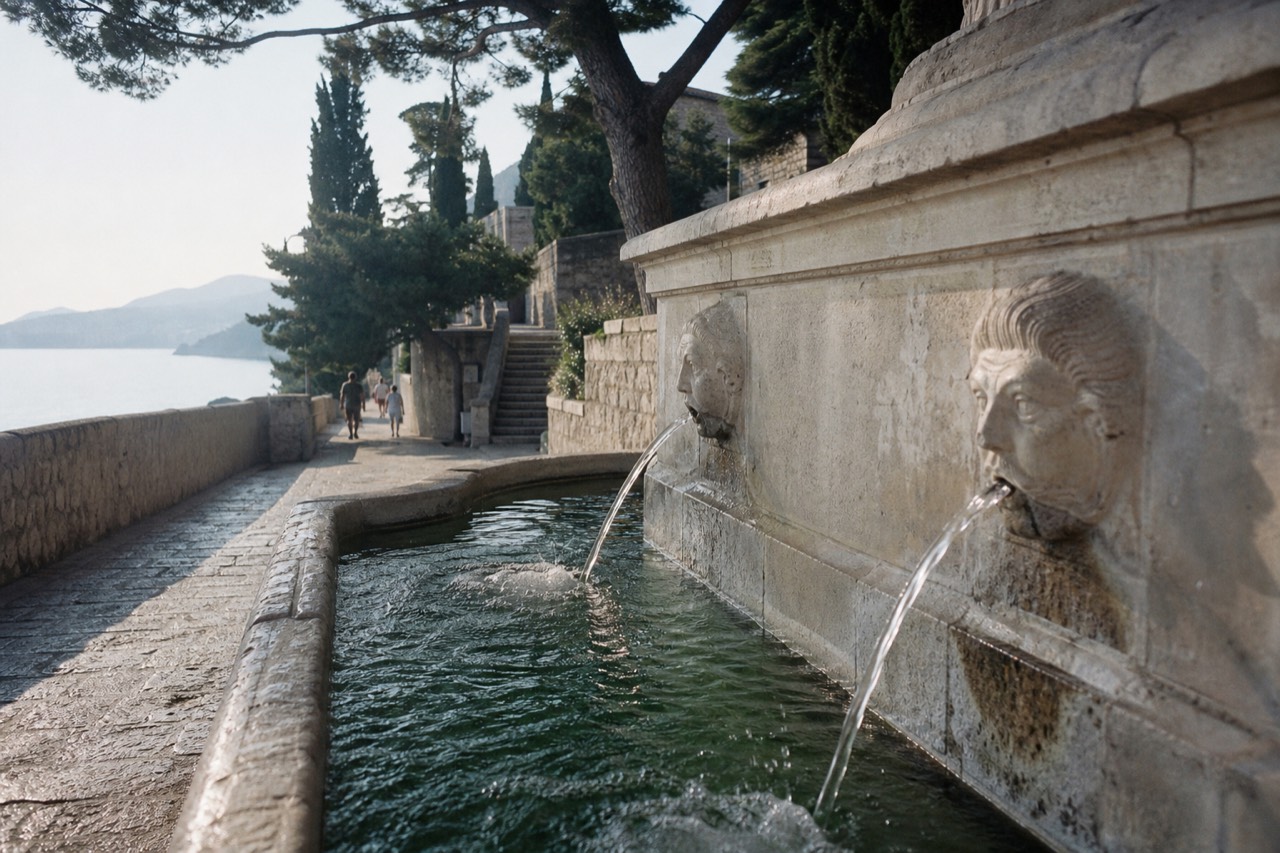
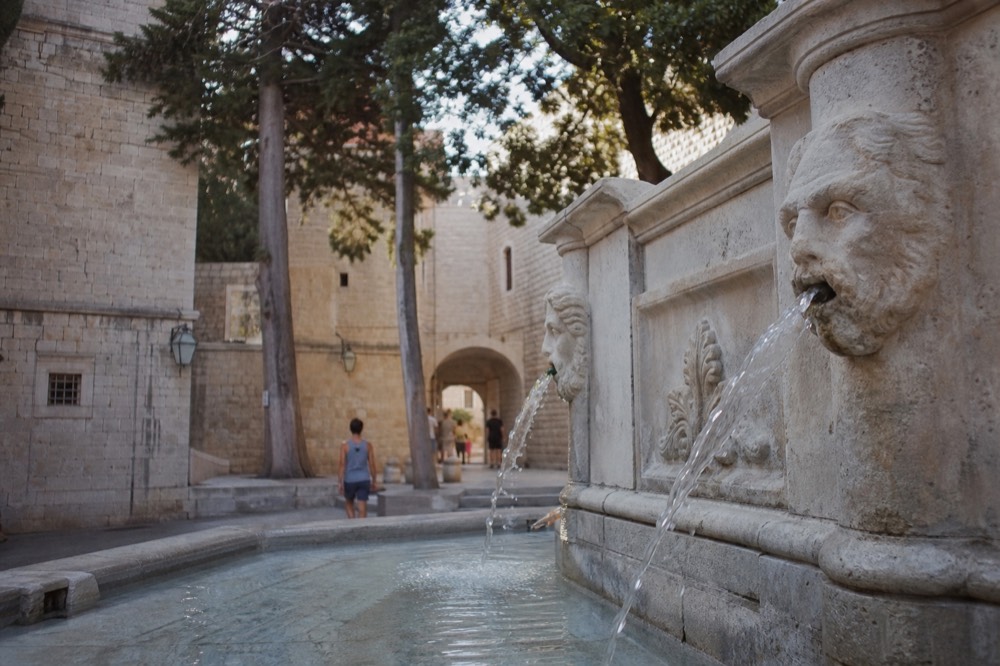
Walk through Pile Gate on any morning and the first thing you meet is noise: water tumbling from a ring of carved stone masks into a wide octagonal pool. That is the Onofrio Fountain, and in a city built almost entirely of pale limestone it is the one landmark that moves. Guides hand out headsets beside it, couples wait for photos beside it, and half the Old Town's daily foot traffic filters past it within a minute of entering the city. I have walked past this fountain more times than I can count, in every month of the year, and the pattern never changes: by mid-morning the steps around it are the busiest free seats in Dubrovnik.
What Is the Onofrio Fountain and Why Does It Matter?
The Onofrio Fountain is a large public fountain standing just inside Pile Gate at the western entrance to Dubrovnik's Old Town, built as the terminus of the aqueduct that once carried water into the walled city. It is one of the first landmarks every visitor sees, it is free to visit at any time, and its pool and carved spouts still run with water today, which is why it doubles as the city's most recognisable meeting point.
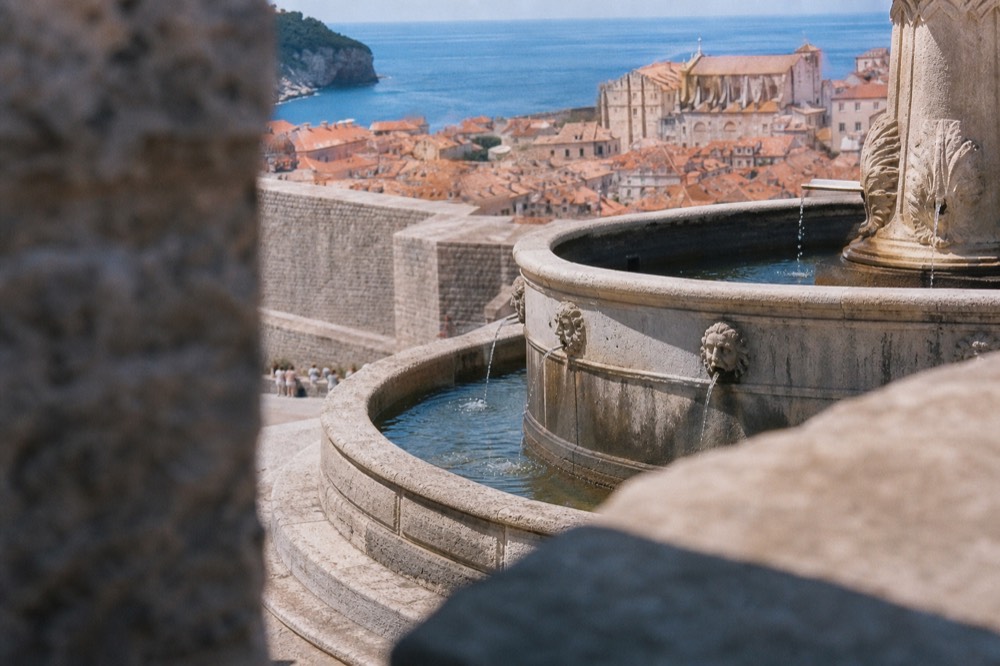
The fountain is the visible end of an engineering story. Dubrovnik's founders needed drinking water inside walls that could survive a siege, so water was brought from a spring outside the city and delivered here, to the spot closest to the main western gate. What you see now is a broad octagonal basin ringed by carved stone masks, each one spouting a stream into the pool. The structure took damage over the centuries, including a serious earthquake, so parts of what stands today are later repair rather than original stone, but the basin, the masks and the constant flow remain the point: this was drinking water delivered to the middle of a fortress city.
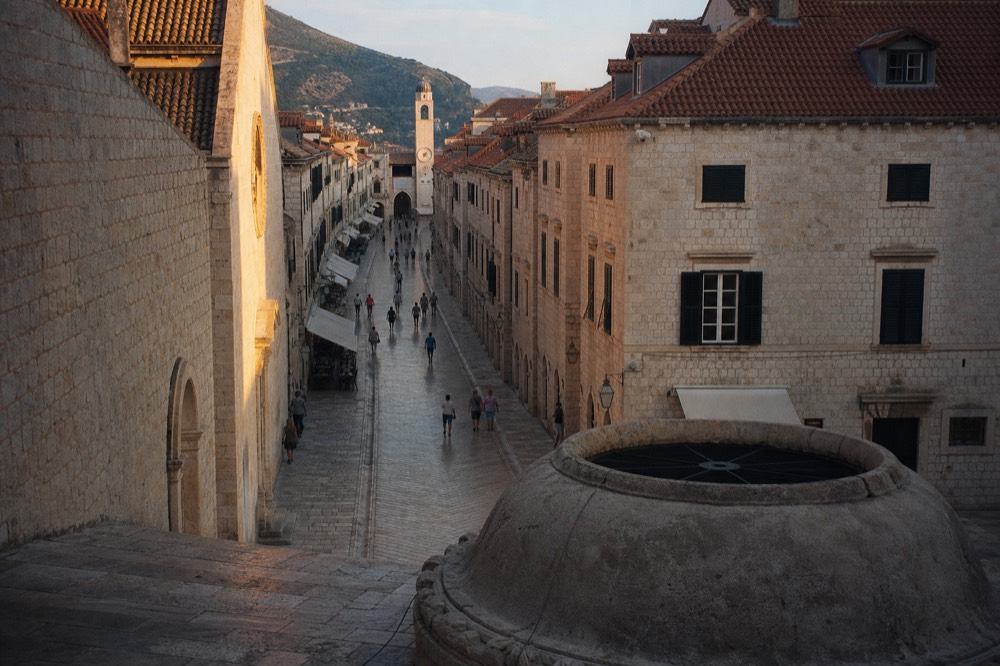
The location is the reason the fountain matters to a visitor in a practical sense. It sits at the top of the Stradun, the Old Town's main street, which the Dubrovnik Tourist Board records as 298 metres long, with its final plan fixed by the Statute of 1272. From the fountain you can see straight down that street to the bell tower at the far end, which makes it the single easiest landmark in the city to give directions from. That is precisely why guides use it. If you are meeting anyone in Dubrovnik, a tour group, a friend, a driver collecting you later, "at the fountain by Pile Gate" removes all ambiguity.
The whole Old Town around it is UNESCO World Heritage, inscribed in 1979 under criteria (i), (iii) and (iv), with a property area of 24.7 hectares inside the walls and a much larger buffer zone around them, per the UNESCO listing for the Old City of Dubrovnik. The fountain is one of the handful of structures that appears in almost every photograph of that heritage core.
Why Is Onofrio Fountain the Meeting Point for Every Walking Tour?
Almost every paid and free walking tour in Dubrovnik designates the Onofrio Fountain as its starting point because it is unmissable, next to Pile Gate, at the head of the Stradun, and impossible to confuse with anything else in the city. For visitors, that means the fountain is not just a photo stop: it is the logistics hub of an Old Town visit, and knowing what meets there, and when, is genuinely useful planning information.
The economics of the location are simple. Pile Gate is where the buses stop, where most hotels funnel their guests, and where the cruise shuttle drops people off, so a guide who starts at the fountain catches the maximum number of participants with the minimum number of missed pickups. The fountain is wide, there is standing room around the pool, and the sound of the water is loud enough that a guide with a headset system can brief a group there without blocking the street.
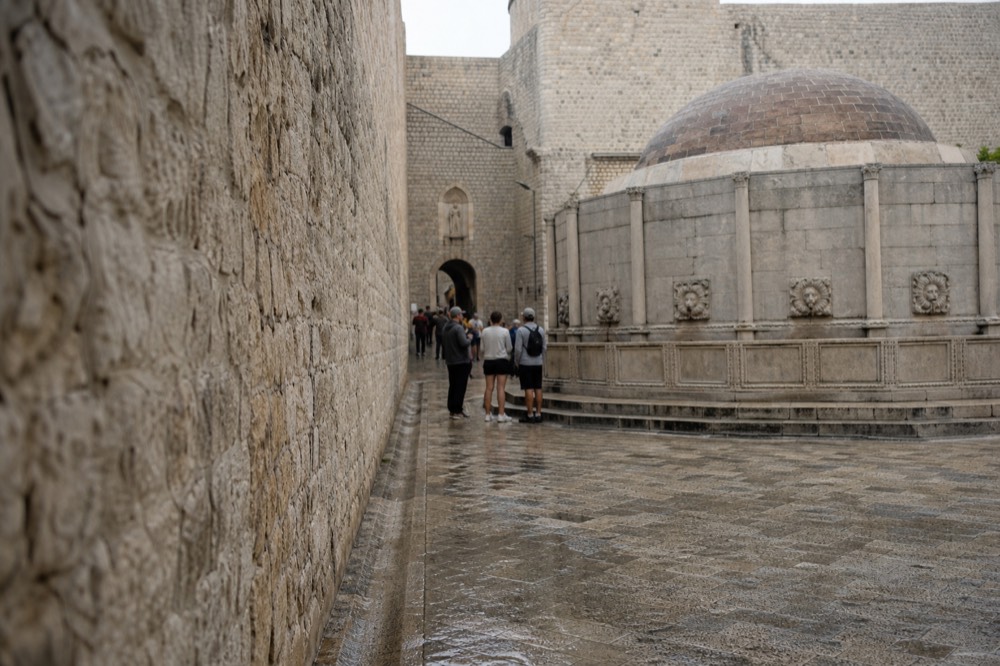
The roster of tours that gather at or near this spot is broad. The paid Old Town walks, the Game of Thrones walks, the history walks, and the free pay-what-you-want walks on GuruWalk all use the Pile Gate and fountain area as a gathering point, because the logic above applies to every operator equally. If you book a morning tour, expect the fountain to be ringed with small clusters of people wearing coloured stickers or holding receivers. If you are travelling independently and want the fountain to yourself, come before 08:30 or after 19:00, when the day's tours have either not started or already dispersed.
Here is how the main guided options that meet in this area compare, using the operators' own listed figures:
| Tour | Length | From (per person) | Rating |
|---|---|---|---|
| Old Town Walk, Local Guide | Old Town circuit | $20 | 4.8 across 5,826 reviews |
| 2-Hour City Walls Walk | 2 hours approx | $29.58 | 4.8 across 1,387 reviews |
| Old Town & Walls Combo Walk | 3 hours 30 minutes approx | $50.94 | 4.8 across 1,183 reviews |
| Free GoT & History Walk (GuruWalk) | 1 hour 30 minutes | Free, pay what you want | 4.74 across 444 reviews |
The three free walks on GuruWalk deserve a specific mention, because "free" here genuinely means free: you pay nothing up front and tip the guide what you think the walk was worth at the end. The Ancient Old City walk runs 1 hour 45 minutes and carries a 4.87 rating across 2,242 reviews, the Game of Thrones and history walk runs 1 hour 30 minutes, and the Magical Dubrovnik Nights legends walk covers the same streets after dark. All three are honest products, and all three gather in this fountain and Pile Gate area.
If a guided walk appeals, these three are the natural starting-from-the-fountain choices:
A walk with a local guide also solves the fountain's one drawback as a landmark: it tells you what you are looking at. The stone in front of you carries centuries of repair, the street beside it follows a plan fixed in the 13th century, and the gate behind you opens onto a moat and drawbridge arrangement that is part of a 1,940-metre wall circuit. A guide turns all of that from scenery into a story in about two hours.
Can Tourists Drink Tap Water in Dubrovnik?
Yes, the tap water in Dubrovnik is drinkable, and it comes from the same regional supply that has fed the city since the aqueduct era the fountain represents. The Onofrio Fountain itself is a historical monument rather than a designated modern drinking point, so fill bottles from taps and fountains marked as potable, but you do not need to buy bottled water for health reasons anywhere in the city.
The fountain is the honest place to have this conversation, because it exists precisely because water had to be brought into this walled city. The spring-fed supply that once ended in this pool was the difference between a city that could survive a siege and one that could not. Modern Dubrovnik is served by a treated municipal system, and the water from any normal tap, in a hotel, an apartment or a restaurant, is safe to drink. Locals drink it, restaurants serve it, and there is no practical reason to buy plastic bottles.
Two practical notes are worth having. First, in the hottest months, July and August, carry a bottle and refill it rather than buying drinks at Old Town kiosks, where prices climb with the temperature. Second, do not treat the Onofrio Fountain's pool itself as your refill station: it is a heritage monument, people sit on its rim, and the city provides drinking taps elsewhere. If you want the deeper answer on water safety, ice, and where the supply comes from, we cover it in can tourists drink tap water in Dubrovnik.
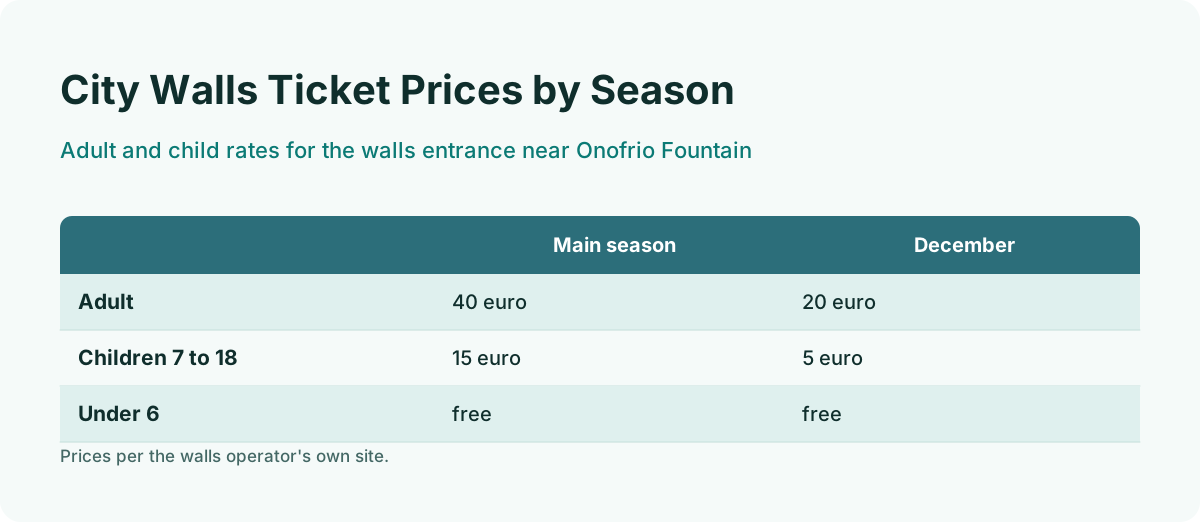
One related cost question comes up constantly beside the fountain, because the walls entrance is a two-minute walk away. The adult City Walls ticket is 40 euro in main season, 1 March to 30 November, and 20 euro in December, with children 7 to 18 at 15 euro then 5 euro, and under 6 free, per the walls operator's own site. That ticket is actually a combination covering the walls, Fort Lovrijenac, the Western Outer Wall and a coin collection. The one-day Dubrovnik Pass costs the same 40 euro in main season and adds roughly ten more sights plus a 24-hour bus ticket, which we break down in the Dubrovnik Pass guide.
| Product | Main season (1 Mar to 30 Nov) | December |
|---|---|---|
| City Walls adult (includes Lovrijenac) | 40 euro | 20 euro |
| City Walls child 7 to 18 | 15 euro | 5 euro |
| Child 6 and under | Free | Free |
| Dubrovnik Pass, one day | 40 euro | Not on sale |
| Dubrovnik Pass, three days | 50 euro | Not on sale |
| Dubrovnik Pass, seven days | 60 euro | Not on sale |
What Not to Do in Dubrovnik?
The main mistakes visitors make around the fountain and the Old Town are blocking the walking lanes for photos, climbing on the fountain's rim and walls, underestimating the limestone when it is wet, treating the fountain pool as a drinking tap, and arriving at the walls or the Stradun at midday expecting calm. None of these will ruin a trip, but all of them are avoidable, and avoiding them makes the city easier for everyone, including you.
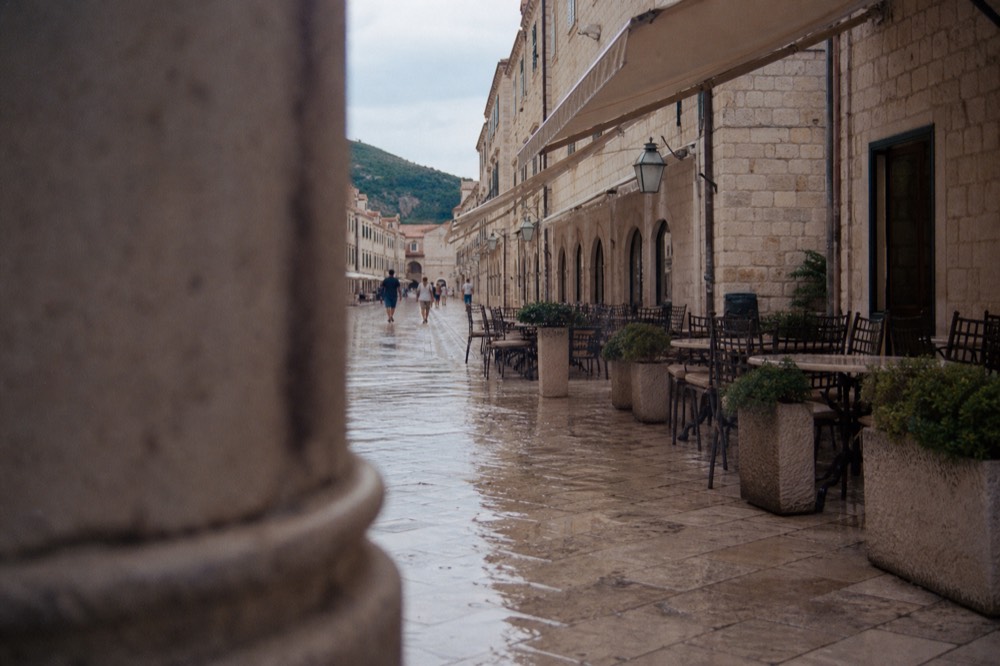
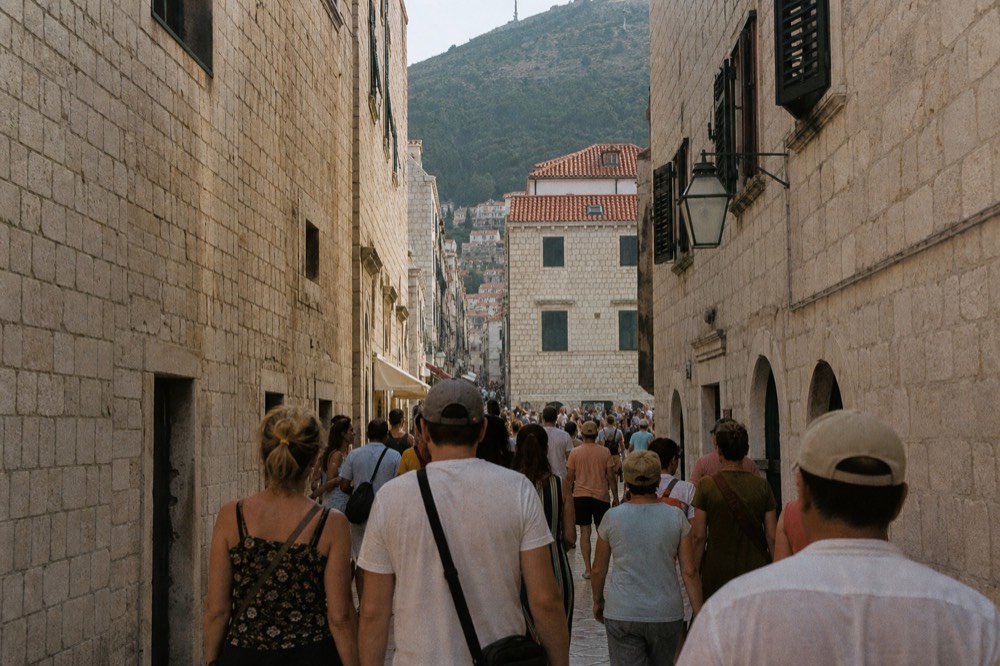
Start with the photo problem, because the fountain is its epicentre. The steps and rim around the pool are the default resting spot for hundreds of people a day, and the lane past it is the main pedestrian artery into the city. If you stop dead in the middle of that lane for a photo, you create a human traffic jam behind you within seconds. Step to the side, take the shot, and let the river of people flow. The same rule applies all the way down the Stradun: the middle of the street is a walking lane, the edges are for pausing. Other pages covering the same trip are gathered on Things to Do in Dubrovnik.
The fountain itself deserves a little respect as a monument. Sitting on the rim is normal and tolerated, but climbing onto the basin or the carved masks is not, and in high summer people who wade or splash in the pool draw immediate attention from city staff. Wet limestone is the other hazard worth naming twice: the Stradun and every alley off it are polished by centuries of feet, and after rain or morning washing they are genuinely slippery. Wear shoes with grip, not smooth-soled sandals, on your first day.
A few further don'ts, briefly. Don't buy a "discounted" walls ticket from anyone on the street; the only real tickets come from the operator's shop at the entrance. Don't plan to drive into the Old Town, because cars cannot enter it and the nearest parking fills early, a topic we cover in the parking guide. And don't leave the fountain area for a boat or tour without checking where your departure point actually is, because several docks sit a solid walk away in the Old City Port or Gruž.
If your instinct is that a guide would help you avoid exactly these mistakes while also explaining what you are looking at, the walls-focused walk is the one that pairs best with a fountain-area start:
When to Avoid Dubrovnik?
Avoid Dubrovnik's Old Town between roughly 10:00 and 16:00 on peak cruise days, and be aware that the busiest cruise months are September and October, not July and August. In 2025, September brought 101,246 cruise passengers and October 100,132, above July's 96,072 and August's 87,385, so the classic "avoid August" advice is, in this city, aimed at the wrong month.
That September and October peak is the single most useful crowd fact about Dubrovnik, and it comes from the Port Authority's own statistics rather than travel folklore. The full year 2025 saw 625,257 cruise passengers against 582,499 in 2024, and 461 cruise calls are scheduled for 2026. The Port Authority limits cruise passengers to 8,000 a day in most cases, and of 243 cruise days a year only 18 exceed that number, but those days concentrate hard around the fountain: everyone coming off a ship walks through Pile Gate past this spot.
The city also counts its own crowds. Six counters at every Old Town entrance update a headcount every 15 minutes, and the official carrying capacity from the UNESCO assessment is 11,275 people. On a real September morning the count read 1,200 at 04:00, 5,419 at 08:00, a 7,739 peak at 10:00, then 7,205 at 11:00. Read that curve as a schedule: the fountain area is calm before 09:00, saturated by 10:00, and eases again in late afternoon. The pattern holds for shoulder-season months too, which is why early morning and evening are the two windows locals actually use for a walk down the Stradun.
| Month 2025 | Cruise passengers | What it means at the fountain |
|---|---|---|
| July | 96,072 | Busy, hot, peak land tours |
| August | 87,385 | Hot and full, but fewer ships than autumn |
| September | 101,246 | The busiest cruise month of the year |
| October | 100,132 | Second busiest, milder air temperatures |
| November | 28,480 | Quiet streets, reduced boat schedules |
For the fuller picture on timing, including the sea temperature angle, see when to avoid Dubrovnik and the best time to visit guide. The short version: if your dates are flexible and you want the fountain and the Stradun to yourself, November through April trades warmth for space, and the walls ticket drops to 20 euro in December while the cable car closes entirely from January to March, per the cable car operator's timetable.
Is Dubrovnik Good for Beaches?
Dubrovnik is genuinely good for beaches, but they are not the wide sand expanses of some Mediterranean resorts: most are concrete platforms, pebble coves or rocky shelves, and the swimming season runs roughly from June into early October. The nearest swimmable spots sit a short walk or bus ride from the fountain, and the sea itself is the attraction, clear, clean and warm through late summer.
Start with the water. The long-run September average for this coast is about 23.6 degrees and August about 25.8, from a 1991 to 2020 open-water climatology, and sheltered bays run warmer than that: the Croatian met service's Dubrovnik buoy read 27.0 to 27.4 degrees on one September day against a 23.6 monthly mean. So the sea is comfortably swimmable in September and often into October, which pairs nicely with the fact that October is calmer on land than August in every way except cruise numbers.
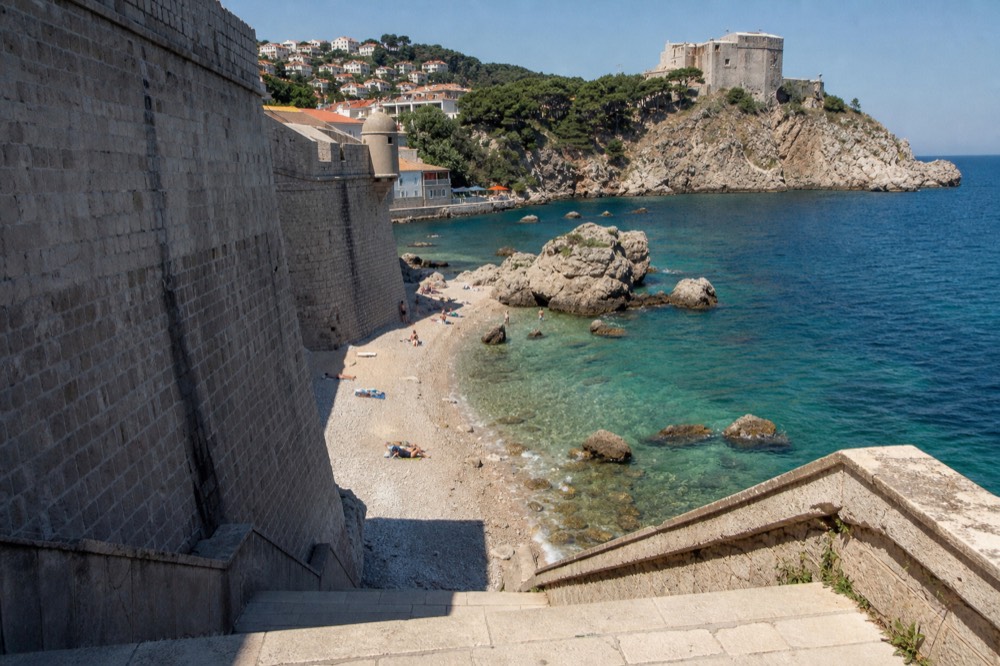
The beaches themselves cluster in a few areas. East of the Old Town, below the Ploče side, you have the famous Banje beach with its postcard view back over the walls, reached in roughly ten to fifteen minutes on foot from the fountain. West, the Lapad peninsula holds the biggest concentration of swimmable bays and hotel beaches, connected by bus from Pile in minutes. The nearest option of all, for a quick dip without leaving the historic setting, is the rocky shelf below the walls at Buža, where a bar cut into the fortifications lets you swim directly under the city's ramparts. We map all of these in the beaches guide.
| Month | Average sea temperature | Swimming verdict |
|---|---|---|
| June | 22.5 | Warm and pleasant |
| July | 24.9 | Peak swimming |
| August | 25.8 | Warmest month |
| September | 23.6 | Still very comfortable |
| October | 21.0 | Fine for most, cooling fast |
One warning that belongs beside the water: these are long-run open-water averages, not a beach forecast, and a windy day or a shaded cove will read differently. The practical takeaway is simply that a Dubrovnik trip in late September can honestly combine quiet streets in the morning, a swim at midday, and a walk past the fountain at dusk, which is a harder combination to pull off in August.
If you would rather see the coastline from the water than from a towel, the kayak option that leaves from the Old Town side is the natural pairing, and it starts a short walk from the fountain area:
How to Fit Onofrio Fountain Into a Day in Dubrovnik?
Plan the fountain as your anchor rather than a destination: start there at opening time, walk the walls first while the stone is cool and the queues short, come down to the Stradun as the crowds build, then move out to a beach or Lokrum for the middle of the day and return for the evening, when the Old Town empties and the fountain becomes a quiet place to sit.
A concrete shape for a first day looks like this. Be at Pile Gate by 08:00; the walls operator's stated hours at time of check run 08:00 to 19:30, and the morning light on the western sections is the best of the day. The circuit is 1,940 metres, up to 25 metres high, and takes most people a couple of hours with photo stops. Come down, refill your bottle, and let the Stradun carry you 298 metres east to the Sponza Palace, the Rector's Palace and the Old City Port, where the Lokrum boats leave at 09:00 and then every 15 minutes from 10:00 to 18:00, with the 30 euro Lokrum ticket covering both reserve entry and the return boat. Spend the hot hours on an island or a beach, then walk back in for dinner and an empty fountain at dusk.
The fountain works as a base for this shape because everything else is reachable from it on foot or by one bus, and because returning to it in the evening gives you the city at its best. The evening return is the part most visitors miss. After the day-trippers and cruise groups leave, the fountain area becomes one of the pleasantest free seats in the city, and the walk down the Stradun under the streetlights is a different experience from the midday scrum. If you have energy left, the free Magical Dubrovnik Nights walk on GuruWalk, rated 4.9 across 288 reviews, covers the legends of these same streets after dark, and it too gathers in this area. For a full framework rather than a single day, the one day itinerary and the how many days guide build outward from exactly this anchor point.

If you would rather have someone assemble the city's story for you on day one, the local-guide walk that meets here is the one I would point a first-timer toward, and it is the tour this page is built around:
A recent guest on that walk put the value of a guided start better than I can:
Alex was a fantastic guide, she explained the complex history of Dubrovnik to give a lasting impression of the history of the area. Really appreciated that she aimed for shaded areas on a boiling September day. The food recommendations for after were much appreciated too! Great tour for a first experience of the old town!
Sophie
For anyone weighing the guided options that all funnel through this same meeting point, these are the three that fit the fountain-first plan best:
Common Questions About the Onofrio Fountain in Dubrovnik
Can tourists drink tap water in Dubrovnik?
Yes. The municipal supply is safe to drink from any normal tap in hotels, apartments and restaurants, and locals drink it. Treat the Onofrio Fountain as a historical monument rather than a refill point, but you do not need bottled water for health reasons.
When to avoid Dubrovnik?
Avoid the Old Town between about 10:00 and 16:00 on peak cruise days, and note that September and October, not July and August, are the busiest cruise months: 101,246 and 100,132 cruise passengers respectively in 2025. Early morning and evening are calm in every season.
Is Dubrovnik good for beaches?
Yes, with a caveat: the beaches are pebble, concrete and rock rather than sand, but the water is clear and warm, averaging about 23.6 degrees in September and 25.8 in August as a long-run open-water figure. Banje, the Lapad bays and the Buža swimming spot below the walls are all close to the fountain.
What not to do in dubrovnik?
Do not stop in the middle of the walking lanes for photos, do not climb on the fountain or the walls, do not buy "discounted" walls tickets on the street, and take wet limestone seriously, it is genuinely slippery. Step aside, wear grippy shoes and buy tickets only from the operator's own shop.
Do walking tours really meet at the Onofrio Fountain?
Most do, or at a named point within a minute of it beside Pile Gate, because it is the one unmissable landmark every visitor can find. Paid Old Town walks, Game of Thrones walks and the free pay-what-you-want walks on GuruWalk all gather in this area, usually in the morning.
Does the Onofrio Fountain cost anything to visit?
No. The fountain is a free public landmark in the open street, visible at any hour with no ticket, no queue and no opening hours. Only the attractions around it, such as the 40 euro main-season City Walls ticket, carry a charge.