Sponza Palace Dubrovnik: What to See at Luža Square
Sponza Palace stands at the eastern end of the Stradun, at Luža square, and almost every walking tour in Dubrovnik passes its carved facade within the first ten minutes. Here is what the building is, what you see there, and how the name gets confused with a hotel on the other side of town.
Short answer
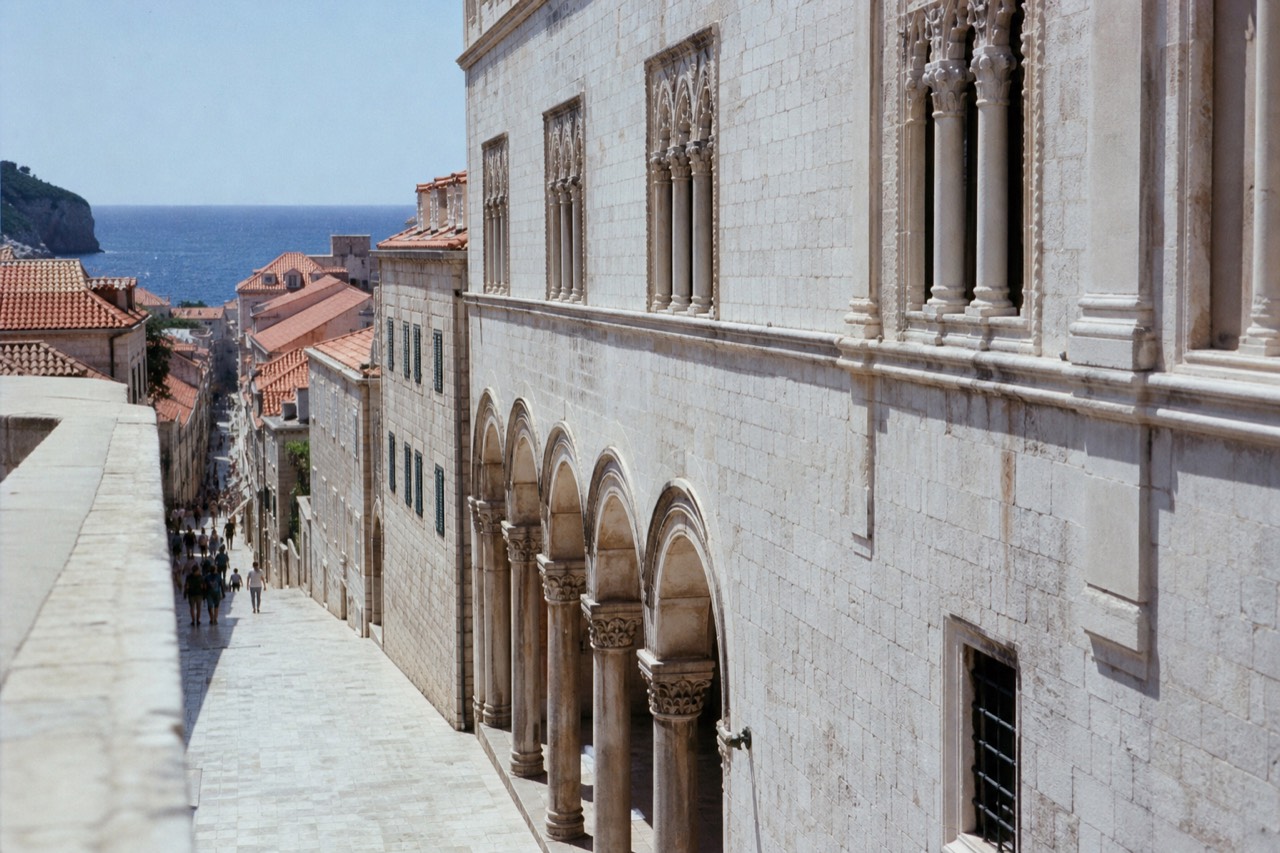
Sponza Palace is the ornate stone palace on Luža square at the eastern end of the Stradun, the 298-metre main street of Dubrovnik's Old Town. It is a landmark you see from outside on almost any walk. It is not a hotel: the Hotel Dubrovnik Palace is a separate property in Lapad, well outside the walls.
The first thing to understand about Sponza Palace is that it is a building you experience as part of a walk, not a destination you queue for. It stands on Luža square, where the Stradun, Dubrovnik's 298-metre main street, opens out at its eastern end, and its carved stone facade is one of the most photographed stretches of wall in the city. I have walked past it hundreds of times with visitors, and the reaction is always the same: people slow down without being told to.
This page answers the questions people actually type before a trip. What is the palace in Dubrovnik called? Is the Dubrovnik Palace a good hotel? What makes that hotel unique? And what should you avoid doing in the city once you get here? Along the way I will place Sponza in its setting, explain how it fits a one-day route, and point you to the walks and tickets that make the whole Old Town legible. If you are planning a wider trip, the Things to Do in Dubrovnik homepage gathers every guide on the site in one place.
What Is the Name of the Palace in Dubrovnik?
The palace you are almost certainly thinking of is Sponza Palace, on Luža square at the eastern end of the Stradun. Dubrovnik also has the Rector's Palace, the ceremonial seat of the old republic, a few steps away, and two fortresses, Minčeta inside the walls and Lovrijenac outside on its 37-metre sea rock. Each name belongs to a different building, and the mix-up is common.
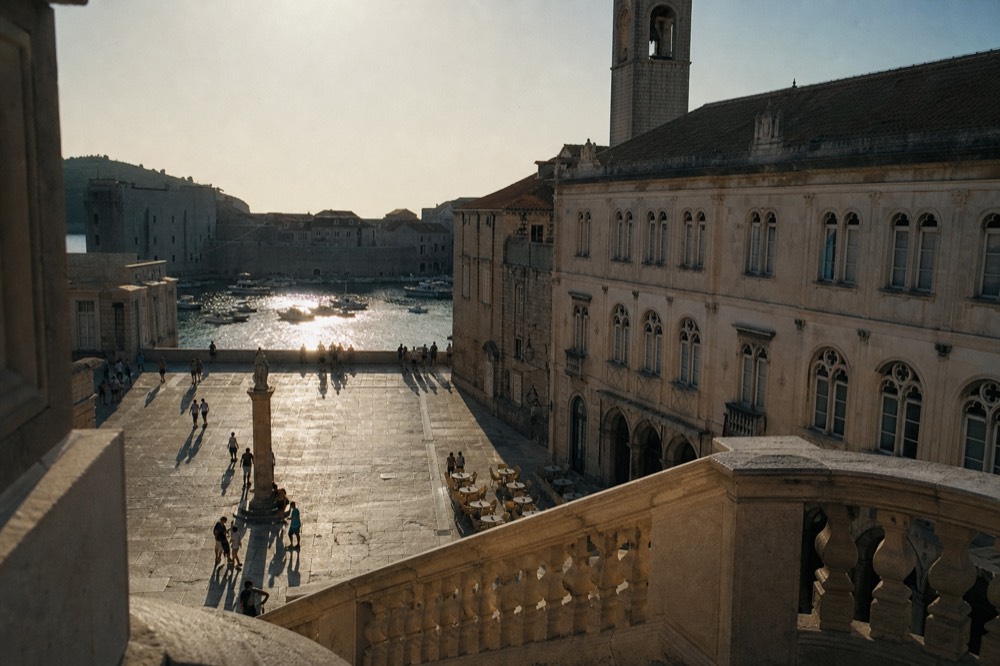
Sponza Palace is the one with the ground-floor arcade and the elaborate carved facade facing the open square. Luža is the natural crossroads of the Old Town: the Stradun ends here, the bell tower rises beside it, and the small side lanes toward the old port and the Dominican monastery all branch off within a few paces. Every guided walk in the city stops here, usually early, because from this one square you can explain the whole layout of the town in five minutes.
The Rector's Palace is the other building visitors often mean. It sits one block south of Luža and now works as a museum, and it is included in the Dubrovnik Pass alongside the walls. If your question was really "which palace do I go inside", the answer is the Rector's Palace; Sponza is primarily admired from the square and the courtyard, and it hosts exhibitions and cultural events rather than a permanent ticketed collection in the way its neighbour does. For the full picture of the street that links them, see the Stradun walking guide.
A note on names, because it trips people up in search bars: "Dubrovnik Palace" with no first name usually means the Hotel Dubrovnik Palace, a large resort hotel in the Lapad area, well outside the walled town. The palace on Luža is always Sponza. If you type "Dubrovnik Palace" into a map you will be sent to the hotel, and you will spend your first hour confused about which side of the city you are on. The Old Town, Lapad and the port area are covered in detail in the where to base yourself guide.
What Do You Actually See at Sponza Palace?
You see a Renaissance-style palace built around a columned atrium, with a ground-floor arcade, an ornate first-floor facade carved with relief work and inscriptions, and a small central courtyard that is usually free to glance into. There is no long ticketed circuit. Most visitors spend five to fifteen minutes here, longer if an exhibition is open, and it costs nothing to see the facade and the square.
The facade is the payoff. Stand back toward the bell tower and you get the full width of it: rows of tall windows, carved framing, and lettering cut into the stone above the arcade. In morning light, before the square fills, the detail reads best, and the marble-paved square in front of it is quiet enough to hear your own footsteps. By midday the same square is a thoroughfare, and by evening it is one of the loveliest lit-up corners of the city.
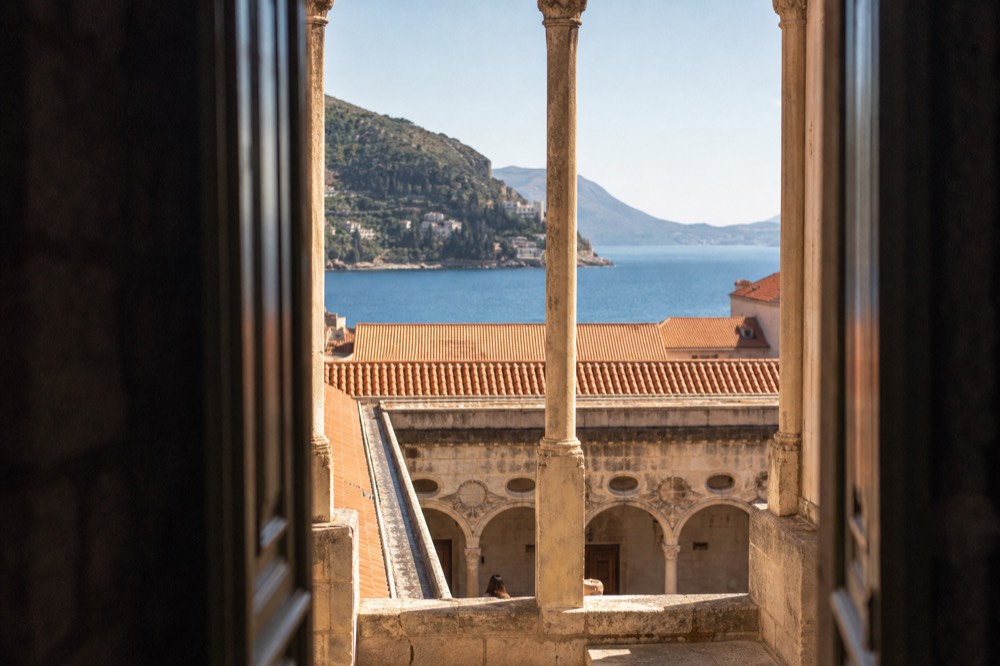
The courtyard is the second act. Step under the arcade and you find a small columned atrium, cool and shaded at the height of summer, with the sky open above it. This is the spot people remember, not the facade: a moment of stillness in a town that can feel relentless between 10:00 and 16:00. The building has served the city in several capacities across its life, and today it functions as a cultural venue, so what is open inside depends on what is running during your visit.
Because Sponza sits on every walking route, the cheapest way to get value from it is to arrive with a guide who can read the building for you. The Old Town Walk, Local Guide runs from $20 per person, is rated 4.8 across 5,826 reviews, and spends its first stretch exactly here, on Luža and the Stradun. If you would rather compare formats and prices before committing, this trio covers the three most useful ways to see the Old Town around Sponza.
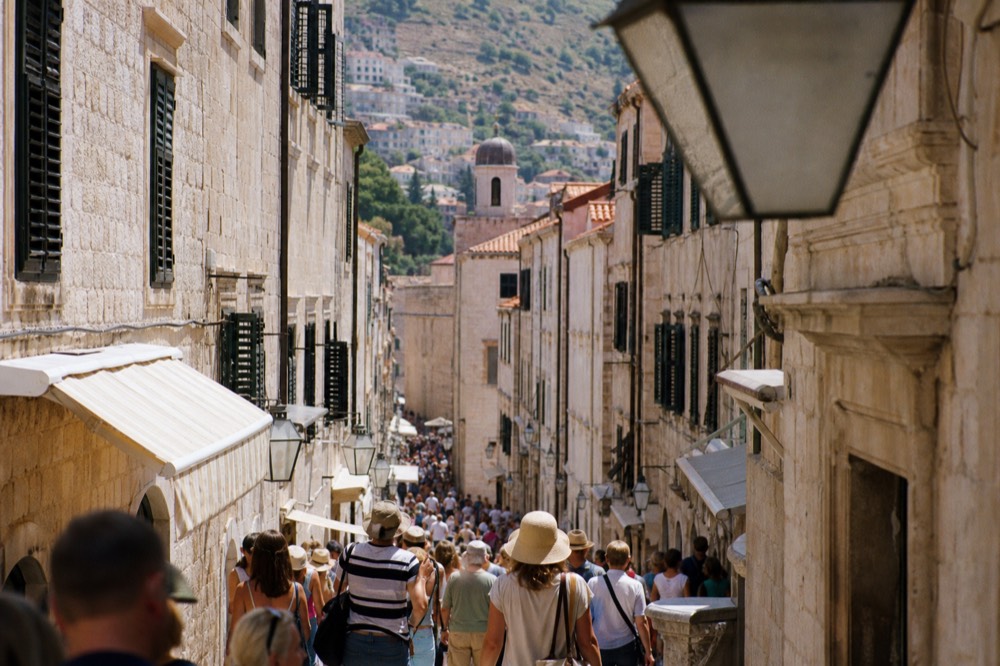
A guided walk is not the only sensible approach, but it is the one that turns Sponza from a pretty facade into a story. The alternative is a good audio guide and an hour of your own reading, which suits travellers who like to move at their own pace. What I would not do is walk the Stradun at peak crowd hours and try to appreciate the square then: the detail on the facade is genuinely hard to enjoy when you are being funnelled along with thousands of others.
Is Dubrovnik Palace a Good Hotel?
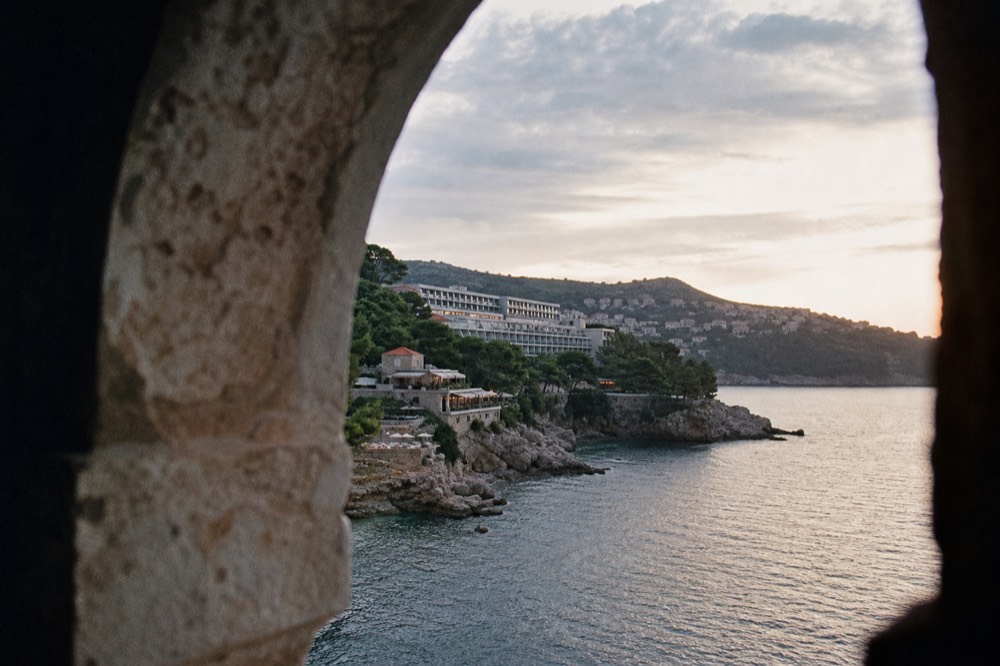
The Hotel Dubrovnik Palace is a large resort-style property in the Lapad area, outside the walled Old Town, and it is generally reviewed as a comfortable full-service base rather than a characterful Old Town stay. Whether it is a good choice depends on what you want: sea access and space, or stepping out of your door into the lanes around Sponza.
The key fact, before any review question, is geography. The hotel is not in the Old Town and not within sight of the walls. It sits toward the Lapad peninsula, the district most visitors reach by bus or taxi, where the bigger hotels cluster near the water. That makes it a different proposition from staying inside the walls, where rooms are smaller, older and more atmospheric, and everything from Sponza to the city walls is a walk of a few minutes.
For travellers who prioritise a pool, seafront terraces and hotel-scale breakfasts, that trade works well, and Lapad is the standard answer for it. For travellers whose whole point is the Old Town, waking up in Lapad means a bus or a 30-plus-minute walk each way, and in July and August that commute eats the coolest hours of the morning, which are exactly the hours the walls and Luža square are at their best. The Lapad area guide breaks the district down street by street.
I cannot review the hotel from personal experience, and I will not pretend otherwise; what I can tell you is what the question usually hides. Most people asking it are really choosing between an Old Town stay and a resort stay, and the honest framing is: do you want Dubrovnik as a town you live inside, or as a town you visit daily from a comfortable base? Both are legitimate. Families and summer swimmers lean Lapad; first-timers with two or three nights lean Old Town.
If you are comparing where to sleep, the site's hotel coverage is the right next stop. Hotel Komodor in Lapad is the budget reference point, rated 7.8 out of 10 across 822 reviews on the ten-point Expedia scale, with the number 6 bus to Pile Gate rather than a walk. Hotel Lapad is the mid-range option in the same district, and Hotel Lapad suits the resort-style stay most people mean when they ask about the Dubrovnik Palace.
What Makes Hotel Dubrovnik Palace Unique?
Its uniqueness is the combination: a resort-scale hotel with direct sea access and pool decks on one side, set in a city whose headline attraction is a walled medieval town you reach by a short bus ride. That pairing, full-service seaside comfort beside a UNESCO-listed Old Town, is what separates it from the small guesthouses inside the walls and from beach resorts in towns with no Old Town at all.
Put plainly, most Dubrovnik accommodation forces a choice. Inside the walls you get atmosphere and staircases and noise, and often a room the size of a wardrobe. In Lapad you get space, pools and parking, and a commute to the sights. A large seafront property resolves that tension for travellers who want the second lifestyle without giving up the first city, and that is the whole pitch. It is the same logic that makes Lapad the default answer for families, and the itinerary for families is built around it.
The other thing worth saying is what it is not. It is not the palace on Luža square, and no amount of searching under "Dubrovnik Palace" will get you a room inside Sponza. The building on Luža is a civic palace, a piece of the city's public fabric, not a hotel. If you arrived at this page hoping to sleep in a palace, the closest you will get inside the walls is a converted townhouse guesthouse, and even those are private conversions rather than palaces proper.
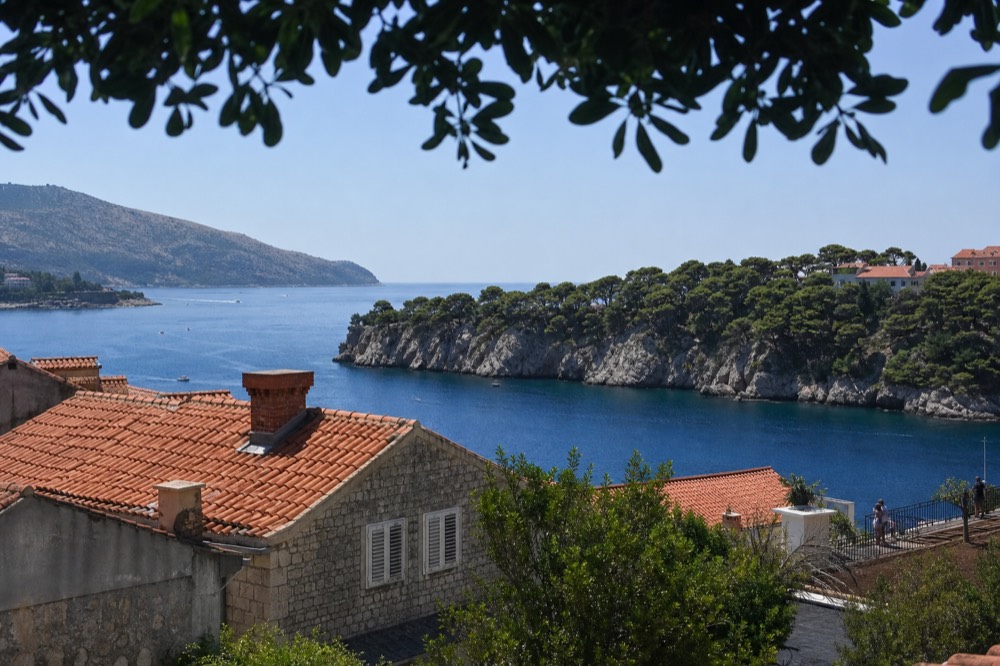
For swimmers, the location question has a data answer rather than a taste answer. The September average for this coast is about 23.6 degrees, from the NOAA long-run 1991 to 2020 series, and sheltered bays along the Lapad shoreline run warmer than that open-water average in high summer. That is why the resort-and-sea combination works best from June through September: the sea is genuinely warm, with the August average at 25.8 degrees. The swimming season guide carries the full monthly picture.
How Does Sponza Palace Fit Into a One-Day Route?
Start at Pile Gate, walk the Stradun east for its full 298 metres, and Sponza and Luža square arrive naturally at the far end, roughly ten minutes into your day. Do the walls either before the crowds build or late afternoon, and slot the Rector's Palace and the cathedral into the lanes just south of the square. Sponza is the hinge between the street and the sights.
The single most useful thing I can tell you about timing is that the Old Town has a measurable daily curve, and it is steep. Six counters at every Old Town entrance update a headcount every 15 minutes, and on a real September morning the count ran 1,200 at 04:00, 5,419 at 08:00, a 7,739 peak at 10:00, then 7,205 at 11:00. The official carrying capacity for the historic core is 11,275 people. In other words, the difference between 08:00 and 10:00 is not a feeling, it is thousands of people, and Luža square is where they all end up.
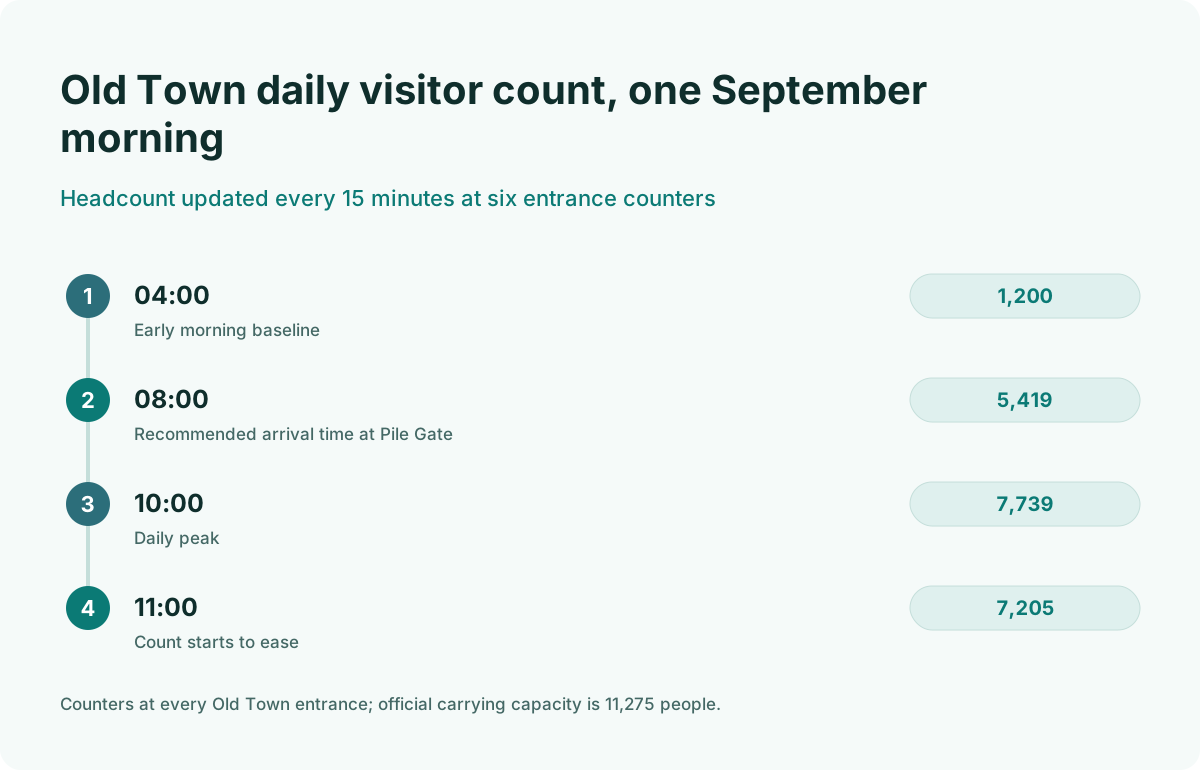
So the practical route is this. Be at Pile Gate by 08:00 if you can, and if the walls are on your list, do them first while the stone is still cool and the count is still climbing: the walls operator's stated hours are 08:00 to 19:30, and the first hour is the calmest. Come down off the walls mid-morning, walk the Stradun east, and let Sponza and Luža be your late-morning reward, when the square is busy but the shaded arcade and courtyard give you somewhere to breathe. The afternoon belongs to the lanes south of the square and the Rector's Palace, and the evening to the square again, lit up and emptied of day-trippers.
The walls ticket itself is worth understanding before you go, because it is not a simple single sight. The adult ticket is 40 euro in main season, 1 March to 30 November, and 20 euro in December, and it is actually a combination covering the walls plus Fort Lovrijenac, the Western Outer Wall and the coin collection. The city walls tickets guide works through every option, and the table below is the short version.
| Ticket | Main season, 1 Mar to 30 Nov | December |
|---|---|---|
| Adult, walls + Lovrijenac | 40 euro | 20 euro |
| Child 7 to 18 | 15 euro | 5 euro |
| Child under 6 | free | free |
| Lovrijenac bought alone | 15 euro | 15 euro |
If you are doing the walls on your own rather than with a guide, the admission-only ticket is the direct route, and it is the related pick for this page: from $36.37 per person, rated 3.6 across 249 reviews, with the low rating reflecting what it is, a ticket and not a tour. Pair it with a walk if you want the buildings explained.
One more planning piece: the Dubrovnik Pass. In main season the one-day pass costs the same 40 euro as the standalone walls ticket and adds ten more sights plus a 24-hour bus ticket, and every tier lists the walls and Lovrijenac as its first inclusion, with a one-time visit to each. In December no pass tier is on sale at all, so the equivalence is a main-season fact only. The full breakdown is in the Dubrovnik Pass guide.
| Pass | Price | Transport included |
|---|---|---|
| One day | 40 euro | 24-hour bus ticket |
| Three days | 50 euro | 72-hour bus ticket, suburban coupons |
| Seven days | 60 euro | 168-hour bus ticket, suburban coupons |
What Not to Do in Dubrovnik?
Do not walk the Stradun and Luža square between 10:00 and 16:00 in high season and expect to enjoy them, do not buy a walls ticket without knowing it is a combination, do not plan a hotel by the name alone, and do not assume July and August are the busiest cruise months: September and October carry more cruise passengers. Avoiding those four mistakes changes the whole trip.
The cruise point deserves the emphasis, because almost everyone gets it backwards. Port Authority data for 2025 shows cruise passengers peaked in September at 101,246 and October at 100,132, above July's 96,072 and August's 87,385. The full-year figure was 625,257, and 461 cruise calls are scheduled for 2026. The Port Authority limits cruise passengers to 8,000 a day in most cases, and of 243 cruise days a year only 18 exceed 8,000. So autumn is not the quiet shoulder season people imagine, and if you want calm, the best time to visit guide works through it month by month.
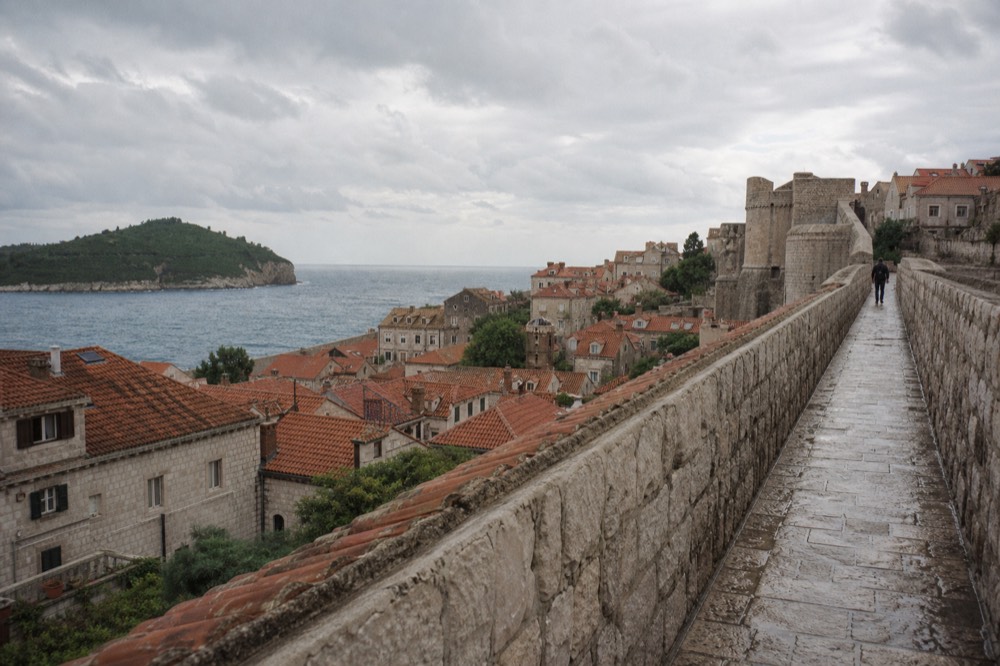
The second mistake is treating the walls as a quick add-on. The circuit is 1,940 metres long, up to 25 metres high, and there is almost no shade and a lot of staircase, in summer heat that is a real undertaking, not a stroll. Go early or late, carry water, and wear shoes with grip, because the polished stone is slick in places. The city walls guide covers the full circuit, and the walkability guide is honest about how much climbing this town involves for anyone with knee or mobility concerns.
The third mistake is eating and drinking on the Stradun itself. The square and the main street are where the rents are highest and the value lowest, and the lanes two or three streets north and south of Luža hold the better konobas at better prices. The restaurants guide and the cheap eats guide are the two to read before you book anything. And the fourth mistake, the one this page exists partly to prevent, is booking the Hotel Dubrovnik Palace when you meant to stay near the palace on Luža, or the reverse: check the map pin, not the name.
What Are the Best Tours That Pass Sponza Palace?
The best tours for this part of town are a guided Old Town walk from $20 per person, a two-hour city walls walk from $29.58 per person, and the combined Old Town and walls walk from $50.94 per person. All three pass Luža square within their first stretch, so Sponza comes free with whichever you choose.
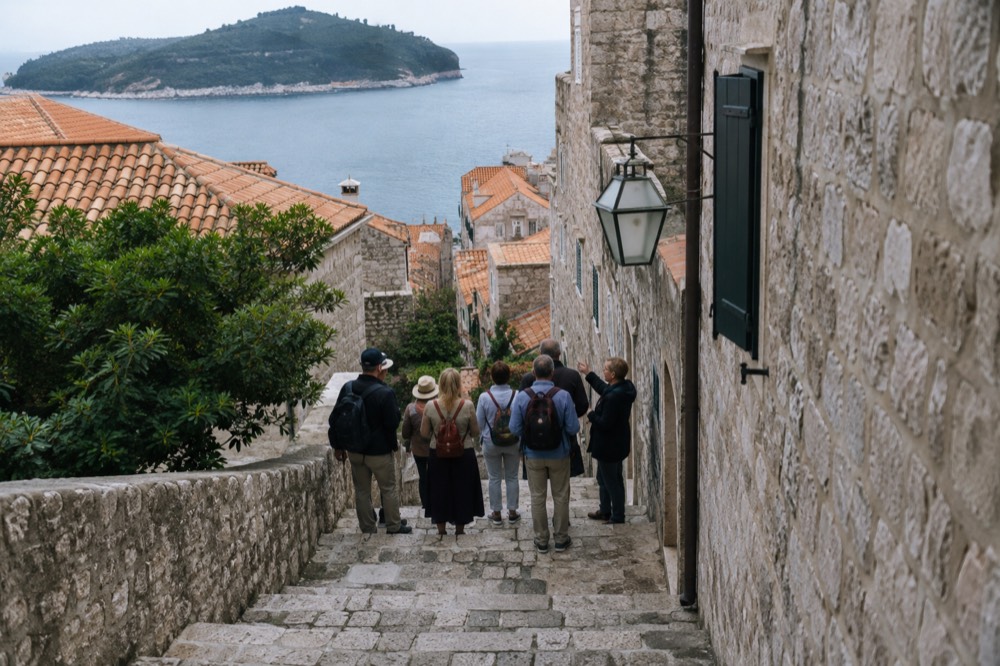
The Old Town walk with a local guide is the value pick: from $20 per person, rated 4.8 across 5,826 reviews, and it exists precisely to make buildings like Sponza mean something. One recent guest review captures what a good guide adds here: "Alex was a fantastic guide, she explained the complex history of Dubrovnik to give a lasting impression of the history of the area. Really appreciated that she aimed for shaded areas on a boiling September day. The food recommendations for after were much appreciated too! Great tour for a first experience of the old town!"
Alex was a fantastic guide, she explained the complex history of Dubrovnik to give a lasting impression of the history of the area. Really appreciated that she aimed for shaded areas on a boiling September day. The food recommendations for after were much appreciated too! Great tour for a first experience of the old town!
Sophie
For the walls themselves, the guided option is the 2-Hour City Walls Walk, from $29.58 per person and rated 4.8 across 1,387 reviews, run by Dubrovnik Walks. The combo version, Old Town and walls together over three and a half hours, from $50.94 per person, is the single most efficient way to cover both if you only have one full day.
| Tour | Length | From, per person | Rating |
|---|---|---|---|
| Old Town walk, local guide | about 1.5 hours | $20 | 4.8 across 5,826 reviews |
| 2-hour city walls walk | 2 hours | $29.58 | 4.8 across 1,387 reviews |
| Old Town and walls combo | 3.5 hours | $50.94 | 4.8 across 1,183 reviews |
| Walls admission only | 1 to 3 hours | $36.37 | 3.6 across 249 reviews |
If your time is short or your legs are not up to the walls, the convertible panorama bus is the third format worth knowing: from $34.77 per person, rated 4.6 across 796 reviews, with an audio guide, giving you the town and the views without the staircase. It does not replace the walk through Luža, but it suits a cruise day, and the cruise day itinerary is built around exactly that constraint.
When Is the Best Time to See Luža Square?
Early morning, before 09:00, is the calmest time on Luža square, when the headcount is still climbing rather than peaked, and evening after 20:00 is the most atmospheric, when the facade is lit and the day-trippers have gone. Midday is the worst trade: the largest crowds, the harshest light on the stone, and the least reward.
The counting system gives this advice teeth. On that real September curve, the Old Town held 5,419 people at 08:00 and peaked at 7,739 at 10:00, so the two hours from opening are worth more than any other two hours of your day. Photographers should note the light too: the facade faces the square broadly westward, so late afternoon gives warm side light on the carved stone, and the square's marble throws that light back up. The viewpoints guide ranks the whole city's angles if the photo matters to you.
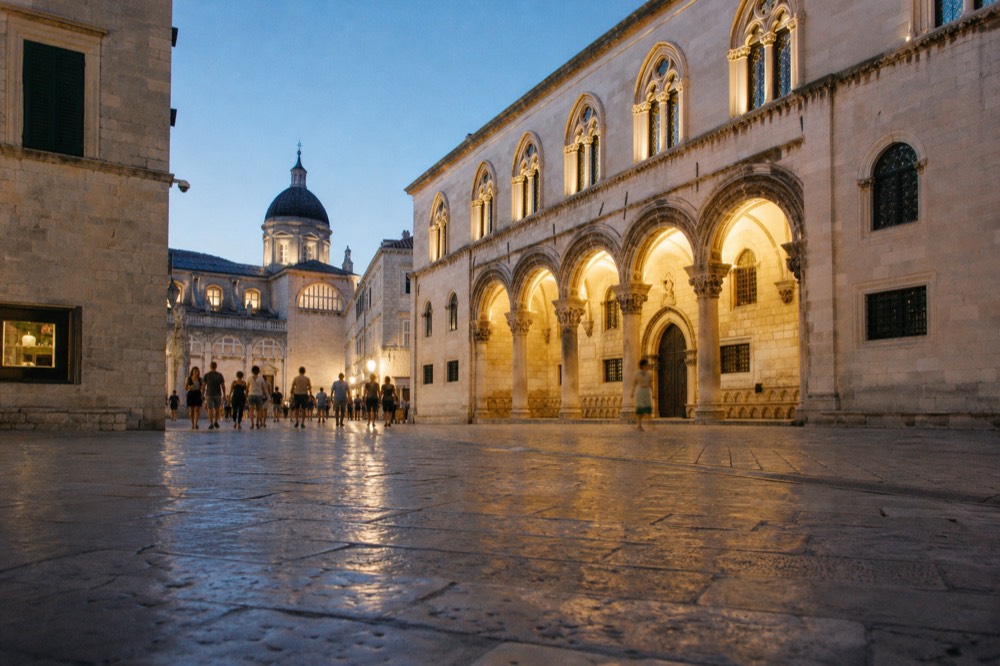
Evening is the underrated window. Once the excursion groups leave, Luža becomes a local square again, the bell tower is lit, and the bars in the lanes around it fill rather than the square itself. The sunset spots guide and the nightlife guide pick up the evening from there. If you are staying outside the walls in Lapad, remember the buses thin out late, so check your last connection before you settle into a long dinner.
Before the closing questions, here are the three formats that cover this whole page in one decision: the admission ticket if you want to walk the walls yourself, the guided walk if you want the buildings explained, and the panorama bus if the stairs are not for you.
Common Questions About Sponza Palace
What Is the Name of the Palace in Dubrovnik?
The palace on Luža square at the eastern end of the Stradun is Sponza Palace. The Rector's Palace, the old republic's ceremonial seat, stands a block south and is the ticketed museum. Fort Lovrijenac, on its 37-metre sea rock outside the walls, is the third building often called a palace by visitors.
Is Dubrovnik Palace a Good Hotel?
The Hotel Dubrovnik Palace is a large resort-style property in the Lapad area, outside the walled Old Town, generally suited to travellers who want pool and sea access with a bus ride to the sights. It is not in the Old Town and has nothing to do with Sponza Palace, so check the map pin before you book.
What Makes Hotel Dubrovnik Palace Unique?
Its combination of resort-scale comfort, direct sea access and pool decks with proximity, by a short bus ride, to a UNESCO-listed walled Old Town. Most Dubrovnik accommodation forces a choice between atmosphere inside the walls and space outside them; a large seafront property in Lapad resolves that trade for travellers who want both.
What Not to Do in Dubrovnik?
Do not walk the Stradun and Luža square at midday in high season, do not buy a walls ticket without knowing it is a walls plus Lovrijenac combination, do not book a hotel by name alone, and do not assume July and August are the peak cruise months: Port Authority data shows September and October carried more cruise passengers in 2025.
How Much Does It Cost to See Sponza Palace?
Seeing the facade and the square costs nothing, and the courtyard is usually open to glance into. The paid sights nearby are the city walls at 40 euro for an adult in main season, 1 March to 30 November, and 20 euro in December, and the Rector's Palace, which is included in the Dubrovnik Pass.
How Long Should I Spend at Sponza Palace?
Plan on five to fifteen minutes for the facade, arcade and courtyard, longer if an exhibition is open during your visit. Its value is as the hinge of a walking route: the Stradun ends here, the bell tower rises beside it, and every lane worth exploring branches off within a few paces.