What Adapter Do I Need for Dubrovnik?
Croatia runs on the standard European mains system with Type C and Type F sockets, so most travellers need a simple two-round-pin adapter for Dubrovnik. Here is what to pack, what to buy in town, and how many days to plan.
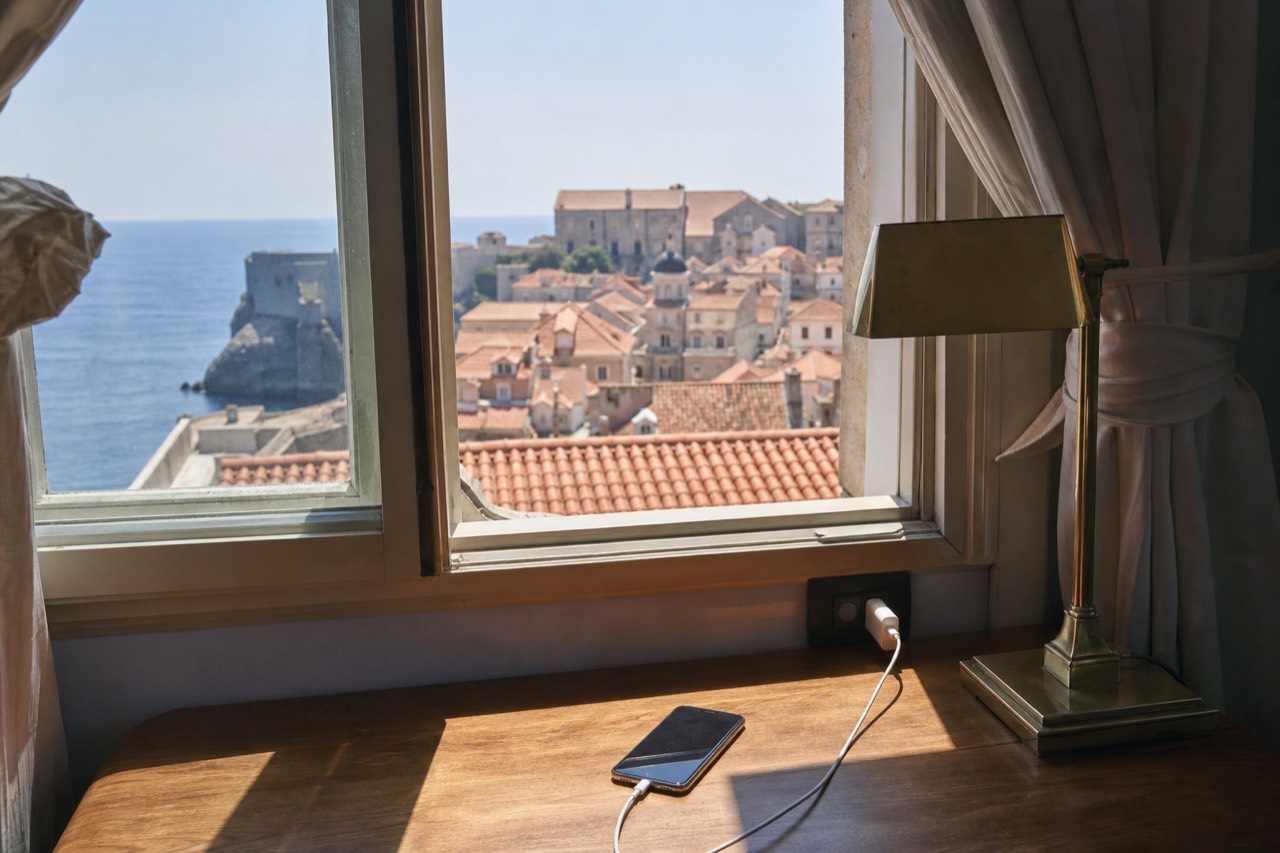
What Adapter Do I Need for Dubrovnik?
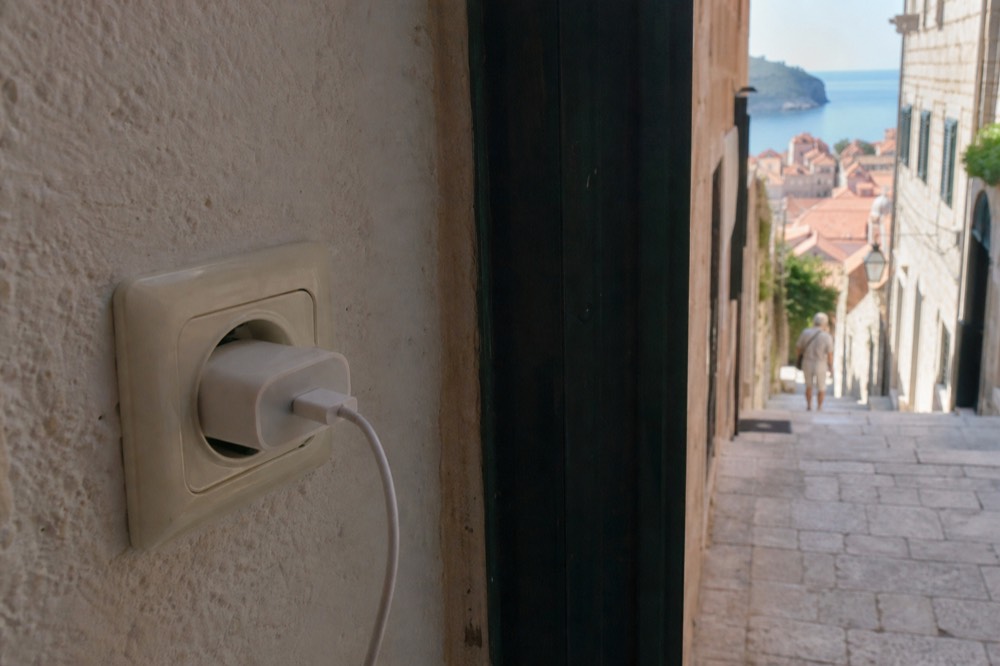
You need a Type C or Type F adapter, the standard two-round-pin plug used across most of continental Europe. Croatia uses the European mains system, and Dubrovnik's wall sockets accept both the Type C plug, with two round pins, and the Type F plug, which adds two earth clips on the side. Travellers from the UK, the US, Canada, Australia and much of Asia all need one, and a single basic adapter covers every socket in the city.
That is the whole answer for most people, but the details matter more than you might expect, because the adapter question and the voltage question are two different questions. An adapter changes the shape of the plug so it physically fits the socket. It does nothing to the electricity itself. A converter changes the voltage. Confuse the two and you can end up with a hair dryer that glows, dies, or trips the breaker in your apartment at eleven at night, which is a memorable way to meet your host.
The good news is that almost everything people actually travel with in 2026 is dual voltage. Phone chargers, laptop power bricks, camera battery chargers, e-reader cables, electric toothbrushes and shavers from any major brand are built to accept mains electricity anywhere in the world, and the small print on the plug itself says so. Look for a label on the body of the charger listing an input range that spans both the American and European mains voltages. If it is there, a two-euro adapter is all you need. If the label lists only one voltage, you have a single-voltage device and the picture changes.
Where you are coming from determines what you pack:
| Coming from | Plug at home | What you need for Dubrovnik |
|---|---|---|
| United States, Canada, Mexico, Japan | Flat pins, Type A/B | Type C/F adapter; check device voltage |
| United Kingdom, Ireland, Malta | Three flat pins, Type G | Type C/F adapter; most UK devices are dual voltage |
| Australia, New Zealand, China | Angled pins, Type I | Type C/F adapter; check device voltage |
| Germany, France, Italy, Spain, Netherlands | Round pins, Type C/F/E | Usually nothing at all |
| India, South Africa | Three round pins, Type D/M | Type C/F adapter |
One practical note from someone who has watched a lot of travellers fumble at the Pile Gate taxi rank: bring two adapters, not one. They get left in wall sockets, dropped behind hotel beds, and lent to the friend who forgot theirs. A basic multi-pack costs less than a single coffee on the Stradun, which runs 298 metres from Pile Gate to the clock tower and is lined end to end with places happy to sell you that coffee at Old Town prices.
Since you are already thinking about the practical side of the trip, the sightseeing side deserves a little planning too. These are the three products that solve the most common first-day questions in Dubrovnik, the walls ticket, the combined walk, and the bundle that adds the cable car and museums:
Do You Need a Voltage Converter as Well as an Adapter?
Most travellers do not. Any dual-voltage device, which includes nearly every phone, laptop, tablet and camera charger sold in the last decade, needs only the plug adapter. Single-voltage appliances, typically American hair dryers, curling irons and straighteners built for the lower US mains voltage, need a voltage converter or, far better, a dual-voltage travel version bought before the trip.
The distinction is worth a minute of your packing time. Plug an American hair dryer into a Dubrovnik socket with only an adapter and it receives close to double the voltage it was built for. Sometimes it simply burns out. Sometimes it takes the room's power with it. Hotels deal with this so often that many have stopped allowing guest hair dryers from overseas altogether and provide their own, so check before you pack a converter that weighs half a kilogram.
Here is the honest checklist I would run before any trip to Croatia:
| Device | Usually dual voltage? | What to pack |
|---|---|---|
| Phone charger | Yes, almost always | Adapter only |
| Laptop power brick | Yes | Adapter only |
| Camera battery charger | Yes | Adapter only |
| Hair dryer or straightener | Often no, if bought in the US or Japan | Dual-voltage travel model, or use the hotel's |
| Electric shaver or toothbrush | Usually yes | Adapter only, check the base |
| CPAP machine | Most modern units yes | Adapter, plus a surge strip if the manual advises it |
A small caveat that saves arguments: "adapter" and "converter" are used interchangeably in airport shops, and the boxes rarely help. Read the specification, not the picture. A travel adapter that says "no voltage conversion" is exactly what you want for your electronics and exactly the wrong thing for a single-voltage appliance.
While we are on the subject of what to sort out before you arrive, the city walls are the one sight where a little advance planning genuinely pays off. The adult ticket is 40 euro in main season, 1 March to 30 November, and 20 euro in December, and the operator's stated hours run 08:00 to 19:30, per the walls operator's own site. If you would rather have the whole story explained while you walk, there is a guided option that covers both the Old Town and the walls in a single morning.
Where Can You Buy a Plug Adapter in Dubrovnik?
You can buy a Type C/F adapter in Dubrovnik at larger supermarkets, electronics and mobile-phone shops in Gruž and Lapad, and sometimes at hotel receptions, though prices in the Old Town run high. Most hotels and apartment hosts keep a box of forgotten adapters at the desk and will lend you one free if you simply ask, which is the first move I would make.
The geography matters here. The Old Town is a pedestrian zone with small shops oriented toward souvenir budgets, and a plug adapter bought within the walls can cost several times what the same item costs ten minutes away by bus. The Gruž end of town, around the market, the bus station and the cruise and ferry port, has the ordinary shops locals actually use, and that is where the fair prices are. Lapad's shopping streets sit in between.
If you arrive late and your phone is at four percent, the pragmatic order of operations is: ask reception first, walk to the nearest larger shop second, buy in the Old Town only as a last resort. And if you are staying in an apartment rather than a hotel, message your host before you fly. Croatian hosts are, in my experience of the local hospitality trade, unusually willing to meet a guest with a spare adapter, and many keep a drawer of them precisely because so many visitors ask.
How Many Days Do I Need to See Dubrovnik?
Three days is the right answer for most first-time visitors. Day one covers the Old Town and the city walls, day two adds the cable car or Mount Srđ viewpoint and a beach or swim stop, and day three takes a boat out to Lokrum or the Elaphiti islands. Two days works if you are disciplined, and one day means choosing between the walls and everything else.
The walls deserve a morning, not an afternoon slot squeezed between lunch and a nap. The circuit is 1,940 metres long, up to 25 metres high, and it is a genuine walk with stairs, sun and very little shade, so starting at 08:00 when the operator opens at 08:00 to 19:30 means cooler air and thinner crowds. By late morning in summer the stone radiates heat and the queue at the entrance stretches along the street.
Here is how the days map out in practice:
| Trip length | What you can realistically see | What you give up |
|---|---|---|
| 1 day | Old Town, the walls, one viewpoint, dinner on the Stradun | Islands, beaches, museums, any day trip |
| 2 days | All of the above plus the cable car and a swim | Lokrum, the Elaphiti islands, relaxed evenings |
| 3 days | Full city plus Lokrum or an Elaphiti cruise | Border-crossing day trips like Mostar or Kotor |
| 4 to 5 days | Everything plus one or two day trips | Very little, which is the point |
If your time is short and you want the walls explained rather than just walked, a ticket-only visit is the cheapest way in. The admission product starts from $36.37 per person and covers the circuit at your own pace, though its rating of 3.6 across 249 reviews reflects what it is: entry, not a tour, so the history is whatever you bring with you.
How Many Days Do You Need for Dubrovnik?
Plan on three days if you want the city at a human pace, two if your itinerary is tight. The honest breakdown is one day for the Old Town and walls, one for the water, whether that is a kayak, a beach or a boat, and one for height and distance, the cable car, Mount Srđ, or an island. Visitors who compress all of it into a single day leave having seen stone and crowds but none of the sea.
The reason the pacing advice splits into "days" rather than "sights" is geography. The Old Town is compact, 24.7 hectares inside the walls, inscribed by UNESCO in 1979, and you can cross it on foot in fifteen unhurried minutes. But everything that defines Dubrovnik beyond the postcard, the water at Betina Cave, the botanical gardens on Lokrum, the sunset from Srđ, eats half a day each, because each one involves getting to a boat, a cable car or a kayak launch and back.
For the first day, the product that solves the most problems at once is the combined Old Town and walls walk. It runs about 3 hours 30 minutes, costs from $50.94 per person, is rated 4.8 across 1,183 reviews, and is run by Dubrovnik Walks, a local operator. You get the streets, the stories and the walls circuit with a guide who knows which stretches have shade at which hour, which matters more than it sounds in a summer where the Croatian met service's own Dubrovnik buoy read 27.0 to 27.4 degrees on a single September day against a 23.6-degree September sea average.
There is a fuller treatment of trip length, including what a strict one-day plan looks like hour by hour, in our guide to how many days you need in Dubrovnik, and a first-visitor orientation in the Dubrovnik first-timers guide. Between those two pages you can build a plan for anything from a single overnight to a full week.
How Many Days in Dubrovnik Do You Need?
Cruise passengers and short-stay visitors need one focused day, land-based travellers need two to three, and anyone adding a day trip needs four. On a single day, walk the walls first thing, spend the afternoon in the Old Town's lanes, and ride the cable car for sunset, which costs 30 euro round trip for an adult. Do not try to add an island on a one-day visit, because the boats and the crowds do not fit together.
The timing of crowds inside the walls is now measured, not guessed. On a real September day the counters recorded 1,200 people in the Old Town at 04:00, 5,419 by 08:00, a peak of 7,739 at 10:00, and 7,205 at 11:00, against an official carrying capacity of 11,275. What that curve tells a short-stay visitor is simple: the early morning is a different city from the late morning, and the same streets you share with thousands at 11:00 are nearly yours at 08:00.
Cruise timing matters just as much. The Port Authority's own figures show passenger numbers peaked in September at 101,246 and October at 100,132 in 2025, both ahead of July at 96,072 and August at 87,385, with 461 cruise calls scheduled for 2026 and a daily limit of 8,000 cruise passengers in most cases. If your one day in Dubrovnik falls in early autumn, you have chosen a beautiful month, and a busy one.
For anyone with a spare day beyond the city, the official Dubrovnik Pass is worth a look before you commit: at 40 euro for one day, 50 for three days and 60 for seven, the one-day tier costs exactly the same as the standalone walls ticket in main season, 1 March to 30 November, and adds ten more sights plus the bus. In December the walls ticket drops to 20 euro and no pass tier is on sale, so the comparison only holds in the main season.
What Not to Do in Dubrovnik?
Do not walk the walls at midday in high summer, do not drive toward the Old Town, which is fully pedestrianised, do not buy adapters or essentials inside the walls at marked-up prices, do not plan a single day around both an island boat and the walls, and do not assume July and August are the busiest months, because September and October now carry more cruise passengers. Each of these mistakes costs either comfort, money or half a day.
The midday walls walk is the classic one. The circuit is beautiful at 08:00 and punishing at 13:00 in July and August, when the operator's own timetable logic and every local's advice converge on the same instruction: go early, carry water, and wear real shoes, because the stone steps are polished by centuries of feet and there is almost no shade on the seaward side.
Driving is the second. The Old Town has no cars at all, and the streets around Pile and Ploče choke quickly in season. Parking exists but fills early, and the money you save on a parking spot you often pay back three times in frustration. The bus network and your own feet cover everything a visitor needs, and the cable car's own timetable page shows why the ride up Mount Srđ beats any attempt to drive up for the view.
The shopping mistake is the one this article exists to prevent. An adapter bought inside the walls can cost more than a proper meal in Gruž, and the same goes for sunscreen, batteries and bottled water. Buy the boring essentials where locals buy them, and save your Old Town spending for the things that are actually worth it. That philosophy, applied to the whole trip, is what Things to Do in Dubrovnik is built around: real figures, primary sources and honest pacing, so you spend your days and your kuna-equivalent on what matters.
One last "not to do": do not leave the water out of your plan. The September sea average along this coast is about 23.6 degrees, a long-run open-water figure rather than a beach thermometer reading, and the swimming season stretches well past the school holidays. Travellers who treat Dubrovnik as a stone city only, and never touch the Adriatic, have seen half of it.
Before the practical questions, here are the three products that keep coming up for visitors working through a first plan:
Common Questions About Adapters and Trip Length in Dubrovnik
What adapter do I need for Dubrovnik?
A Type C or Type F adapter, the two-round-pin European standard. Croatia uses the European mains system, and sockets in Dubrovnik accept both types. Travellers from the UK, US, Canada, Australia and most of Asia need one; travellers from most of continental Europe need nothing at all.
Do UK Plugs Work in Dubrovnik?
No, UK three-pin Type G plugs do not fit Croatian sockets, so you need a Type C or Type F adapter. The good news is that most UK phone and laptop chargers are dual voltage, built for mains electricity anywhere in the world, so an adapter alone is enough and no converter is required.
how many days in dubrovnik do you need?
Two days for the core sights, three for a comfortable pace that includes the water. One focused day works for cruise passengers who start at the walls at 08:00. Four days or more lets you add a day trip to Mostar, Montenegro or the Elaphiti islands without rushing the city itself.
what not to do in dubrovnik?
Do not walk the walls at midday in high summer, do not drive toward the car-free Old Town, do not buy adapters or essentials inside the walls at marked-up prices, and do not assume July and August are the peak months, since September and October carried more cruise passengers in 2025.
Can I Charge My Phone With Just an Adapter in Croatia?
Yes. Phone chargers sold worldwide are almost universally dual voltage, built to accept mains electricity in any country, so a simple Type C or Type F adapter is all you need. Check the small print on the charger body for a dual-voltage input rating to confirm yours, and bring a second adapter as a spare.
Is a Voltage Converter Ever Needed in Dubrovnik?
Only for single-voltage appliances, most often American hair dryers, curling irons and straighteners built for the lower US mains voltage. Electronics like phones, laptops and camera chargers are dual voltage and need no converter. For hair tools, a dual-voltage travel model or the hotel's own dryer beats carrying a heavy converter.