What Time Do People Eat Dinner in Dubrovnik?
Dinner hours in Dubrovnik explained: when kitchens open, when locals actually sit down, where residents really eat, and whether a Dinner in the Sky style experience is worth your evening.
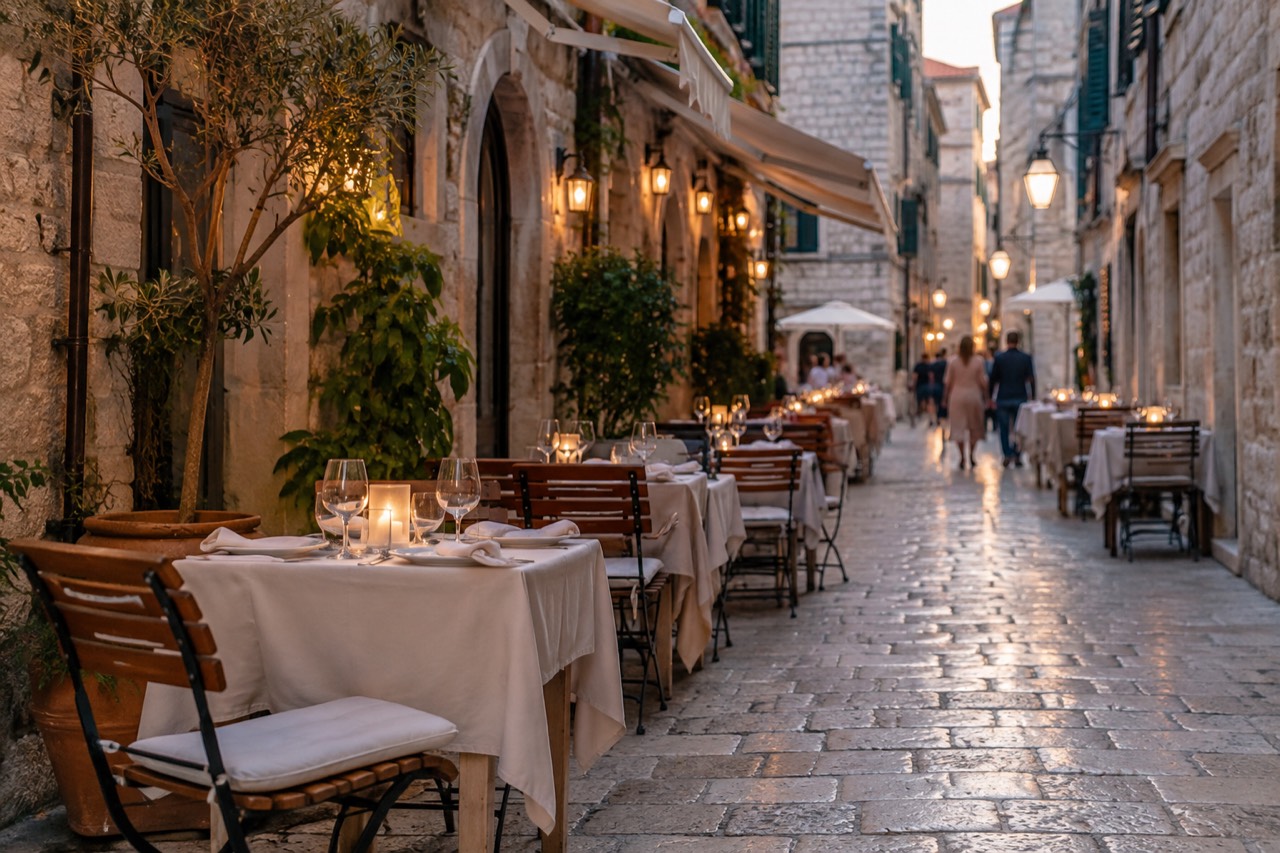
What Time Do People Eat Dinner in Dubrovnik?
Dinner in Dubrovnik runs late by northern European standards: most local tables fill somewhere between half past seven and half past nine in the evening, and family tables on weekends often sit down closer to nine. Restaurant kitchens in and around the Old Town generally serve continuously from midday deep into the evening during the season, so an early dinner is always possible, you will simply be sharing the room with other visitors rather than residents.
I have walked the Stradun at every hour of the evening for years, and the pattern never changes. At six the restaurants along the main street belong to day visitors finishing their sightseeing, many of them cruise passengers working against a ship departure. By eight the balance shifts. The tables turning over are increasingly overnight guests, people staying in the city who have showered off the walls and come down to eat. The genuinely local crowd, the people who live and work here year round, tends to appear last, often after a drink elsewhere first, and dinner stretches long because nobody is rushing anywhere.
The Stradun itself, all 298 metres of it, is the stage where this rhythm plays out most visibly, and the Dubrovnik Tourist Board's own page on Placa records how the Statute of 1272 fixed the plan of the city and its main street. Six centuries later the street still functions as the city's living room, which is exactly why the restaurants facing it skew tourist: they trade on the view, not on a loyal local clientele. Walk two streets in any direction and the character of the kitchens changes, prices soften and the language around you shifts back toward Croatian.
A few practical points follow from the timing. First, if you want a specific table at a specific konoba in July, August or September, book for eight or half past, because that is the slot everyone else wants too. Second, the late local dinner means kitchens keep cooking late: a kitchen that stops taking orders at nine is the exception here, not the rule, in season. Third, and this is the one that surprises people, September is not a quiet shoulder month. Port Authority figures show cruise passengers in 2025 peaked in September at 101,246 and October at 100,132, above July's 96,072 and August's 87,385, so the early-evening tourist wave you are dining around in September is as heavy as midsummer's.
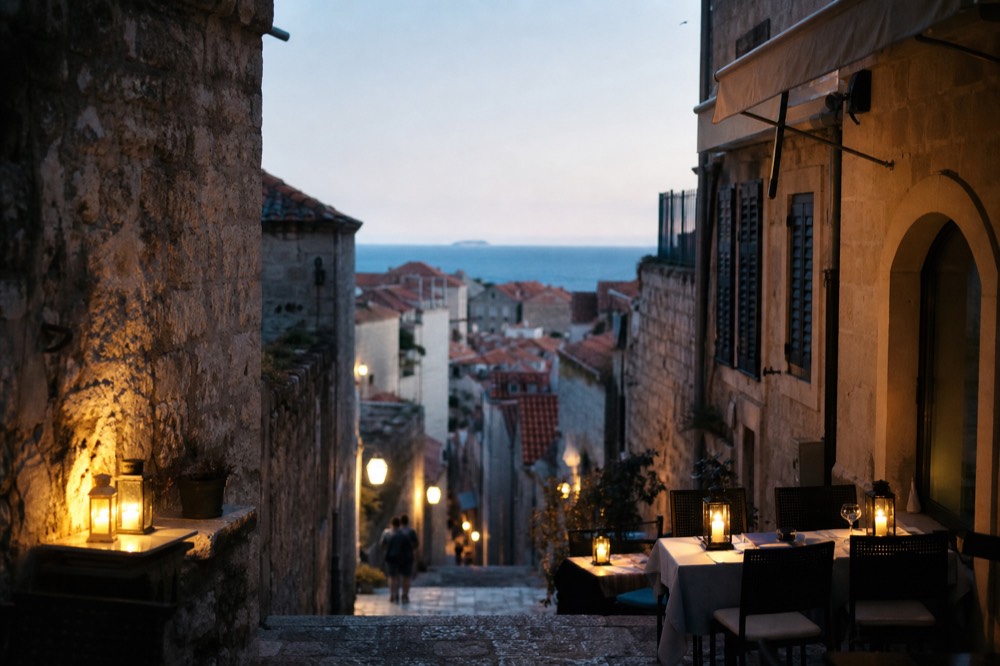
For visitors who want the evening to be about food rather than just timing, a guided food walk is the most efficient way to hit several kitchens in one night, and the best-reviewed option on the roster is the three-hour Dubrovnik Food and Drink Walking Tour with a Local Guide, from $165.64 per person and rated 5 across 704 reviews. It is not a cheap evening, but it bundles tastings, wine and orientation into one sitting, which matters on a first night.
If a full evening of eating your way through the city sounds like too much commitment, these three bookable options cover the food-and-wine angle at different price points and formats:
The trio spans a full-day shellfish and wine expedition to Ston, a hands-on peka cooking lesson, and a plain city walls admission ticket for travellers whose real priority is sightseeing with a good dinner found independently afterwards. The walls ticket, from $36.37 per person, is the budget anchor of the set, though note its rating sits at 3.6 across 249 reviews, which reflects what a self-guided ticket can and cannot offer compared with a guided walk.
One more timing note worth internalising: the whole city runs on a southern Dalmatian clock, so lunch is a real meal here too, often the main one for people working in hospitality. Do not be surprised to see restaurant staff eating their own dinner close to midnight after the last covers leave. That is not a curiosity, it is just the local week.
To make the evening rhythm concrete, here is how the dining hours typically break down across the day in high season. Treat it as a planning guide rather than a promise from any single restaurant, since individual kitchens set their own last-order times.
| Time of evening | Who is at the tables | What it means for you |
|---|---|---|
| 17:00 to 18:30 | Day visitors and cruise passengers | Easiest walk-in seating, thinnest local presence |
| 18:30 to 20:00 | Overnight guests, mixed crowd | Good balance of availability and atmosphere |
| 20:00 to 21:30 | Locals begin arriving, peak demand | Book ahead, this is the prime local slot |
| 21:30 onward | Local families and hospitality staff | Late kitchens still serving, unhurried pace |
How you plan around that table depends on which month you are visiting. In July and August, the prime local slot between 20:00 and 21:30 carries the heaviest demand, and the Port Authority numbers explain why: 96,072 cruise passengers arrived in July and 87,385 in August, most of them eating early before ships depart, which is exactly why the 17:00 to 18:30 window feels so visitor-heavy then. September needs the same planning discipline, since its 101,246 cruise passengers actually top the midsummer figures. October, at 100,132, is barely quieter, so the shoulder-season traveller who assumes an easy walk-in table at eight is making the same mistake the August traveller would.
The table also suggests a useful compromise for anyone who wants a taste of the local evening without staying out past eleven. The 18:30 to 20:00 stretch offers the best balance of availability and atmosphere, when overnight guests and the first mixed crowds share the room and kitchens are running at full tilt without the peak-demand crunch. Arrive at half past six or a quarter to seven, take your time over the meal, and you will have eaten well and still be back at your accommodation before the local families have even sat down. If you would rather see the late scene for yourself, pick a konoba two streets off the Stradun, where prices soften and Croatian is the language around you, and settle in; the unhurried pace after 21:30 is the whole point.
What Time Do People Eat Dinner in Split, Croatia?
Split keeps broadly the same late Dalmatian dinner rhythm as Dubrovnik, with most residents eating between eight and half past nine in the evening. The practical difference for a visitor is the setting: Split's dining heart around the Diocletian's Palace cellars and the Riva is a genuinely mixed local-and-visitor space, so the evening crowd feels less sharply divided into tourists-early and locals-late than Dubrovnik's Old Town does.
Both cities share the same cultural baseline, and it runs down the whole coast: a late afternoon swim or coffee, a drink at sunset, then dinner well after eight. Split, being a much larger working city, layers that rhythm onto a student and resident population that eats out year round, not only in season, so its konobas and wine bars have a steadier local base through the winter months in a way Dubrovnik's walled core, which empties dramatically once the season ends, cannot match. If your Croatia trip includes both cities, do not adjust your watch between them, adjust your expectations of who will be at the next table.
The contrast matters for planning. In Dubrovnik, the sheer weight of visitors, the city recorded about 4.2 million overnight stays in 2025 and shares first place among Croatian destinations with Rovinj, per the Croatian Bureau of Statistics, means the early dinner slot is functionally a tourist product. In Split you can eat at seven at a neighbourhood konoba in Veli Varoš and still be surrounded by Split families, because the residential fabric sits immediately against the old centre rather than being priced out of it. The timing advice is identical; the company differs.
For travellers building a food-focused itinerary across both cities, the honest summary is this: Dubrovnik rewards booking ahead and eating late, Split rewards wandering and eating wherever the terraces are full of Croatian. Neither rewards the six o'clock dinner your hotel breakfast schedule might be nudging you toward. If you want a deeper comparison of the two cities as bases, our Dubrovnik vs Split comparison guide breaks down cost, crowds and day-trip logistics in detail.
A useful rule of thumb I give friends: when in doubt, push dinner thirty minutes later than feels natural. In Dalmatia the evening has barely started at eight, and kitchens are built for it. The only people eating at six are eating against the grain.
There is one seasonal wrinkle worth adding for anyone travelling outside high summer. In the off-season months, from November through March, the calculus shifts: fewer visitors means restaurants inside the walls close earlier and some shut entirely for a winter break, while the neighbourhood konobas in Gruž and Lapad keep their local hours regardless. A February dinner in Dubrovnik is therefore an even more local affair than a September one, with the tables around you almost entirely residents and the menus leaning on whatever the market and the sea are giving that week. The late-sitting habit does not change, only the number of restaurants still lit at ten.
Where Do Locals Eat in Dubrovnik?
Locals eat mostly outside the walled Old Town, in the neighbourhoods of Gruž, Lapad and the smaller konobas up the hillsides, where prices are lower and the menus are shorter and more seasonal. Inside the walls, a handful of long-standing establishments keep a resident clientele, but the majority of Old Town restaurants are oriented to visitors, so the real local food scene is a bus ride or a stiff walk away.
The geography is simple once you see it. Gruž, around the port and the market, is where the city's daily food economy actually happens; the morning market there supplies half the restaurants in town, and the konobas around it feed the people who work the boats and the stalls. Lapad has the densest concentration of neighbourhood restaurants within easy reach of the beaches. Above the city, on the slopes of Srđ and in the surrounding villages of the Dubrovnik hinterland, you find the grill houses and peka specialists that families drive to on Sundays, the places where a meal is a three-hour event and nobody asks for the bill until the last carafe is finished. Other pages covering the same trip are gathered on Things to Do in Dubrovnik.
This is also where the region's food identity lives. The Pelješac peninsula and Ston, an hour up the coast, produce the oysters and mussels that define the local shellfish culture, and the Konavle valley behind the airport supplies the wine. Our full guide to what to eat in Dubrovnik covers the dishes themselves, and the restaurant guide sorts the Old Town's options by budget, but the honest answer to "where do locals eat" is: rarely on the Stradun, often off it, and frequently outside the walls entirely. For a deeper dive into exactly this question, see our piece on where locals eat in Dubrovnik.
The most direct way to taste that hinterland food culture without renting a car is the Dubrovnik oyster, mussels and wine tasting tour in Ston, from $157 per person and rated 4.9 across 111 reviews. It takes you to the source: the shellfish beds of Ston, a lunch built around them, and the local wines poured alongside. It is a full-day commitment rather than a dinner substitution, but as an education in what Dalmatian food actually is, it does in one day what a week of Old Town restaurant roulette rarely manages.
For travellers who would rather cook than be cooked for, the same hinterland tradition is available in a hands-on format. Peka, the dish of meat or octopus slow-cooked under a domed metal lid in embers, is the region's ceremonial meal, the thing families make for hours on Sunday. The Croatian Traditional Cuisine: Peka Cooking Lesson runs about four hours from $159.83 per person and teaches the technique from scratch, which is the kind of souvenir that outlasts anything sold on the Stradun.
A word on timing again, because it loops back to the first question: the local places outside the walls keep local hours. A konoba in the hills may want notice for a peka, since it cannot be rushed, and the family tables around you will sit down at eight or later without exception. Book the day before, arrive hungry, and let the evening run long.
Is Dinner in the Sky in Dubrovnik Worth It?
There is no permanent Dinner in the Sky installation in Dubrovnik among the city's verified bookable experiences, so the question is really whether a novelty elevated-dining experience is worth chasing at all. The honest answer for most travellers is no: the memorable elevated dining here is the cable car summit on Mount Srđ, where a real restaurant sits at the top of a 367-metre ascent and the view range on a clear day is up to 60 km.
Dinner in the Sky, the crane-suspended dining format that tours various cities, occasionally appears in Croatian marketing conversations, but nothing in Dubrovnik's stable of 43 verified products matches it, and I would treat any pop-up claim with caution unless you can confirm the operator, the safety certification and the price in writing before paying a deposit. Novelty dining of that type lives or dies on logistics, and in a city whose old core is a UNESCO-protected site with strict rules about what can be built or suspended anywhere near it, the odds of a legitimate version operating over the walls themselves are effectively nil.
What Dubrovnik does have, legitimately, is altitude with dinner attached. The cable car from the lower terminal just outside the Old Town rises 367.0 metres over a 778.2-metre track in three and a half minutes to the station on Mount Srđ at 405.0 metres above sea level, per the operator's own technical page, and there is dining at the top. The 2026 round-trip adult fare is 30 euro, with children 4 to 12 at 8 euro round trip and under 4s free, and the timetable runs late in summer, until midnight in June, July and August and through 1 to 14 September, which makes a summit sunset dinner genuinely practical. If your question is really "is there a dinner with a spectacular view worth booking in Dubrovnik", the answer is the summit, not a crane.
For a different kind of memorable evening, one that trades altitude for tradition, the peka cooking lesson is the stronger spend. Four hours, from $159.83 per person, learning the region's slow-fire cooking method with your hands in it, beats a suspended table for food you will actually remember eating. It is also the more defensible answer to "what did you do in Dubrovnik" than a novelty whose main credential is height.
The pattern across all of this is consistent, and it is worth stating plainly: Dubrovnik's best food experiences are the ones rooted in something real, the shellfish of Ston, the peka of the hinterland, the summit restaurant on Srđ, the konobas of Gruž. The generic novelty formats that travel from city to city add nothing here that the city does not already do better on its own terms. Eat late, eat local, and if you want a view with dinner, take the cable car.
Common Questions About Dinner Times in Dubrovnik
What time do people eat dinner in Dubrovnik?
Most locals sit down to dinner between half past seven and half past nine in the evening, with family tables on weekends often closer to nine. Kitchens in and around the Old Town serve continuously from midday into the late evening in season, so early dinners are always available, just surrounded by other visitors rather than residents.
Do I need to book restaurants in Dubrovnik?
In July, August and September, yes, for any specific well-regarded table at eight or half past, which is the slot everyone wants. September in particular is as busy as midsummer for evening crowds, since cruise passengers peaked in September and October of 2025 ahead of July and August.
Where Do Locals Eat in Dubrovnik?
Mostly outside the walled Old Town: in Gruž around the port and market, in Lapad near the beaches, and at the grill houses and peka specialists in the hills and hinterland villages. A handful of Old Town establishments keep a resident clientele, but the majority of restaurants inside the walls cater primarily to visitors.
Is Dinner in the Sky in Dubrovnik Worth It?
There is no permanent Dinner in the Sky installation among Dubrovnik's verified bookable experiences. The worthwhile elevated dining is the restaurant at the top of the Mount Srđ cable car, a 367-metre ascent with a stated view range of up to 60 km on a clear day, running until midnight in high summer.
What Time Do People Eat Dinner in Split, Croatia?
Split keeps the same late Dalmatian rhythm as Dubrovnik, with most residents eating between eight and half past nine. Because Split's residential neighbourhoods sit directly against the old centre, its dining scene mixes locals and visitors more evenly than Dubrovnik's Old Town does.
What is the best food tour near Dubrovnik?
The Dubrovnik oyster, mussels and wine tasting tour in Ston, from $157 per person and rated 4.9 across 111 reviews, is the strongest food-focused option, combining a shellfish lunch with wine tastings at the source in Pelješac. In the city itself, the three-hour food and drink walking tour, from $165.64 and rated 5 across 704 reviews, covers several kitchens in one evening.