Dubrovnik Nightlife: Bars, Clubs and After-Dark Plans
Dubrovnik is not a party capital, but its nights are better than most visitors expect: lamplit lanes, cliffside bars, a nightclub inside a fortress and a sea that stays swimmable into autumn. Here is how to plan an evening that does not end at nine.
Short answer
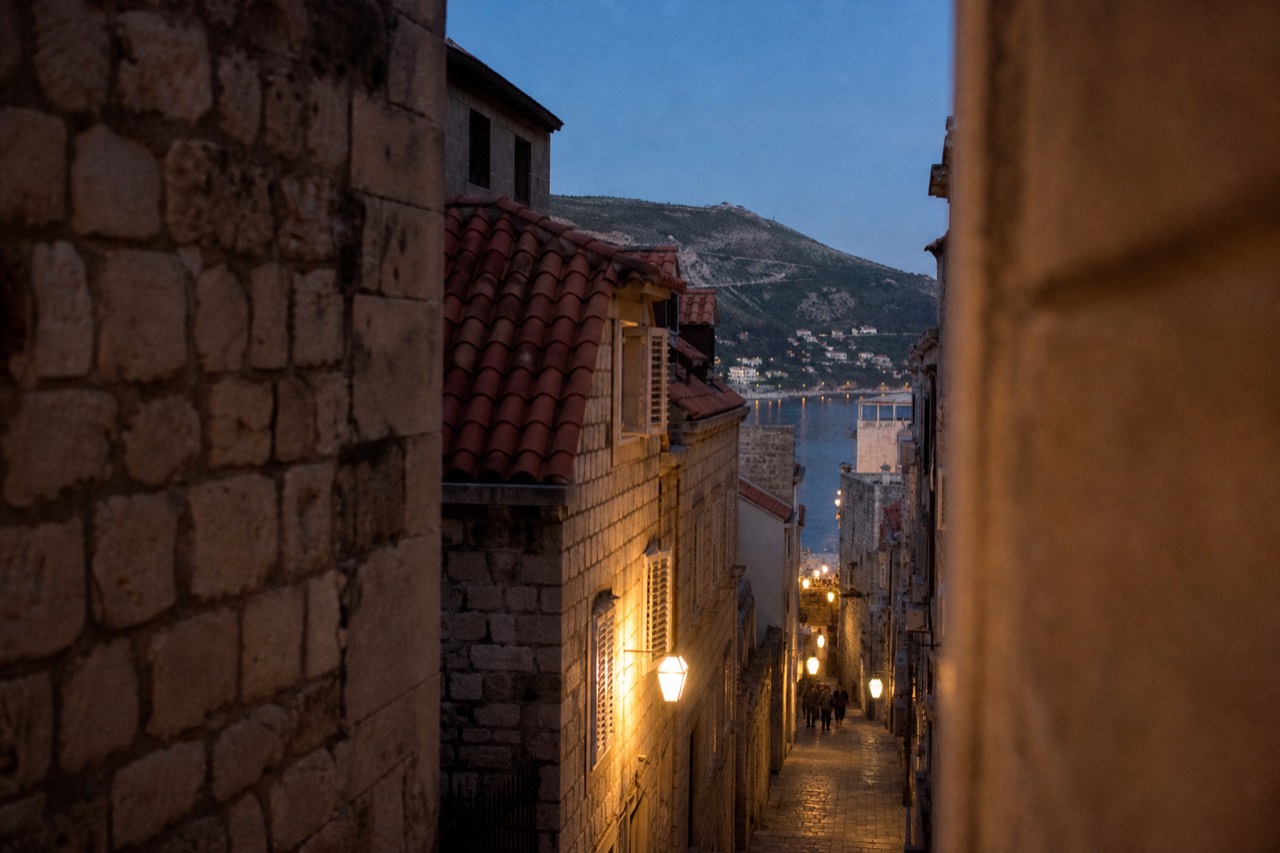
Dubrovnik nightlife is compact, scenic and early-leaning. Evenings centre on the Stradun and the side lanes off it, Buža Bar's cliff terrace, and Culture Club Revelin inside the Revelin Fortress. Most bars fill from around 21:00 and the club runs to the early hours in season. A sunset cruise or a free night history walk on GuruWalk rounds out the after-dark options.
Dubrovnik after dark is a strange and lovely thing. The day-trippers thin out, the stone of the Old Town gives back the heat it stored all afternoon, and the Stradun turns into a slow promenade of people who have nowhere particular to be. I have walked these streets at every hour for years, and the evenings are when the city feels most like itself.
That said, anyone arriving expecting a beach-party town will be disappointed. This is a small city of 41,562 residents at the 2021 census, carrying roughly 4.2 million overnight stays in 2025, and its nightlife is scaled accordingly: a handful of genuinely good bars, one famous nightclub in a fortress, live music in season, and a lot of long dinners that roll on past midnight. Done right, that is a better night out than a strip of clubs.
This guide covers what Dubrovnik nightlife actually is, where the evenings start, the best bars, the Split comparison people always ask about, the castle club, the after-dark activities beyond drinking, the best months for it, and what a night costs. There is also a cluster of evening products worth knowing about, from a free legends walk to two very different sunset cruises.
Is Dubrovnik Good for Nightlife?
Yes, for a certain kind of night. Dubrovnik nightlife is atmospheric rather than sprawling: a compact set of bars inside the walled Old Town and around Lapad Bay, live klapa singing and jazz in season, a world-famous nightclub inside a fortress, and terraces where you drink above the open sea. What it lacks is volume. There is no multi-block party district, and outside July, August and early September, weeknights quiet down early.
The honest framing is this: Dubrovnik is a beautiful-evening city, not a club-hopping city. The Old Town is a UNESCO World Heritage site, inscribed in 1979, covering just 24.7 hectares, so the entire nightlife district is a ten-minute walk end to end. That compactness is the appeal. You can have an aperitif on the Stradun, dinner in a side lane, a nightcap on a cliff terrace and still be in bed by one, all without a taxi.
The season matters enormously. In July and August the city runs late: terraces are full at midnight, the cable car runs until midnight in high summer, and Culture Club Revelin hosts international DJs. In shoulder months like May, June and late September, evenings are milder and quieter, which many visitors prefer. In winter the Old Town is nearly silent after dark, with a handful of hotel bars and konobas keeping the lights on.
One more thing worth knowing before you plan: the crowd that fills the Old Town by day largely empties by evening. The official counting system, six counters at every Old Town entrance updating every 15 minutes, recorded 7,739 people at the 10:00 peak on a sample September day, but the vast majority of those are day visitors who leave before dark. The night city belongs to the people staying overnight, and it feels completely different.
Where Do Dubrovnik Nights Actually Start?
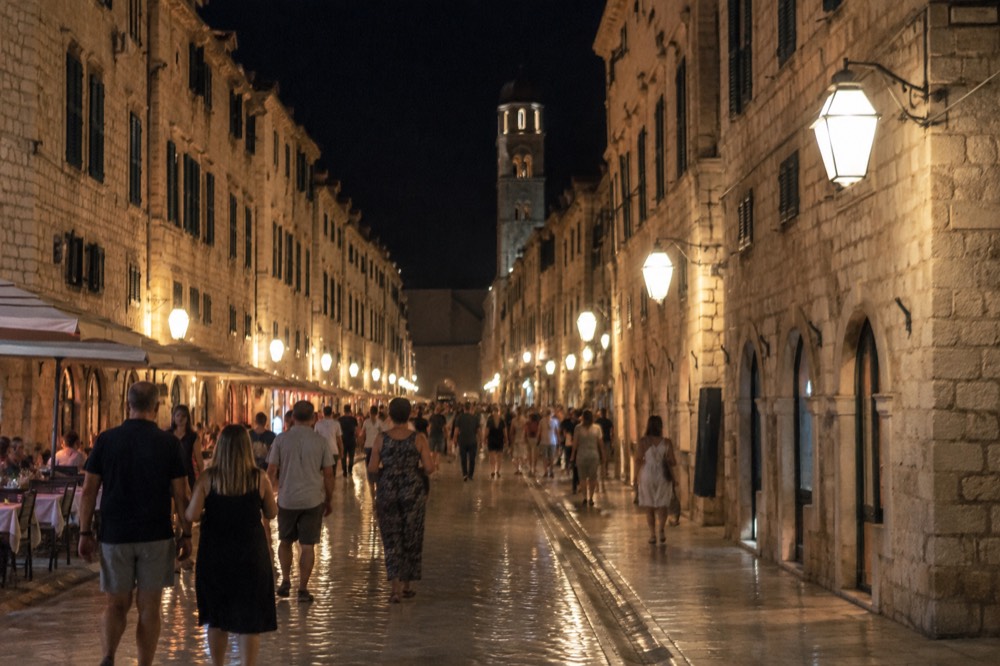
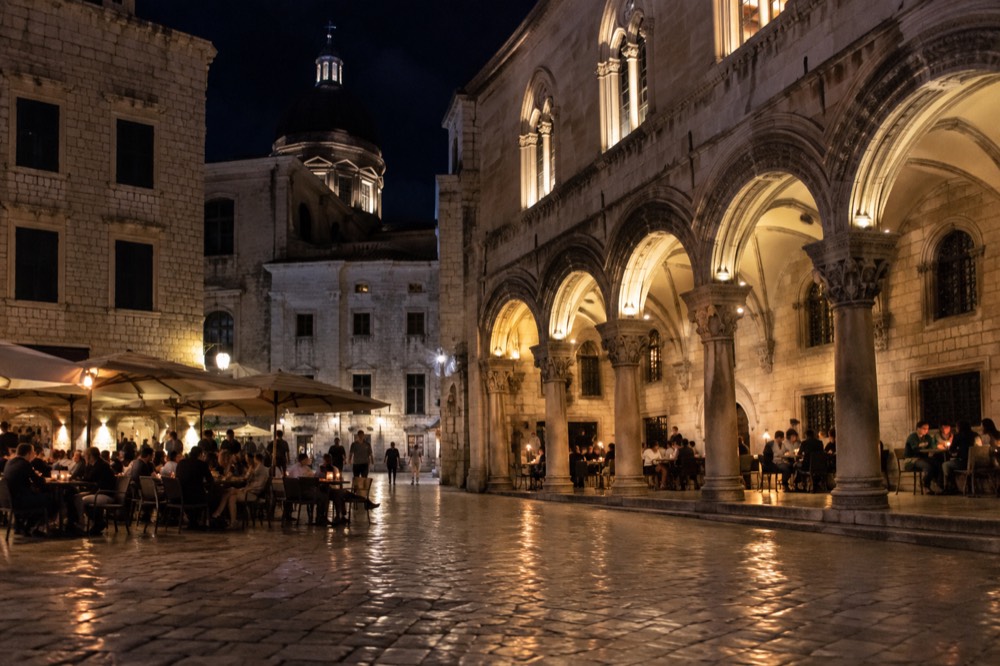
On the Stradun and the lanes running off it, from around 20:00. The Stradun, the 298-metre limestone main street whose plan was fixed by the 1272 Statute, becomes an evening promenade after dinner service begins, and the bars in the side streets fill behind it. Prijeko, the parallel restaurant street, and the small squares around Luža and Gundulićeva poljana are where the first drinks happen. Everything is walkable.
The rhythm of a Dubrovnik evening is a slow compression. People finish dinner late by northern European standards, often 21:00 or later, then drift. An evening walk here is genuinely an activity in itself, and the city rewards it: the Onofrio Fountain, the Sponza Palace and the Rector's Palace are floodlit, and the lane light catches the stone in a way the midday glare flattens out.
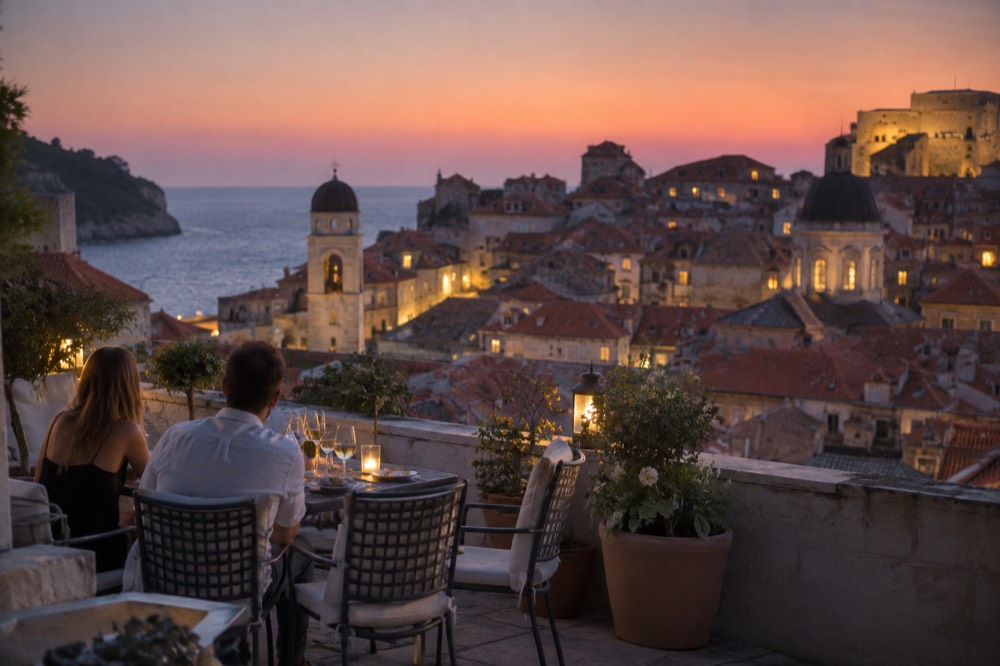
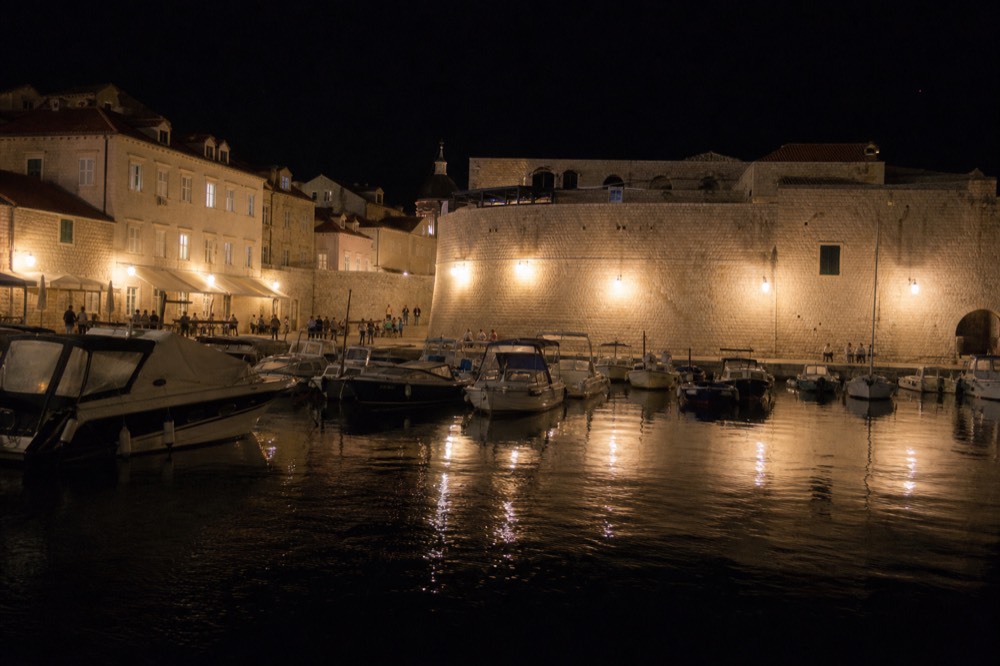
The classic first stop is an aperitif on or just off the Stradun, followed by a wander down to the Old City Port, where the fishing boats and the Karaka replica ship sit under lights. From there the evening either climbs back up into the lanes toward the bars, or heads out to the western cliff edge, where Buža Bar, the famous terrace through a hole in the walls, pours drinks over the open Adriatic. Our guide to the city's best sunset spots in Dubrovnik covers the viewing angles if you want to time that part.
If you would rather have the evening's stories than find them yourself, there is a free option that has quietly become one of the best-reviewed evening activities in the city. Magical Dubrovnik Nights: History and Legends is a 1 hour 45 minute pay-what-you-want walk on GuruWalk, rated 4.9 across 288 reviews, run by a guide named Marco. It covers the legends, the ghosts and the history the daytime crowds never stop to hear, and because it is free to join and you pay what you think it was worth, it fits any budget. You can See this free tour on GuruWalk and check the evening departure times.
For visitors who prefer their first drink to come with the sun going down over the sea, an evening cruise is the other natural opener. The two most popular options are very different animals: a replica tall-ship panorama cruise with drinks, and a small-boat sunset run down to Cavtat with a cold platter. Both are covered in detail further down this guide.
What Are the Best Bars in Dubrovnik?
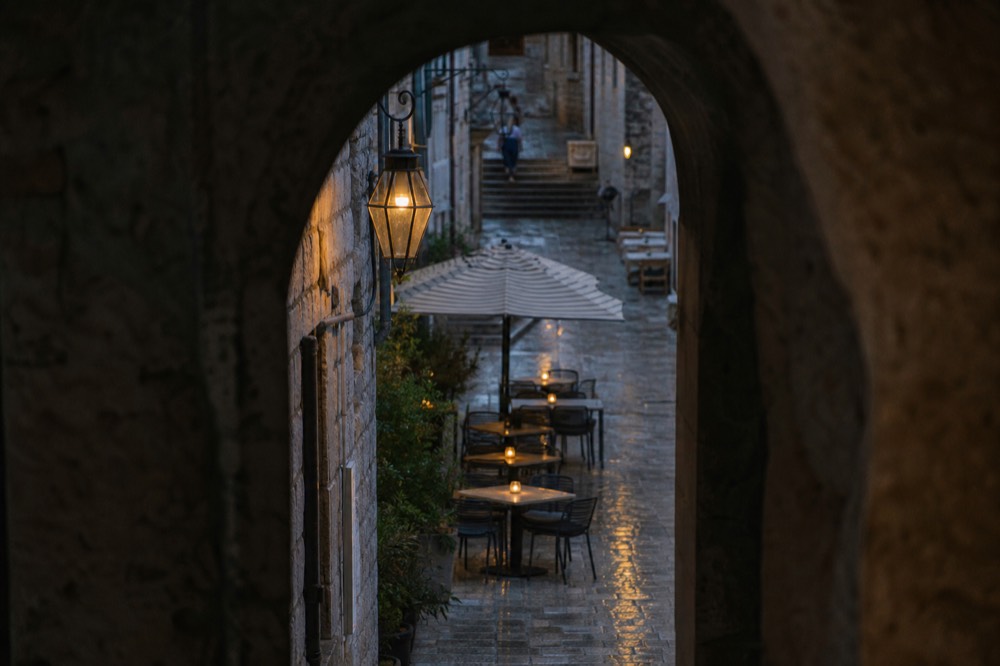
The core of Dubrovnik's bar scene sits inside the Old Town walls: Buža Bar on the western cliffs, a cluster of cocktail and wine bars in the lanes between the Stradun and the cathedral, and the terraces around Luža with fortress views. Across the bay, Lapad's café strip offers cheaper, more local evenings. Expect cocktails to run high, house wine to be the value pick, and bars to fill from 21:00.
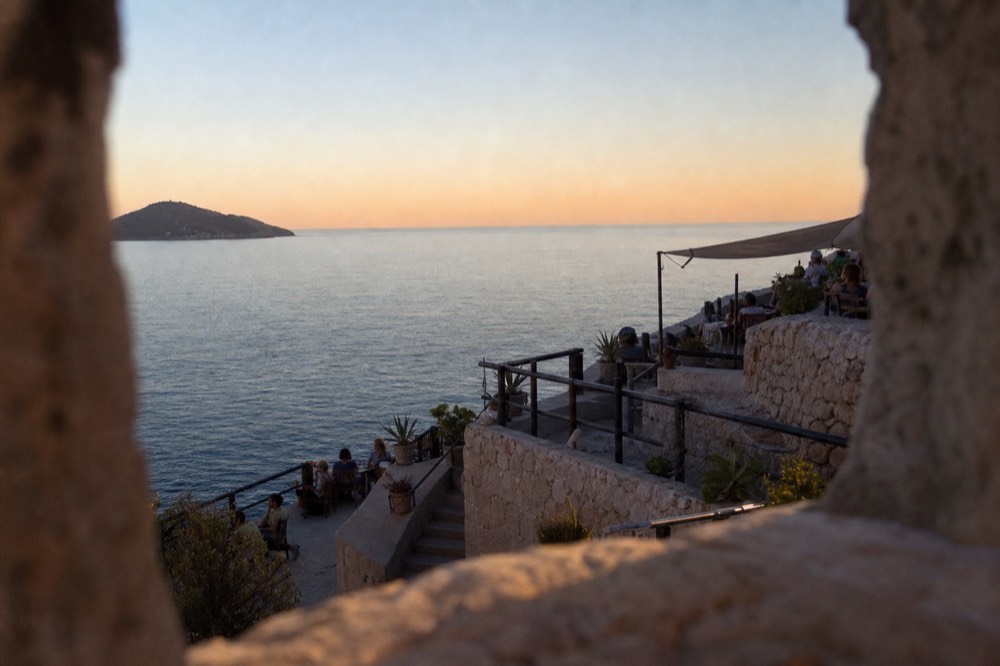
Start with Buža, because there is nothing else like it. You enter through a doorway in the city walls, descend, and suddenly you are on a terrace on bare rock above the sea, with nothing between your table and the island of Lokrum but open water. It is busiest at sunset and it closes comparatively early, so treat it as the first stop of the night rather than the last. Our full guide to Buža Bar covers how to find the entrance and when to go.
Inside the walls, the lanes do the heavy lifting. The streets running off the Stradun hold most of the good cocktail bars and wine bars, and the standard is genuinely high: this is a city that takes its wine seriously, and a glass of local Plavac Mali or Pošip usually costs far less than a cocktail and tastes of the place. If you want the deeper cut, our Plavac Mali grape guide explains what to order and why it matters.
| Area | Character | Best for | Typical price level |
|---|---|---|---|
| Buža and the western walls | Cliff terrace, sea views, no music | Sunset drinks, first stop of the night | High |
| Lanes off the Stradun | Cocktail bars and wine bars in stone interiors | Wine, cocktails, conversation | Mid to high |
| Around Luža and the port | Terraces with fortress and harbour views | People-watching, after-dinner drinks | Mid to high |
| Prijeko street | Restaurant strip with table service | Dinner that turns into a long evening | Mid |
| Lapad Bay café strip | Pedestrian promenade, locals and hotel guests | Cheaper rounds, relaxed nights | Mid |
Lapad deserves more attention than it gets in most write-ups. The pedestrianised strip along the bay has café-bars with outdoor seating, ice cream, and a slower, less expensive rhythm than the Old Town. If you are staying in Lapad, and many visitors are, it is the natural place for a nightcap rather than walking back into the walls.
One practical note: reservations matter for dinner but rarely for bars, with the exception of Buža at sunset in July and August, when the terrace tables go fast. Our answer page on whether to book restaurants in Dubrovnik covers the dinner side of that equation.
Is Split or Dubrovnik Better for Nightlife?
Split, clearly, if nightlife is the main purpose of your trip. Split has a larger resident population, a bigger student base, cheaper drinks and more venues open later. Dubrovnik wins on setting: drinking on a fortress terrace or above the open sea beats a concrete club floor. For most travellers the honest answer is Split for volume, Dubrovnik for atmosphere, and a night or two in each if the itinerary allows.
The comparison is really about scale. Split is a working city with a year-round social life; Dubrovnik is a small heritage city whose nightlife breathes with the tourist season. In Dubrovnik, prices are higher, the venue count is smaller, and in the off-season the choice narrows sharply. In Split, the bars around the Diocletian's Palace cellars and the Bačvice beach strip run reliably all year.
Where Dubrovnik punches above its weight is uniqueness. A nightclub inside a UNESCO-listed fortress, a bar on the outside face of the city walls, and a sunset over the Elaphiti islands from a wooden ship are things Split simply cannot copy. If your evenings are about one memorable drink in an unforgettable place, Dubrovnik wins. If they are about crawling between six venues until 04:00, Split does.
| Factor | Dubrovnik | Split |
|---|---|---|
| Venue count | Small, compact scene | Larger, more varied |
| Price of a round | Higher across the board | Noticeably cheaper |
| Season dependence | Strong, quiet in winter | Year-round social life |
| Signature venue | Club inside a fortress, cliff bar on the walls | Palace cellars, beachfront strip |
| Walkability at night | Everything within 15 minutes | Compact core, wider sprawl |
| Best for | Atmosphere and setting | Volume and value |
For travellers fitting both cities into one trip, our Dubrovnik vs Split comparison goes deeper on cost, beaches and day-trip logistics. The short version for night owls: base yourself in Split if the night is the point, and treat Dubrovnik as the place for one or two beautiful evenings rather than a marathon.
What Is the Nightclub in the Castle in Dubrovnik?
Culture Club Revelin, inside the Revelin Fortress that guards the eastern land approach to the Old Town. It is a multi-level club set into the stone vaults of the fortress, hosting international DJs through the summer season, and it is the one genuinely famous late-night venue in the city. Doors run late, typically past midnight into the early hours on event nights, and it operates in summer season.
The fortress itself is the draw before the music even starts. Revelin stands above the Ploče Gate on the eastern edge of the walls, and the club's terraces look down over the Old Town harbour and the rooftops. Inside, the vaulted stone interior does things to a sound system that no purpose-built club can manage. Our full Culture Club Revelin guide covers the season, the door policy and how to get tickets.
The practical realities: entry is priced like a destination club, the dress code is enforced more than at the beach bars, and the night starts late by local standards, so treat dinner as the warm-up rather than the main event. On big-name DJ nights in July and August, advance tickets matter.
| Late-night venue type | Where | Hours character | Notes |
|---|---|---|---|
| Destination club | Culture Club Revelin, Revelin Fortress | Late, past midnight to early hours | Event calendar drives the season |
| Hotel bars | Ploče and Lapad hotel terraces | Until late, year-round | Cocktail pricing, sea views |
| Wine bars | Lanes off the Stradun | Until around midnight | Best wine lists in the city |
| Cliff terrace | Buža Bar, western walls | Evening, closes earlier | Sunset first, then move on |
Beyond Revelin, the late scene is thin by design. A few hotel bars around Ploče and Lapad serve until late year-round, and some wine bars stretch toward midnight in season. That is the whole map, and honestly, it is enough: the city's best nights rarely depend on a 03:00 venue.
What Can You Do in Dubrovnik After Dark Besides Bars?
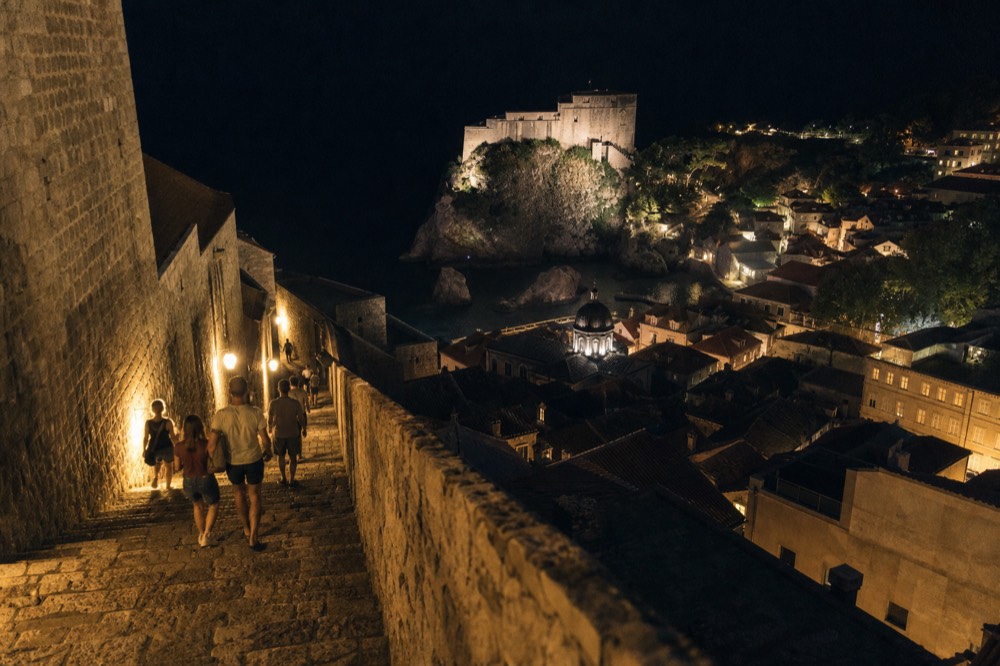
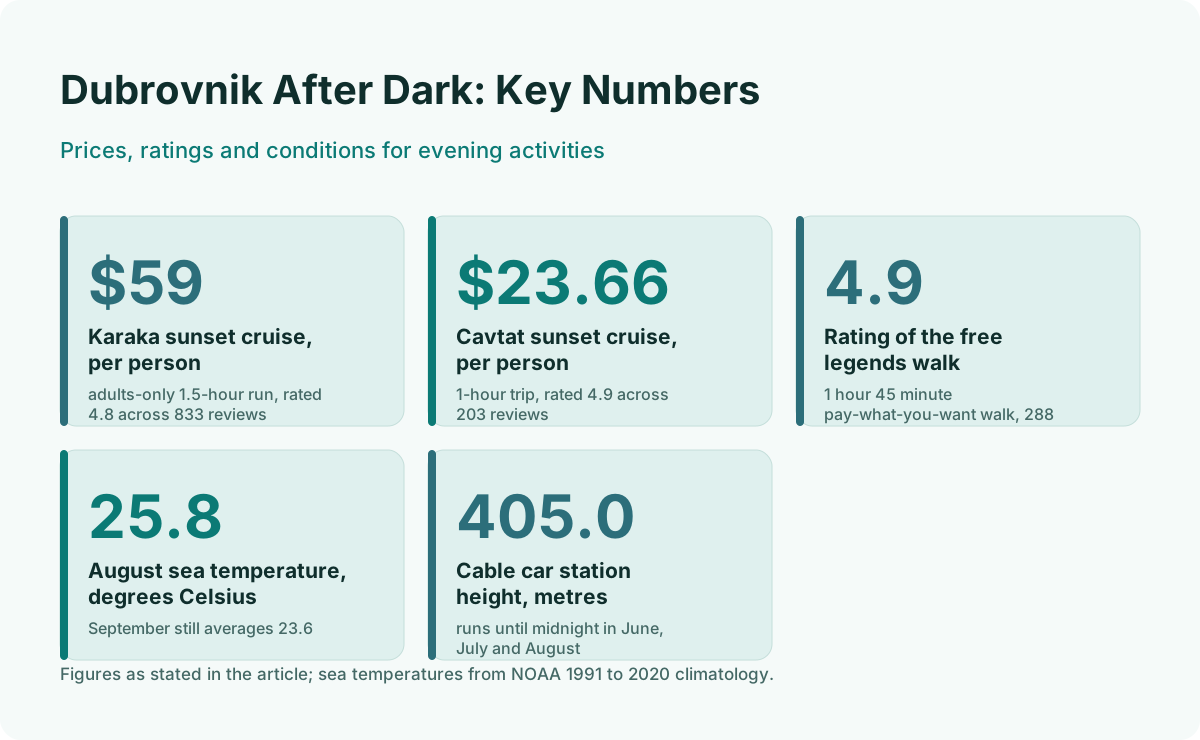
Plenty, and this is where Dubrovnik outperforms its reputation. Options include a free evening history and legends walk on GuruWalk, a sunset cruise on a replica tall ship or a small boat to Cavtat, the cable car's late summer runs to the 405-metre Mount Srd station, night swimming in August when the sea's long-run average is 25.8 degrees, open-air cinema and the summer festival programme. None of it requires a club.
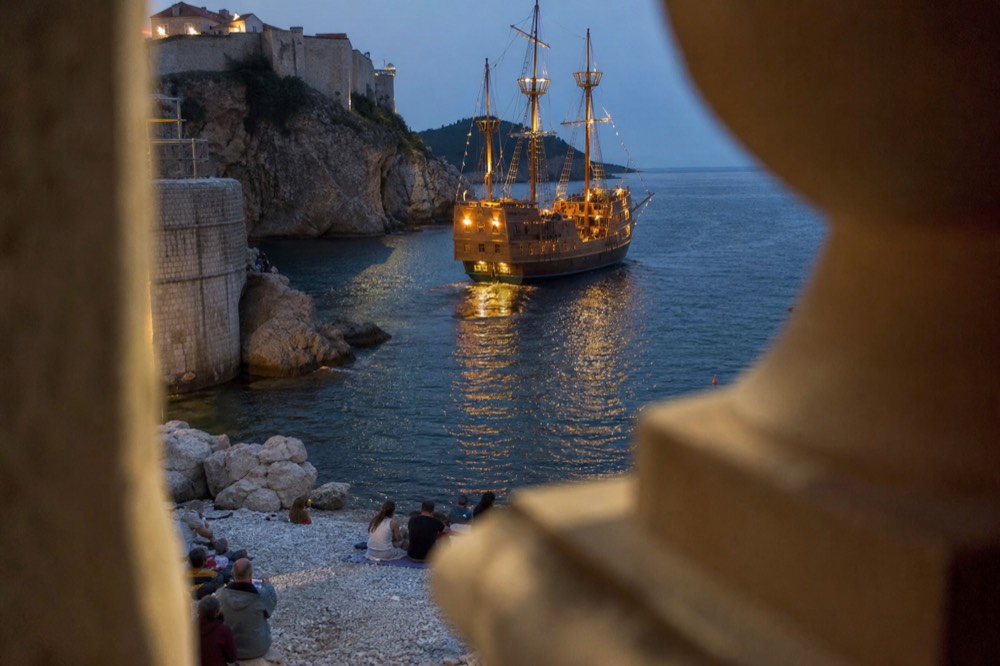
The sunset cruises deserve their own paragraph, because they are the most booked evening products in the city. The Panoramic Sunset Cruise on the Karaka ship is an adults-only 1.5-hour run on the replica of a merchant vessel, from $59 per person, rated 4.8 across 833 reviews. You sail the city walls from the water with a drink in hand while the light goes gold on the stone. It is the single most photogenic hour and a half available in Dubrovnik after dark, and it ends early enough that the night is still young when you dock.
The quieter alternative runs south rather than along the walls. The Cavtat Sunset Cruise with Cold Platter and Drinks is a 1-hour trip from $23.66 per person, rated 4.9 across 203 reviews, sailing down the coastline toward Cavtat with a cold platter and drinks included. It is shorter, cheaper and calmer than the Karaka evening, which makes it the better pick for families or for a pre-dinner departure rather than a post-dinner one.
On land, the cable car runs until midnight in June, July and August and through 1 to 14 September, then until 23:00 from 15 to 30 September, per the operator's published timetable at dubrovnikcablecar.com. The upper station sits at 405.0 metres above sea level, and the night view over the lit city is the best in the region. The adult round trip is 30 euro in 2026.
| After-dark activity | Duration | From (per person) | Rating |
|---|---|---|---|
| Night history and legends walk (GuruWalk, free) | 1 hour 45 minutes | Free, pay what you want | 4.9 across 288 reviews |
| Karaka sunset cruise, adults only | 1.5 hours | $59 | 4.8 across 833 reviews |
| Cavtat sunset cruise with platter and drinks | 1 hour | $23.66 | 4.9 across 203 reviews |
| Cable car to Mount Srd at dusk | 3 minutes 30 seconds each way | 30 euro round trip | View range up to 60 km by day |
Swimming is the sleeper option. The long-run August average for this coast is 25.8 degrees Celsius from the NOAA 1991 to 2020 climatology, and September still averages 23.6, so a night swim off a beach like Banje or a Lapad bay is warm enough to be genuinely pleasant in high summer. The swimming season guide has the month-by-month picture.
When Is the Best Time of Year for Dubrovnik Nightlife?
July and August for full-throttle nights, late June and September for the best balance. In high summer the terraces, the club calendar and the cable car all run to midnight and beyond. September is the insider pick: the sea is still near its warmest, the cruise calendar actually peaks that month, and the evenings are warm without the August heat. May, June and October are pleasant but quieter, and November to April is quiet.
The counter-intuitive fact worth building a trip around is that September and October, not July and August, are the busiest cruise months. Port Authority data shows 101,246 cruise passengers in September 2025 and 100,132 in October, against 96,072 in July and 87,385 in August, with the full-year total at 625,257. Those figures are ship capacity, not people who actually walk ashore, but the pattern holds: early autumn evenings have more life in them than the "summer is peak" instinct suggests. The Port Authority's own statistics are published at portdubrovnik.hr.
| Period | Nightlife character | Sea for night swims | Verdict |
|---|---|---|---|
| May | Mild, festival season beginning | 18.6 degree average | Quiet and pleasant |
| June | Full bar season, warm nights | 22.5 degree average | Excellent balance |
| July and August | Loudest, latest, hottest | 24.9 and 25.8 degree averages | Peak everything |
| September | Warm evenings, peak cruise calendar | 23.6 degree average | The insider pick |
| October | Softening, some venues close late month | 21.0 degree average | Calm and golden |
| November to April | Very quiet, hotel bars only | 18.5 down to 14.0 | Not a nightlife trip |
Note the sea temperatures are long-run open-water averages for 1991 to 2020 from the NOAA climatology, not beach thermometer readings; sheltered bays run warmer, and the Croatian met service's own Dubrovnik buoy read 27.0 to 27.4 degrees on one early September day against that month's 23.6 average. Our month-by-month weather guide has the full series.
How Late Do Things Stay Open, and What Does a Night Out Cost?
Bars fill from 21:00 and most close around midnight to 01:00; Culture Club Revelin runs past that on event nights; kitchens typically stop serving around 22:30 to 23:00. Budget roughly 5 to 8 euro for a beer or a glass of house wine in the Old Town and 12 to 18 euro for a cocktail. Dinner with wine adds the rest, so a full evening for two is a three-figure affair in the Old Town.
Those are planning ranges, not promises: prices vary by street, by season and by how far you walk from the Stradun. The lanes one street back from the main drag are consistently cheaper for the same pour, and Lapad cheaper again. Our guide to cheap eats in Dubrovnik and the trip cost breakdown cover the food and full-budget sides in detail.
| Item | Planning range | Notes |
|---|---|---|
| Beer or house wine, Old Town bar | 5 to 8 euro | House wine is the value pick |
| Cocktail, Old Town | 12 to 18 euro | Higher at fortress-view terraces |
| Dinner per person with wine | Check the room | Higher on Prijeko, lower in the back lanes |
| Club entry, event night | Check the venue's listing | Advance tickets for headline DJs |
| Karaka sunset cruise | From $59 | 1.5 hours, adults only |
| Free legends walk on GuruWalk | Free, pay what you want | 1 hour 45 minutes |
Two closing pieces of local advice. First, pace the evening the way the city does: the long dinner is the institution here, and the bars are the afterthought, not the main event. Second, book the one or two things that genuinely sell out, the sunset cruise and a Revelin headline night, and leave the rest to the evening itself. The Stradun's own plan has been fixed since the Statute of 1272, per the Dubrovnik Tourist Board's Placa page; your night does not need to be planned any more tightly than that.
For everything the daylight hours hold, the Things to Do in Dubrovnik homepage is the full index, and our answer on whether Dubrovnik has good nightlife is the short version of this page.
Common Questions About Dubrovnik Nightlife
Is Dubrovnik Good for Nightlife?
Yes, for atmospheric evenings rather than marathon club nights. The city has a compact set of bars inside and around the Old Town, the famous cliff terrace at Buža, and Culture Club Revelin inside the Revelin Fortress. It is small, scenic and early-leaning, at its best from June through September.
Does Dubrovnik Have a Good Nightlife Scene?
It has a good small scene. The venue count is limited and prices are high, but the setting is unmatched: drinking above the open sea, in stone vaults, or on a fortress terrace. Visitors who want volume usually prefer Split; visitors who want one beautiful evening usually prefer Dubrovnik.
Is Split or Dubrovnik Better for Nightlife?
Split, if nightlife is the main purpose of the trip: it is bigger, cheaper and runs all year. Dubrovnik wins on setting and uniqueness. Many travellers split a trip between the two and give Split the late nights.
What Time Do People Go Out in Dubrovnik?
Late by northern European habits. Dinner often starts at 20:00 or later and runs two hours, bars fill from around 21:00, and Culture Club Revelin on event nights runs past midnight into the early hours.
What Is the Nightclub in the Castle in Dubrovnik?
Culture Club Revelin, inside the Revelin Fortress at the eastern edge of the Old Town. It hosts international DJs through the summer season, with terraces over the harbour and vaulted stone interiors. Check the event calendar and buy advance tickets for headline nights.
Is Dubrovnik Expensive at Night?
By Croatian standards, yes. Plan on 5 to 8 euro for a beer or glass of house wine in the Old Town and 12 to 18 euro for a cocktail, with dinner priced separately by restaurant. The back lanes and Lapad are cheaper than the Stradun frontage.